
For businesses
Running a café in a small town: the year-round plan
Mosey · 22 November 2026 · 11 min read

A small-town café runs on a few hundred faces seen again and again, plus visitors in a good summer. Plan the year around three crowds (regulars, the working week and visitors), count the regulars you need to cover your costs, run each part of the day on purpose and give each season one job. The plan below does all of that on one page.
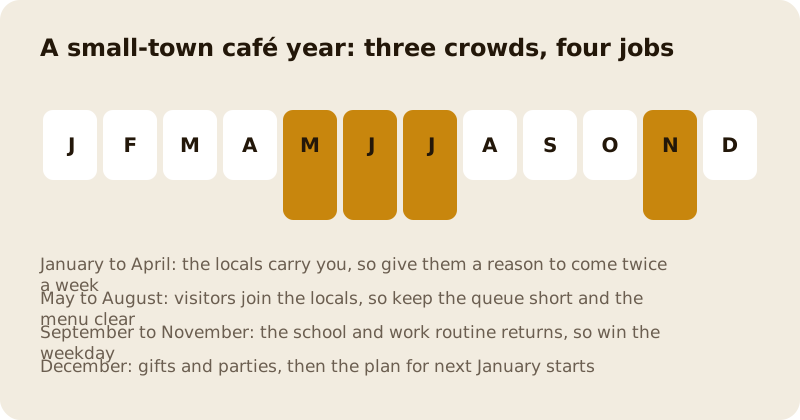
What does a small-town café depend on through the year?
Three crowds, and each carries you in a different part of the year. Name them for your own town before you plan anything.
- Regulars. The people who live within a few minutes of your door and come most weeks. They carry January, February and November. Without them the café has no floor.
- The working week. Tradespeople, shop and office staff, the school run, people with an appointment nearby. They fill the weekday morning and lunch, in every season, and they are the trade a visitor town forgets.
- Visitors. Walkers, cyclists, day trippers and holiday-makers. They add a good summer and some weekends, and they leave. If your town has a market, a festival or a greenway, they arrive for a reason you can plan around.
A big city café can live on passing trade. A small-town café cannot. There is not enough of it, so every regular counts and every lost one shows. The fix for a quiet month is rarely a new crowd. It is more of the first two, more often.
This is the whole-year plan. The harder case of a seasonal tourist town is in the guide to the tourist-season cliff, and the national calendar is in the guide to planning around the Irish calendar. This page is the café's own routine.
How many regulars does your café need?
Work it out in one sum, so you know what you are building. The numbers below are an example, not a benchmark. Swap in your own.
Say a café has 60 regulars who each visit twice a week and spend about €6 a visit. That is 120 visits and about €720 a week. Over 50 weeks it is about €36,000 a year from the 60 people you could name. Ten more regulars on the same pattern add about €6,000 a year. One more visit a month from every existing regular adds about €4,300.
Three things follow from a sum like that:
- Your base is a number you can count and grow. Know roughly how many regulars you have, and which of them have not been in for a month.
- A second weekly visit is worth more than a new face. Getting 30 once-a-week regulars to come twice can be a bigger gain than finding 30 strangers, and it costs far less to ask.
- Losing five regulars hurts more than a quiet Tuesday. Look after the ones you have, as the guide to getting repeat customers sets out.
Names help as much as numbers. A regular who is greeted by name, and whose usual is on the counter before they ask, is slow to try the café across the road. Learn ten names this month and write the usual next to each in a notebook behind the counter.
Your own figures come from your till. Look at last month's sales, count the hot drinks and divide by the days. The picture is usually less rosy and more useful than memory.
How do you run the day, hour by hour?
Treat each part of the day as its own small business with its own job. A small-town café has more daypart variety than it seems.
| Part of the day | Who comes | The job |
|---|---|---|
| Opening | Workers on the way in, the school run | Fast coffee and a bake, no queue |
| Mid-morning | Regulars, parents, people with time | A relaxed table, a reason to stay for a second cup |
| Lunch | The working week, visitors | A short menu that cooks fast and sells out |
| Afternoon | Walkers, people between jobs, the quiet gap | Cake and a drink, a Deal Hour, a collection order |
| Closing | The last regulars, tidy-up | Sell down the day's bakes, set tomorrow's prep |
Use the table to ask where you lose money. The quiet gap in the afternoon is common, so it is where a Deal Hour earns its place: a price rule that applies by itself in a weekly window, so you never discount the busy hour by mistake. See restaurant promotions and Deal Hours and the Deal Hours guide.
Bakes and prep belong in the plan too. Make a little less than you expect to sell by closing, and note on a pad what ran out and what was left over. After two weeks you have a prep list that is yours, not a guess, and the waste you were not seeing shows up on the page.
Staff the day to match it. The guide to planning staff hours around your sales shows how to set the rota from your own sales by hour.
What does each season ask of a small-town café?
One job a season is enough. Here is a plan you can print.
| Season | What your town looks like | Your one job |
|---|---|---|
| January to April | Locals only, quiet weeks, long dark evenings early on | Give regulars a reason to come twice a week: a coffee club, a stamp card, a winter special |
| May to August | Locals plus visitors, longer days | Protect the regulars' seat and keep service fast: a short menu, a clear page, the queue |
| September to November | School and work routines return | Win the weekday: the office lunch, the school-gate coffee, order-ahead |
| December | Gifts, parties, Christmas shopping | Sell gift vouchers and book groups early, then plan January |
January is the month you set up in the autumn. A café that leaves its winter plan until the quiet arrives is a month late. Write the one job for each season on a card by your till, and look at it on the first of each month.
If your town has tourists, the summer detail is in the guide to serving summer tourists.
How do you win the weekday?
The weekday is the trade that does not leave. It is steady, it repeats and it is often under-served. Look at who is in your town from Monday to Friday and what they need.
- The morning coffee on the way to work. Speed beats everything. A short list of drinks, a bake in a bag and a queue that moves. Order ahead lets a worker pay and collect without waiting. See online ordering for collection. Order Ahead runs at 1.5% commission on the food, and the customer pays a booking fee on top (see pricing).
- The lunch trade. Offices, shops and workshops need a fast, filling, reliable lunch. The guide to winning the office lunch trade covers the menu and the order cut-off.
- Company orders. A local firm that orders sandwiches for a meeting is a regular with a bigger basket. Mosey's catering and company orders let a business send a request and you quote it. See catering and company orders.
- The people with an appointment. Anyone waiting for a nearby clinic, solicitor or garage has half an hour and a need for somewhere to sit. A clear sign and a card on the nearby counter helps.
Ask one tradesperson, one shop worker and one parent what they would order if you did it quickly. Their answers are your weekday menu.
How do you use your town's own calendar?
Mark your town's dates on the year before you mark anyone else's. A small town has a rhythm, and a café that follows it looks local.
List the dates that change your day: the market day, school term and holiday dates, local sports fixtures, a parade or festival, a school concert, the Christmas lights. For each, note whether it brings you more people, fewer people or different people.
Then give each one a small response:
- More people: a shorter menu, an extra pair of hands, a bake that travels.
- Fewer people: a quieter prep day, a stock take or a day off for the team.
- Different people: a take-away tray for a match crowd, a family table for a school holiday.
Tell your regulars by word of mouth, on the door and on your page. If the café is a stop on a local food trail, join in. See food trails for restaurants. A joint offer with a neighbour costs little, and the guide to teaming up with local businesses shows how.
How do you keep the margin all year?
Price for the year, not for the busy month. A café that discounts in winter and cannot raise prices in summer loses on both ends.
Three habits protect the margin:
- Know what each item earns. Cost your five best sellers and keep the ones that pay. The menu engineering guide shows the method.
- Raise prices in small, planned steps, with a reason your regulars can see. The guide to raising prices without losing regulars covers it.
- Sell something that carries more margin than a coffee. A bake, a lunch special or a retail item can do it. See the guide to selling retail products in your café.
Keep the cash picture clear too. A quiet month still has rent, energy and wages. The 13-week cash-flow plan shows what lands when.
How do you keep your team, and yourself, through the year?
A small-town café is often one owner and a handful of staff, so the team is the business. When a good barista leaves in October, you cannot hire from a long list.
- Give hours that stay steady. A team with predictable hours stays. The guide to keeping staff through the quiet season covers it.
- Hire for the summer in spring. Students and returners are often free for a short window. The seasonal hiring guide shows when to start. Vacancies on Mosey Jobs are free to post.
- Train once, write it down. A one-page routine for opening, closing and the first ten minutes of a shift saves you every time someone new starts.
- Take your own days off. Put them in the rota first. An owner who works every day of the year has nothing left for the planning that makes next year easier.
Plan one slow week for yourself a year, in the quietest part of the calendar, and keep it.
How does Mosey fit a small-town café?
Mosey gives a café the tools for each crowd without a stack of separate subscriptions. Every tool is optional, and the money goes to your own Stripe account.
- Regulars. Loyalty is free on every plan, with no commission and no monthly fee, and it needs a connected Stripe account. A stamp card gets a second visit. A coffee club is a membership paid up front: Mosey takes 8% of the subscription fee and there is no monthly fee. See loyalty programmes and Mosey Tap, restaurant memberships and the coffee club guide. In Ireland a first membership cycle carries the 14-day right to cancel, so read the membership guide before you launch.
- The working week. Order Ahead for the morning coffee and the lunch pickup, and catering requests from local firms.
- Visitors. Your page, with hours, menu, photographs and allergens, is found by dish and by town. Nobody can pay to hide a rating or to move up Mosey picks.
- The quiet gap. Deal Hours for the afternoon, at no charge of their own.
- December. Gift vouchers at 4.5% of the value when sold (the buyer pays a flat booking fee), and event tickets at 4% of the ticket price for a coffee morning or a tasting night. See gift vouchers and event tickets.
- A regular who has gone quiet. The business inbox is free, and Mosey can send win-back messages to people who have agreed to hear from you, priced per person and shown before you pay.
The guide to how customers find you on Mosey covers the page.
Where should you start this month?
Do one thing for each crowd, in this order, and nothing more until it is done.
- Count your regulars. Write the number down, with the date.
- Write the one job for each season on a card by the till.
- Look at the afternoon gap and pick one idea for it.
- Ask three weekday customers what they would order if it were quick.
- Mark your town's dates on the calendar for the next twelve months.
- Put your own slow week in the rota.
Host on Mosey free, finish your page, then switch on a stamp card for your regulars. Every other guide for Irish food businesses is on the business guides page.
This guide is general information, not legal, tax or financial advice. Rules change and depend on your business and where it is, so check the current rule with the official body named in the guide and take advice from a solicitor or accountant in your area before you act.
Questions
Common questions
How many regular customers does a small-town café need?
It depends on your costs and spend per visit. As an example, 60 regulars who visit twice a week and spend about €6 a visit bring in about €36,000 over 50 weeks. Use your own till figures to find the number that covers your rent, wages and stock.
How do I keep a café busy in a small Irish town all year?
Plan for three crowds: regulars, the working week and visitors. Give regulars a reason to come twice a week, win the weekday with fast coffee and lunch, and use a short summer plan for visitors. Give each season one job, written on a card by the till.
What can a café do about quiet afternoons?
Look at who is in town then and offer them one clear thing, such as a coffee and cake at a set price. On Mosey a Deal Hour applies by itself in a weekly window and has no charge of its own, so you do not discount a busy hour by mistake.
How do I win weekday trade in a small town?
Be fast in the morning, reliable at lunch and easy to order from. Offer order ahead for collection, ask local firms if they want a regular lunch or meeting order, and ask three weekday customers what they would order if it were quick.
Is a coffee club worth it for a small café?
It can be, if the price leaves a margin on every visit. A coffee club is a membership paid up front, so regulars commit before they visit. Work out the cost of what you give, then price it. The coffee club guide shows the sum.
How do I keep my staff through a quiet winter?
Keep hours steady, train people so they feel useful and tell them what the quiet weeks are for. Plan one job for them in the quiet season, such as a menu change or a deep clean, and pay for it as normal hours.
How do I use my town's events to bring in customers?
List the dates that change your day, such as a market, a match, a festival or school holidays, and decide a response for each: a shorter menu, an extra pair of hands or a take-away tray. Tell your regulars by word of mouth, on the door and on your page.
Can I run all of this on Mosey?
Mosey covers the page, loyalty, a coffee club, order ahead, Deal Hours, gift vouchers, event tickets, a free inbox and win-back messages to consented customers. Every tool is optional. Host on Mosey is free to start, and you keep your own Stripe account.
More like this
Read next
A hotel restaurant that locals use too
A hotel dining room earns local trade when it acts like a restaurant of its own. Here is why locals stay away, how to set the dining room up on Mosey beside your hotel, and which offers fill it.
An alcohol-free drinks menu that still makes margin
More guests are drinking less, in January and the rest of the year. Here is how to cost, price, name and sell an alcohol-free menu so it earns as well as the wine list, with the Irish VAT and offer rules checked.
A pub that does food: making the kitchen pay
A pub kitchen pays when its gross profit covers its own wages and running costs. Here is how to count it, which services to fill, what the alcohol rules say and how Mosey fits.
Auto-enrolment pension for Irish restaurants and cafés: what you pay and do
Since 1 January 2026 an Irish employer matches the pension contribution of each eligible employee. Here is who counts, what it costs on a wage bill, the payroll steps and what staff can opt out of.
Get started
Host your business on Mosey. It is free to claim.
Free to list, no set-up fee, and Order Ahead is 1.5% commission when you start taking orders.