
For businesses
An alcohol-free drinks menu that still makes margin
Mosey · 22 November 2026 · 11 min read
An alcohol-free drinks menu makes margin when you cost each drink from its ingredients, keep the range short, make two or three drinks that take real craft, and put the menu next to the wine list, not behind it. Many guests are drinking less, in January and the rest of the year. Give them something worth ordering and the bill still grows.
Why add an alcohol-free menu, and is Dry January the only reason?
Dry January, a month without alcohol run by the charity Alcohol Change UK, brings the subject to your door. It is not the whole story. On any night of the year some of your guests are not drinking: someone driving, someone pregnant, someone on medication, someone training for a race, someone who does not want a second glass. Others drink at the weekend and not midweek, or have one glass and then switch.
None of them stays at home for long. They still book, still eat and still want something better than tap water while the table orders wine. What they order depends on what you offer. A card with one cola and one sparkling water tells them the evening was planned for someone else. A short list of drinks made with care tells them they were expected, and it gives a midweek table something to order beyond the food.
Watch your own room for a month before you decide how far to go. Count the tables where someone drinks only water or a soft drink, and note what they asked for that you did not have. A guest with nothing to order leaves with a lower bill. The January plan shows where this fits in a quiet month.
What goes on an alcohol-free menu?
Fewer drinks, better made. Six to eight lines is a menu a team can make well on a Friday, and long lists go stale in the fridge.
| Type | What it costs you | What it takes | Watch for |
|---|---|---|---|
| A zero-alcohol beer or two | A bought-in price per bottle | Nothing but cold glasses | The lowest cash per drink on the page |
| A house soda or shrub | Fruit, sugar, vinegar or acid, time | A batch made in the quiet | Shelf life and labelling |
| A long drink or spritz-style mocktail | Juice, syrup, soda, garnish | Ten seconds at the bar | The garnish cost creeping up |
| One drink of real craft | Better ingredients and prep | Training | Do not let it sell only to staff |
| Something hot | Tea, coffee or spiced juice | Your usual machine | The easy win in winter |
| Good water and a plain soft drink | Low | Ice and a clean glass | They must still be there |
A mocktail is a cocktail-style drink without alcohol. Give each drink a name that says what it tastes of, and not what it lacks. Nobody orders "the no-alcohol one" with pride.
How do you price a mocktail so it earns as much as a glass of wine?
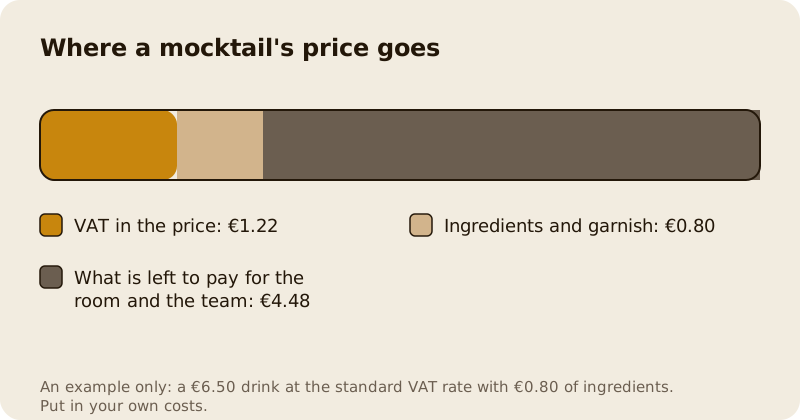
Price from cash, not only from percentage. A mocktail has a high percentage margin and a small price, and a glass of wine has the opposite. What pays the rent is the cash left in each drink. This is an example with round numbers: use your own costs.
| Example drink | Price | VAT in the price at 23% | Cost | Cash left | Margin on price ex VAT |
|---|---|---|---|---|---|
| House mocktail | €6.50 | €1.22 | €0.80 | €4.48 | 85% |
| Glass of wine | €8.50 | €1.59 | €2.40 | €4.51 | 65% |
| Bought-in zero-alcohol beer | €5.00 | €0.93 | €1.60 | €2.47 | 61% |
At these figures the made drink earns about the same cash as the glass of wine, at a higher percentage, and the bought-in bottle earns the least. So give the made drinks the best place on the page, price a zero-alcohol beer by what the bottle costs you and not by habit, and make the second drink an easy one to choose by keeping the whole list in view.
To cost a house soda, cost the batch, not the glass. Say a litre of shrub costs €6 in fruit, sugar, vinegar and your time, and each drink uses 40 ml: that is about 24 cents of base per drink, before the soda water, ice and garnish. Write the batch cost and the yield on the recipe card, so that a new member of staff makes the same drink at the same cost on a Sunday as you do on a Tuesday. This is an example with round numbers.
Three habits protect the margin. Weigh and write the recipe, with the garnish. Cost the ice, the glass and the wash. And review it every season, because juice and syrup prices move. The guide to costing a recipe and the one on food cost and gross profit show the method, and menu engineering shows how to read which drink earns its place.
What VAT rate do alcohol-free drinks carry in an Irish restaurant?
Do not assume a cheaper rate. Revenue's Tax and Duty Manual says alcohol, bottled waters, soft drinks, sports drinks and vegetable juices (fruit juices aside) are liable to VAT at the standard rate even when provided as part of a restaurant service. Revenue lists the standard rate at 23%. Its rates summary from 1 July 2026 puts fruit juices and hot coffee and tea at the second reduced rate when served in a restaurant, hot coffee and tea at that rate as a takeaway too, and fruit juices at the standard rate as a takeaway.
That makes the VAT on a mocktail a matter for your accountant. A drink that mixes fruit juice, soda and syrup does not match a single line of the table, and a zero-alcohol beer is not named in it. Ask your accountant, or check the current rule with Revenue, which rate each of your drinks takes, and write the answer next to its recipe. The example above uses the standard rate, so change it if your drink takes another.
Your till and your sales by rate should follow the answer. The guides on VAT for restaurants and cafés, getting your sales by VAT rate ready for your accountant and pricing your menu after the VAT change cover the rest.
How do you stock zero-alcohol beers, wines and spirits without tying up cash?
Start with two. A zero-alcohol beer is an easy first line because guests already know what it is, and a second line, a wine or a spirit alternative, makes a choice. Buy small, because a case that sits for months is cash gone and a date to watch. Ask your supplier whether they take returns on unopened stock, and put the cost of each bottle on the same sheet as your wine, so you see it next to the rest of the page.
Keep the shelf separate in the fridge and in your stock-take, so you can see what sells. Treat an opened bottle like any other: label it with the date and count what you pour away. If a line has not sold in eight weeks, swap it for one that your regulars have asked about. The stock-take guide shows how to count it.
How do you lay out the menu so guests see it?
Put it where the wine list lives. A page at the back of the food menu says "afterthought". The choice of drinks, the way each is served and the price all matter, so treat the page with the care you give the wine.
- Same format, same page. Print alcohol-free drinks on the same card or page as the wine, with the same type.
- Same glass. A mocktail in a pint glass with a straw says one thing. A stemmed glass and a garnish says another.
- Price in the same range as the drinks beside it, so the menu does not apologise.
- Say what is in it. Declare the allergens of every drink, for example milk, egg white, celery or sulphites in a juice or a syrup, and never describe a drink as allergen free. The guide to an allergen matrix shows how.
- Pair it. One line under a dish that suggests a drink is the cheapest upsell you have.
How do you train staff to sell it?
Staff sell what they have tasted. Put each new drink in front of the team before service, with the recipe, the allergens and one sentence about the taste.
Change the question at the table. "Anything to drink?" gets a water. "Can I bring you something long and fresh, or something with a bit of spice?" gets a drink. Guests who are driving, or not drinking, should not have to explain, so make the alcohol-free list part of the normal round and not a special request.
The guide on training servers to upsell without being pushy has the scripts, and the one on allergens training covers the safety side. Keep the speed the same: a mocktail that takes six minutes is a lost second round.
Which offers can include an alcohol-free drink in Ireland?
In Ireland, anything that takes money off or gives something free is kept off alcohol, and alcohol-free drinks can be part of it. S.I. No. 4 of 2020 says a person shall not sell or supply alcohol at a reduced price or free of charge on the purchase of another product or service. Mosey has its own check: a membership discount, a loyalty reward, a Deal Hour or a promotion is worked out on the part of the bill that is not alcohol, and a perk, reward or promotion that gives an alcohol item free is refused. A bill paid by typing an amount has no lines to read, so at a restaurant or café that sells alcohol no percentage or amount comes off it.
So the alcohol-free menu gives you the room to offer something:
- A free coffee or soft drink as a member's perk. See the guide to perks that do not eat your margin.
- A Deal Hour on a mocktail in your quiet window. The Deal Hours guide has the set-up.
- An alcohol-free pairing as one ticket type for a supper or tasting, beside the wine pairing. See event tickets. Ask your solicitor what may be served at an event under your licence.
- A free soft drink on an early booking, chosen as the perk in an Early Bird offer. That perk is wording you write, with no menu item behind it, so name an alcohol-free drink and keep alcohol out of it yourself.
Mark every drink that contains alcohol, including a low-alcohol one, so the rule applies to it. A drink with no alcohol stays unmarked and can sit inside an offer. If you are in doubt about a low-strength drink, mark it as containing alcohol.
If you serve alcohol under a special restaurant licence, Revenue says non-alcoholic beverages, including drinking water, must be available. The licensing guide covers the rest.
How do you know whether the menu is working?
Give it eight weeks, and count. Three numbers matter.
- Drinks sold per table. Count alcohol-free drinks beside every other drink. A rising count means guests have found the page.
- Cash left per drink, from your own costing. Drop a line that earns far less than the others, or reprice it.
- Waste. A fruit, syrup or batch that is thrown away costs you the margin you worked out.
Share the numbers with the team once a month, since the people who pour the drinks know which ones come back unfinished or never move. Keep two lines that always sell, and rotate one or two with the season. A mocktail that matches the weather, such as something warm in winter and something sharp in summer, gives the team something to say. The weekly measures guide shows how to keep the count without extra work.
How does Mosey help you sell alcohol-free drinks?
Mosey does not set your VAT, hold your licence or sell your drinks. It shows guests what you serve and keeps its own offers off the drinks you mark as alcohol.
Add your drinks to your menu page with the Menu Builder, with the allergens you declare, and mark each item that contains alcohol. Guests on Mosey find a restaurant or café by the dish and the mood. Non-Alcoholic Options is one of the drinks tags guests add when they rate a visit, and other guests can filter by it, so a good list earns its tag from the people who ordered from it: you cannot add it yourself. Memberships, loyalty rewards, Deal Hours, Early Bird offers and event tickets can all carry an alcohol-free drink, and Mosey leaves marked alcohol out of every discount it works out for you. Every rate is on the pricing page.
When your menu is ready, Host on Mosey free and add the drinks list beside your dishes. The membership guide shows how a free coffee or soft drink becomes a reason to come back, and every other guide for Irish food businesses is on the business guides page.
This guide is general information, not legal, tax or financial advice. Rules change and depend on your business and where it is, so check the current rule with the official body named in the guide and take advice from a solicitor or accountant in your area before you act.
Questions
Common questions
How much margin should a mocktail make?
Work it from your own costs. In a round example, a €6.50 mocktail with €0.80 of ingredients leaves about €4.48 after VAT at 23%, roughly the cash left on a €8.50 glass of wine. Judge a drink by the cash it leaves, as well as the percentage.
What VAT do soft drinks and mocktails carry in an Irish restaurant?
Revenue says alcohol, bottled waters, soft drinks, sports drinks and vegetable juices carry the standard rate even when served as part of a restaurant service. From 1 July 2026, fruit juices and hot tea and coffee served in a restaurant are listed at the second reduced rate. Ask your accountant about a mixed drink.
Can I discount alcohol-free drinks in a membership or promotion?
Yes. In Ireland, Mosey keeps member discounts, loyalty rewards, Deal Hours and promotions off items marked as alcohol, so an alcohol-free drink can be included. A perk or reward that gives alcohol free is refused. Mark each drink that contains alcohol, including a low-alcohol one.
What should an alcohol-free menu include?
Six to eight lines is enough: a zero-alcohol beer or two, a house soda or shrub, a long drink, one drink of real craft, something hot, and plain water and a soft drink. Name each drink by its taste, declare the allergens and print the list beside the wine.
Who orders alcohol-free drinks in a restaurant?
More guests than you might think: drivers, guests who are pregnant or on medication, people who drink only at the weekend and anyone who wants one glass and no more. They still eat and still want a proper drink, so a short alcohol-free list gives each of them something to order.
Do I have to offer non-alcoholic drinks if I serve alcohol?
Under a special restaurant licence, Revenue says other non-alcoholic beverages, including drinking water, must be available. Other licences have their own conditions, so check the current rule with Revenue and the Courts Service and ask your solicitor before you rely on a drinks list.
How do I show the allergens in drinks?
Declare them like any dish: milk, egg white, celery, sulphites or nuts in a syrup or a juice. Never say a drink is allergen free. On Mosey, you declare allergens per menu item, and an item with no declaration reads as not listed, so guests ask.
How do I put an alcohol-free menu on Mosey?
Add the drinks as items in the Menu Builder with the allergens you declare, and mark each item that contains alcohol. Guests can then see the list on your menu page. Non-Alcoholic Options is a tag guests give when they rate a visit and others can filter by, so it is earned, not set by you.
More like this
Read next
A hotel restaurant that locals use too
A hotel dining room earns local trade when it acts like a restaurant of its own. Here is why locals stay away, how to set the dining room up on Mosey beside your hotel, and which offers fill it.
A pub that does food: making the kitchen pay
A pub kitchen pays when its gross profit covers its own wages and running costs. Here is how to count it, which services to fill, what the alcohol rules say and how Mosey fits.
Auto-enrolment pension for Irish restaurants and cafés: what you pay and do
Since 1 January 2026 an Irish employer matches the pension contribution of each eligible employee. Here is who counts, what it costs on a wage bill, the payroll steps and what staff can opt out of.
Buying an existing café or restaurant in Ireland: what to check
Buying a café or restaurant means buying its debts, staff and paperwork as well as its regulars. Here is what to check at the CRO, Revenue, the council and the HSE, and what the staff transfer rules mean.
Get started
Host your business on Mosey. It is free to claim.
Free to list, no set-up fee, and Order Ahead is 1.5% commission when you start taking orders.