
For businesses
How to make and keep an allergen matrix
Mosey · 15 November 2026 · 12 min read

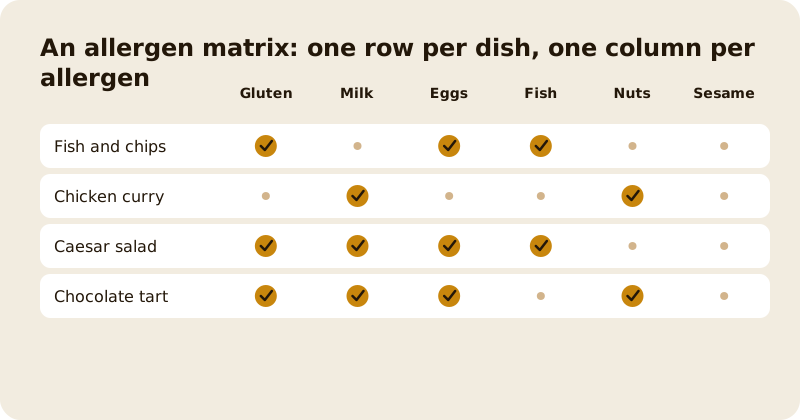
An allergen matrix is a grid with your dishes down the side and the 14 allergens across the top, with a mark where a dish contains one. To make one, write each recipe down to the jar and packet, read every label, mark the allergens, have a second person check each row, then print it where guests can read it and re-check it whenever a supplier or recipe changes.
What is an allergen matrix, and why does your restaurant or café need one?
A guest with an allergy asks one question: "Can I eat this?" The answer lives in a recipe, a supplier's label and the head chef's memory. A matrix pulls all three into one grid that anyone on shift can read and that a guest can read without asking.
It also solves a problem that has nothing to do with the law. When the answer lives in memory, it changes with whoever is on. The weekend cook knows the sauce has mustard; the Tuesday server does not. A written grid gives everyone the same answer, so the guest hears the same thing every visit.
The FSAI names the 14 allergens that must be declared: cereals containing gluten (wheat, rye, barley, oats), crustaceans, eggs, fish, peanuts, soybeans, milk, nuts (almonds, hazelnuts, walnuts and so on), celery, mustard, sesame seeds, sulphur dioxide and sulphites, lupin, and molluscs. Those 14 are your columns.
What does Irish law actually ask you to put in writing?
The rule for food that is not prepacked, which covers nearly everything a restaurant, café or takeaway serves, is in S.I. No. 489 of 2014, updated by S.I. No. 656 of 2024. The 2024 update changed how inspectors take samples and serve compliance notices; it did not change what you must tell guests. The FSAI's guidance sets out what that means in practice:
- Written, in English, or in Irish and English. Handwritten or printed is fine if it is legible.
- Easy to find before the sale. It must be conspicuous and reachable without asking staff.
- About the actual dish. "Our food contains nuts" is not acceptable. "Spaghetti bolognaise: contains milk, celery, wheat" is the kind of line the FSAI gives as an example.
- With each menu item, or in clearly visible places. A restaurant can put it beside each dish or in a central, signposted spot, on paper or on a screen. A chalkboard special must be updated when the offer changes.
- Not a promise to tell them later. Lines such as "ask a staff member for allergen information" or "allergen information available on request" do not meet the requirement on their own, according to the FSAI's Guidance Note 28.
- Drinks too. Draught drinks, wine by the glass and cocktails need the same written information.
The FSAI also says a QR code alone is not enough: digital information can complement the written information, not replace it. If you use a screen or a web page, the information on it still has to be easy to reach and easy to read.
This guide is plain-language help, not legal advice. For the exact wording of the law, read the FSAI's pages directly. The allergen information guide summarises the rules and the staff training guide covers the people side.
How do you build a matrix that is right the first time?
Most wrong matrices are wrong at step one, because the dish was filled in from memory. Build it from paper instead.
- List every item a guest can order. Starters, mains, sides, sauces, children's meals, desserts, specials, condiments and drinks. The FSAI says a condiment decanted into a plain table container needs its allergen information too.
- Write each recipe down to the jar and packet. Stock cube, spice blend, sauce from a tub, dressing, bread, oil. A recipe that lives in a cook's head cannot be checked.
- Read the label on every bought-in ingredient. The allergens must be named in the ingredients list. Photograph the label so you can show where the answer came from.
- Mark the allergens each dish contains. Include the ones inside ingredients: the milk in the sauce, the celery in the stock, the mustard in the dressing.
- Have the cook who makes the dish check the row. Then have a second person sign it off against the recipe.
- Date it and name who checked it. A matrix with no date cannot tell you whether it is current.
Here is how a few rows might look. This is an illustration with made-up recipes, not your menu:
| Dish (example) | Contains | Why |
|---|---|---|
| Fish and chips | Gluten, eggs, fish | Batter, egg in the batter, cod |
| Chicken curry | Milk, nuts | Cream, ground almonds in the sauce |
| Caesar salad | Gluten, milk, eggs, fish | Croutons, parmesan, dressing, anchovy |
| Chocolate tart | Gluten, milk, eggs, nuts | Pastry, cream, hazelnut base |
Notice the last column. Writing why a dish carries an allergen is what lets the next person re-check it in a minute when a supplier changes.
A word on cooking oil. FSAI Guidance Note 28 gives two examples: frying chicken in peanut oil means peanut must be declared, because it is an ingredient. Fries cooked in vegetable oil that battered fish was previously cooked in need not declare fish or wheat, because residual fragments are cross-contaminants rather than ingredients. That is the FSAI's reading; if your kitchen sits near the line, ask your environmental health officer.
What goes in the "contains" and "may contain" columns?
Two columns, kept apart, is the clearest answer.
Contains is for allergens that are ingredients. These are the facts from your recipes.
May contain is for cross-contact: the shared fryer, the flour in the air, the board that serves both the nut brittle and the salad. The FSAI treats statements such as "may contain" as voluntary. They do not replace the required declaration, and they should only be applied after an appropriate risk assessment. So do not stamp "may contain everything" on the menu to avoid the work. The FSAI lists "we use all 14 allergens" among statements that do not on their own meet the rule.
A useful test: if a guest with the allergy asked you directly, would you be comfortable with the answer on the page? If it says "may contain" because you have never looked, go and look.
Put the allergy-relevant steps in the matrix, not in people's heads. If the nut garnish goes on at the pass with tongs that also touch the salad, that is a row note: "garnish tongs shared; ask for plain". The note is the answer a server reads out.
How do you take the matrix to the table, the pass and the till?
A matrix in a drawer helps nobody. It has to be where three people look.
- The guest. On the menu beside each dish, or on a sheet at a clearly signposted spot in the dining area, or both. Keep type legible: the FSAI's guidance treats a size equivalent to 10-point Times New Roman as appropriate.
- The server. The same sheet at the pass, so the answer comes from paper, not memory.
- The cook. On the ticket. An allergy that is in the server's head but not on the docket is the commonest way for a kitchen to miss it.
On Mosey, the matrix is the menu. In Menu Builder you open each dish and declare what it contains and what it may contain, add a note of up to 500 characters, and, where you have checked and found nothing, press "Nothing to declare" yourself. A dish nobody has filled in is never read as "none": the guest is told that allergens have not been listed and to ask before ordering. That is deliberate. A blank is not an answer.
From that one declaration, Mosey does the rest:
- A printable A4 allergen sheet for the wall or the table, with the dishes in rows, your allergens as a grid and the same information in words, so it does not depend on reading dots. It also lists any dishes you have not declared yet, so you can fill them in before you print.
- The kitchen ticket and the kitchen display show what each ordered dish contains and may contain, in capitals.
- The receipt and the order confirmation email repeat it for the guest.
- Every change is saved with who made it and when, so you can show what a dish said on a given day.
Mosey records and repeats what you declare. It never says a dish is allergen free or safe, and it does not check your recipes. The accuracy is yours, which is exactly why the build steps above matter. See allergen labels and the menu builder for how the pieces fit.
What changes when guests order online or for delivery?
A guest ordering from a phone cannot ask the person at the table. The FSAI's guidance on distance selling says the allergen information must be provided before the purchase is concluded and again at the time of delivery, and that it must be in writing at least at one of those two moments. Collection and delivery orders from your own page count.
The practical job is to make sure the dish page the guest buys from carries the declaration, and that the delivery repeats it. Two things make this easy on Mosey. The menu a guest orders from shows each dish's declaration, and a dish with none declared says so. And when an order is placed, the allergen information each line was shown is frozen onto the order. If you change a dish tomorrow, yesterday's ticket, receipt and confirmation email still say what the guest was told when they ordered. That matters if you are ever asked what a guest was shown.
If you take orders by phone, read the declaration aloud and send it in writing with the order. Group bookings and private hire add a second job: a table of twelve has twelve sets of needs, so collect them with the booking, not at the door. For order slots and prep times, see the click and collect guide.
How do you keep the matrix true when a supplier changes a product?
A matrix is accurate on the day it is checked and starts ageing at the supplier's next delivery. The FSAI's advice is to keep the information up to date and to monitor your suppliers' allergen information. Make that a routine, not a good intention.
- At every delivery, the person checking stock glances at the label of anything new or in new packaging. A new brand is a new recipe.
- At every menu change, the matrix is updated before the dish is served, not after. Make this one named person's job.
- Every month, pick five dishes, trace each from recipe to label to row, and sign the check. Rotate so every dish is checked a few times a year.
- After any near miss, re-check the whole dish family, not only the one that went wrong.
- For specials, write the allergens on the docket and the board before the first one is sold. The FSAI expects chalkboard specials to be updated when the offer changes.
Keep the evidence: photographs of labels, dated check records and who signed. If a guest or an inspector asks how you know, you can show them. Allergens also belong inside your wider food safety system; the food safety and HACCP guide shows where.
What about food you pack yourself, and what about the menu you have on paper?
Food you pack on the premises to sell from a fridge or counter, such as a lasagne or a wrapped sandwich, is not treated as prepacked by the FSAI. It counts as non-prepacked, so the written information described above applies to it too. A label is therefore optional for an Irish business, but a label with the ingredients and allergens in bold is a useful extra. Mosey prints labels for dishes you mark as packed here and give an ingredient list to; a dish with no ingredient list is not printed but is listed so you can complete it.
If your menu exists only on paper, you do not have to type it all in. In Menu Builder you can photograph the paper menu and the scan reads it into a draft of dishes. Treat that as a first pass only. Check every name and price. Treat any allergens it picked up as a guess: they are kept as a suggestion you can accept as a starting point, not as a declaration, so a scanned dish still reads as not listed until you declare it yourself. Do the declaration with the recipe in front of you, best sellers first. See the guide to menu scanning.
The same dish record carries each item's VAT rate, so the work you do once feeds your sales by rate too. The VAT records guide shows what that gives your accountant.
What should you do this week?
Do these in order, and stop when the shift starts:
- List every dish, side, sauce, special and drink on the menu today.
- Write the recipe for the five best sellers down to the jar and packet.
- Photograph the label on every bought-in ingredient in those five.
- Fill in the five rows, have the cook check them and sign and date each.
- Put the sheet where a guest can reach it without asking, and on the pass.
- Book the monthly five-dish check in the diary.
- Then do the rest of the menu, five dishes a day.
Do not wait for the whole menu before showing the first rows. A correct row for five dishes is more useful than a perfect matrix next month.
When you want the matrix to be your menu, with one declaration feeding the ticket, the receipt, the confirmation email and the A4 sheet, Host on Mosey free, open Menu Builder and start with your five best sellers. Allergen declarations and the sheet are part of the dashboard; see pricing for what applies only when you take money. More in the guides for food businesses.
This guide is general information, not legal, tax or financial advice. Rules change and depend on your business and where it is, so check the current rule with the official body named in the guide and take advice from a solicitor or accountant in your area before you act.
Questions
Common questions
What is an allergen matrix?
It is a grid with your dishes down the side and the 14 allergens across the top, with a mark where a dish contains one. It gives your cooks, servers and guests the same written answer, so nobody has to rely on memory.
Is an allergen matrix a legal requirement in Ireland?
The law requires written allergen information for non-prepacked food, not a matrix as such. The FSAI says it must be legible, in English or Irish and English, and easy to find before the sale. A matrix is one way to meet it.
Can I use a QR code instead of a printed allergen sheet?
Not on its own. The FSAI says a QR code alone is not enough for the written information, and that digital information can complement it, not replace it. Keep the information written where guests can reach it, and use a screen or QR code as an extra.
Is "ask staff about allergens" enough on a menu?
No. The FSAI lists "ask a staff member for information on food allergens" and "allergen information is available on request" among statements that do not meet the written requirement on their own. Put the written information on the menu or a signposted sheet.
How often should I update my allergen matrix?
Whenever a recipe, brand or supplier changes, and before the changed dish is served. Add a monthly check of a few dishes against recipe and label. The FSAI says to keep the information up to date and monitor your suppliers.
What do I put for "may contain" on my matrix?
Use it for real cross-contact, such as a shared fryer, after you have looked at the risk. The FSAI treats such statements as voluntary and not a substitute for declaring what a dish contains, so do not apply "may contain" to everything.
How do I give allergen information for takeaway and delivery orders?
The FSAI says it must be available before the purchase is concluded and at delivery, and written at least at one of the two. Put the declaration on the page the guest orders from and repeat it on the order confirmation or delivery.
How does Mosey help me keep an allergen matrix?
In Menu Builder you declare what each dish contains and may contain once. Mosey prints it on kitchen tickets, receipts and order emails, makes an A4 allergen sheet, saves who changed what and when, and never calls a dish allergen free.
More like this
Read next
A hotel restaurant that locals use too
A hotel dining room earns local trade when it acts like a restaurant of its own. Here is why locals stay away, how to set the dining room up on Mosey beside your hotel, and which offers fill it.
An alcohol-free drinks menu that still makes margin
More guests are drinking less, in January and the rest of the year. Here is how to cost, price, name and sell an alcohol-free menu so it earns as well as the wine list, with the Irish VAT and offer rules checked.
A pub that does food: making the kitchen pay
A pub kitchen pays when its gross profit covers its own wages and running costs. Here is how to count it, which services to fill, what the alcohol rules say and how Mosey fits.
Auto-enrolment pension for Irish restaurants and cafés: what you pay and do
Since 1 January 2026 an Irish employer matches the pension contribution of each eligible employee. Here is who counts, what it costs on a wage bill, the payroll steps and what staff can opt out of.
Get started
Host your business on Mosey. It is free to claim.
Free to list, no set-up fee, and Order Ahead is 1.5% commission when you start taking orders.