
For businesses
Register a food business in Ireland and write a HACCP plan
Mosey · 23 October 2026 · 5 min read

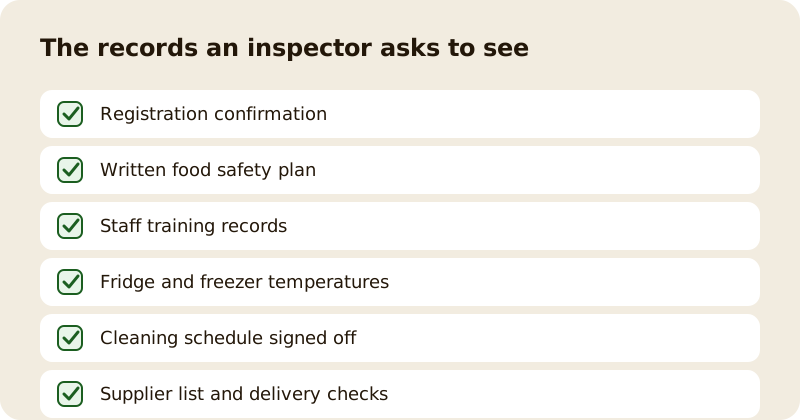
Register your food business with the competent authority before you trade, then write a food safety management system based on HACCP principles and keep the records that show you follow it. In practice that means a registration form, a plan of about ten pages for a small kitchen, and a handful of logs filled in every day. Inspectors read the records first, because a record is proof, and a plan nobody follows is not.
Who do you register with, and what does it cost you to wait?
Every food business operator has to register before starting to trade. Most restaurants, cafes, takeaways and food trucks register with the environmental health service of the HSE, and the Food Safety Authority of Ireland keeps the list of which authority covers which type of business. The form asks who you are, where you operate, what you make and sell, and roughly how many people you employ. Keep the confirmation: it is the first thing an inspector asks for.
Register again, or tell the authority, when something material changes: new premises, a new owner, a new activity such as starting a catering arm, or a mobile unit that moves between counties.
What does HACCP mean for a small kitchen?
HACCP stands for hazard analysis and critical control points. It is a method, and for a small kitchen it comes down to answering six plain questions on paper.
- What can go wrong? List the hazards in each dish: raw chicken cross-contaminating salad, a rice dish left warm, an allergen reaching the wrong plate.
- Where do you stop it? Cooking to a safe core temperature, chilling quickly, keeping raw and ready-to-eat apart. These are your control points.
- What are the limits? Write the number or the rule, for example the temperature a fridge must hold.
- How do you check? Who reads the thermometer, and when.
- What do you do when it fails? The corrective action, written before the problem happens.
- How do you prove it? The record.
Write it in your own words for your own menu. A generic template downloaded from a supplier, with dishes you do not make, fails the moment an inspector asks you to walk through it.
Which records should you keep every day?
Keep few records and keep them honestly. A short daily routine that is actually done beats a thick folder that is filled in on Friday afternoon.
- Temperatures. Fridges, freezers and hot holding, morning and evening. The fridge and freezer log in this guide gives you the columns.
- Deliveries. Check chilled goods on arrival, and note who signed.
- Cooking and cooling. Core temperature for the dishes you cook to order, and cooling times for anything batch-cooked.
- Cleaning. A schedule with initials, signed off by whoever closes.
- Training. Who was trained in what, and when. Food handlers need training in proportion to the work they do, and a short briefing on day one counts only if you wrote it down.
- Allergens. Your allergen information for every dish and the date it was last checked. The allergen guide covers it.
Download the fridge and freezer temperature log (spreadsheet, CSV)
The log is a spreadsheet you print. Fill in your target temperatures from your own plan and your authority's advice, not from ours.
What happens at an inspection?
An inspector can arrive unannounced during opening hours. They look at the premises, how food is stored and handled, the cleaning, the people, and the records. If something is wrong they tell you what and by when, and they follow up. Serious or repeated problems can lead to enforcement action, which can include closure orders for the worst cases.
Treat the visit as a free audit. Ask what they would do about the awkward corner you have never solved; inspectors see hundreds of kitchens and usually know a cheap fix.
What do inspectors find most often?
The same few things turn up in kitchen after kitchen, which makes them cheap to fix before anyone visits:
- No hand wash basin that is actually usable. A basin with a mop bucket in it, or no soap, is a finding on its own.
- Raw and ready-to-eat food stored together. Raw meat above salad in the walk-in is the classic.
- Missing or incomplete records. A temperature log with a week of identical numbers reads as made up.
- Out-of-date or unlabelled food. Decant containers need a name and a date.
- Staff with no training record. The cook may be excellent, but if nothing is written down you cannot prove it.
Walk your own kitchen once a week with a notepad, as if you were the inspector, and fix what you write down.
How do you keep the system alive?
Review the plan every time you change the menu, a supplier, a piece of equipment or the layout. Give one person (a named sous chef or the manager) the job of checking that the records are complete each week. Put the next review date on the front page.
Training is the other half. The new starter checklist puts the food safety briefing on day one, where it belongs, and the Mosey Courses feature has food safety courses your team can take on their phones.
If you are still planning the venue, go back to the opening checklist to see where registration sits in the order of things. Once you are trading, cutting food waste is the next place that records pay for themselves.
Questions
Common questions
Do I need a written HACCP plan for a small cafe in Ireland?
Yes. Food businesses must have a food safety management system based on HACCP principles, in proportion to the size of the business. For a cafe that is a short written plan plus daily records, not a manual.
When must I register my food business?
Before you start trading. Register with the competent authority that covers your type of business, and update the registration if you move, change owner or start a materially different activity.
How often should fridge temperatures be recorded?
Check and record at least at the start and end of each day, and more often for busy or older units. Your own plan sets the frequency, so write down what you decide and follow it.
What if a fridge reading is out of range?
Follow the corrective action in your plan: move the stock, check how long it was out of range, decide what to keep or discard, call the engineer and record all of it. Never fix the number on the log without fixing the fridge.
Is there a Mosey food safety diary?
No. Mosey does not offer a food safety diary, so the sheet in this guide is a printable template you keep yourself. Mosey helps with allergen declarations on menu items, which is a separate record.
More like this
Read next
How to run a supper club or tasting night that sells out
A supper club is a fixed menu, a fixed number of seats and a fixed night, sold as tickets paid in advance. Here is how to cost it, sell it and make it a habit.
How to add catering to your restaurant or café
Office lunches, platters and parties, quoted properly, with a deposit up front, the balance before the day and a prep sheet for the kitchen.
How to make a quiet Monday or Tuesday pay
First decide whether the quiet day should open at all. If it should, shrink it to the hours that trade and give it a reason to come that only exists on that day.
How to get more ratings and reviews for your restaurant, honestly
Ask, at the right moment, every customer, and make it easy. Never offer anything in return. A steady stream of honest ratings is worth more than any burst you could buy.
Get started
Claim your business free
Free to list, no set-up fee, and Order Ahead is 1.5% commission when you start taking orders.