
For businesses
Cut food waste in a restaurant kitchen: measure it, then cut it
Mosey · 23 October 2026 · 5 min read

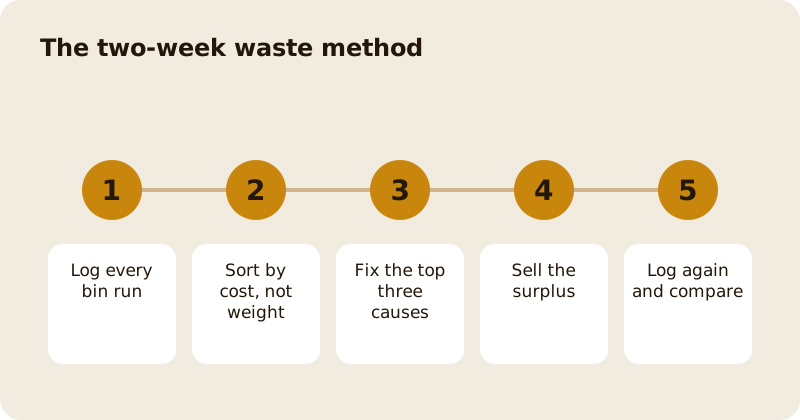
The fastest way to cut kitchen waste is to log it for two weeks: write down what goes in the bin, how much, what it cost and why. Sort the log by cost and not by weight, because a few kilos of fish matter more than a bucket of peelings. Three or four causes usually account for most of the money, and each has a known fix in prep, ordering or portion size.
Why measure before you change anything?
Every kitchen believes it knows where the waste is, and most are wrong by a long way. Cooks remember the dramatic losses, a dropped tray or a failed batch, and forget the slow ones: the extra half portion of rice cooked every night, the bread that goes stale on Tuesdays. Writing it down turns an opinion into a list.
Download the kitchen waste log (spreadsheet, CSV)
Put the log next to the bin. Everyone who throws something away writes a line: date, item, amount, cost and one of a short list of reasons. The reasons we suggest are trim, spoiled, over-prepared, returned by a guest, dropped, and out of date.
What do the common causes look like?
After two weeks, sort by cost. The same patterns appear again and again.
- Over-preparation. You prep for a busy night that does not come. Fix: prep to a par level based on the last four same-days, not on hope.
- Over-ordering. A minimum order forces you to buy more than you use. Fix: share a delivery with a neighbour or change the supplier mix.
- Spoilage. Produce rotting at the back of the fridge. Fix: first in, first out, labels with dates and a weekly tidy.
- Plate waste. Guests leave the same thing every time. Fix: shrink the portion or change the side. Ask the front of house what comes back.
- Trim. Buying whole and using half. Fix: use the trim in stocks, staff meals or a special, or buy it pre-prepared if the real cost is lower.
- Errors. Wrong order, wrong cook. Fix: read-back at the pass, and ticket clarity.
How do you cut it?
Start with the top item on the cost list and ask five questions. Why do we have too much? Can we buy less, more often? Can we prep less? Can we sell it before it turns? Can we use it in something else?
Menu design is a quiet lever. Dishes that share ingredients mean one delivery serves three dishes, so there is less to spoil. A menu with forty unique ingredients is a menu with a bin to match. The menu engineering guide helps you spot a dog whose real cost is the waste around it.
Buy better. Compare your suppliers on price per usable unit and not per pack.
Download the supplier price comparison sheet (spreadsheet, CSV)
How do you sell what would be wasted?
The surplus at the end of a service is still food you paid for. Options that work for a food business:
- A staff meal made on purpose from the day's surplus.
- A special that uses the trim or the day's extra.
- A discount at the end of the day for items that will not keep, such as bakery goods.
- An off-peak offer. Mosey's Deal Hours let you put an offer on a quiet time of day so a slow afternoon sells what a busy morning left; the Deal Hours guide shows how.
- Donation to a food redistribution charity, where the food is safe and within date.
Be careful with food safety. Anything that has been out of temperature control or served to a table cannot be reused or resold; follow your food safety plan.
What does a first two weeks look like?
A forty-seater logs its bin for fourteen days. The total comes to around 360 euro of food. Sorted by cost, the top line is prepared rice and sauces made in batches that nobody eats on a quiet Monday (about 90 euro), the second is fish ordered to a Friday par level that is too high (about 70), the third is bread (about 45), and the fourth is plate waste of the same side dish (about 40). That is 245 of 360 from four causes. Rice is cooked in two smaller batches, the fish par drops by a third, the bread order moves to a daily delivery, and the side shrinks. None of it needs a new system.
What does the law say about food waste?
Businesses that produce food waste in Ireland must separate it and have it collected by an authorised waste collector, rather than put it into general waste. Keep the collector's records. Cooking oil usually has its own collection. Check the current rules with your local authority or the Environmental Protection Agency.
How do you keep it down?
Repeat the log for a week each quarter, and after any menu change. Put the weekly waste cost on the manager's checklist next to labour. The goal is to make the number visible, not to blame the cook who bins a tray.
Waste costs cash twice, and if you are weighing a new tool against a saving like this, the pricing page shows what each part of Mosey costs. Waste is a cash-flow issue too, because every kilo in the bin is money you paid out and cannot get back; the cash flow guide shows the weekly view. If you also want to cost your dishes properly, start with food cost and gross profit.
Questions
Common questions
How long should I keep a waste log?
Two weeks is enough to see the pattern, as long as it covers a normal mix of busy and quiet days. Repeat it for a week each quarter and after any menu change to check the fixes held.
Is it better to track waste by weight or by cost?
By cost. A kilo of fish costs far more than a kilo of vegetable peelings. Sorting by cost points you at the items that cost the most money, which is where the fix is most worthwhile.
Can I sell food that was not served?
Food that has been kept safe, in date and never served to a table can be sold or used, following your food safety plan. Food that was served, or has been out of temperature control, cannot be reused.
Do I have to separate food waste in Ireland?
Commercial premises that produce food waste must generally separate it and use an authorised collector. Check the current rules with your local authority or the Environmental Protection Agency.
Does Mosey help reduce food waste?
Mosey does not track waste. It can help you sell surplus capacity and quiet times through Deal Hours, early bird offers and promotions, which turns food you would have binned into sales.
More like this
Read next
How to run a supper club or tasting night that sells out
A supper club is a fixed menu, a fixed number of seats and a fixed night, sold as tickets paid in advance. Here is how to cost it, sell it and make it a habit.
How to add catering to your restaurant or café
Office lunches, platters and parties, quoted properly, with a deposit up front, the balance before the day and a prep sheet for the kitchen.
How to make a quiet Monday or Tuesday pay
First decide whether the quiet day should open at all. If it should, shrink it to the hours that trade and give it a reason to come that only exists on that day.
How to get more ratings and reviews for your restaurant, honestly
Ask, at the right moment, every customer, and make it easy. Never offer anything in return. A steady stream of honest ratings is worth more than any burst you could buy.
Get started
Claim your business free
Free to list, no set-up fee, and Order Ahead is 1.5% commission when you start taking orders.