
For businesses
Food cost and gross profit explained: cost a dish properly
Mosey · 23 October 2026 · 5 min read
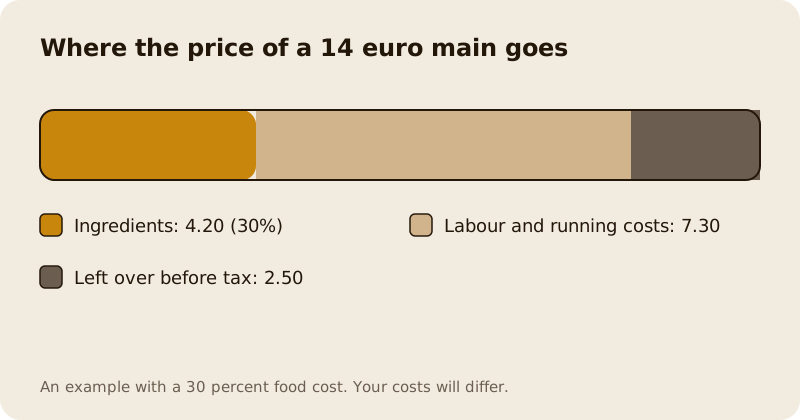
Food cost is what the ingredients in one portion cost you, and food cost percentage is that cost divided by the selling price before VAT. A main with 4.20 euro of ingredients that sells at 14 euro excluding VAT has a food cost of 30%, and a gross profit of 9.80 euro. The division is easy. What goes into the 4.20 is where restaurants lose money, because it must include the trim you throw away, the loss when food is cooked, and the garnish nobody thought to count.
How do you cost one dish?
Cost it from invoices, ingredient by ingredient, and write it down.
- List every ingredient in one portion, including oil, seasoning, bread on the side and the garnish.
- Find the price per unit from your latest invoice: price of the pack divided by the weight or count in the pack.
- Work out the quantity used in one portion.
- Allow for yield. If you buy a whole fish and the fillet is 45% of the weight, you pay for 100 g to use 45 g. Divide the usable cost by the yield.
- Add the portion costs to get the cost of one portion.
Download the recipe costing sheet (spreadsheet, CSV)
The spreadsheet has a row for each ingredient and does the unit price, the yield adjustment and the totals. Fill in the white cells.
What is the difference between food cost and gross profit?
Food cost percentage tells you the share of the price that goes to ingredients. Gross profit is the money left per portion after ingredients: price minus cost. Both matter, and they can disagree.
A 4 euro coffee with 0.40 euro of cost has a food cost of 10% and a gross profit of 3.60. A 24 euro steak with 9 euro of cost has a food cost of 37.5% and a gross profit of 15. The coffee looks cheaper to make, but the steak puts more money in the till per plate. The right view uses both, which is why the menu engineering guide sorts dishes on profit per portion as well as sales.
What is a good food cost percentage?
There is no single number. Many independents aim for something between a quarter and a third of the selling price for food, with drinks lower and a premium restaurant sometimes higher. Your own target should come from the rest of your costs: rent, rates, wages and energy all need paying from the money left over. Work backwards from your accounts, set a target, and then test every dish against it.
Do not apply the same percentage to every dish. A dish can run at a higher percentage if it is your hero and brings people in, as long as the whole menu averages near the target.
What does a worked costing look like?
A fish and chips plate. Cod fillets arrive at 11.50 a kilo, but trimming and skinning leaves 70% usable, so the usable cost is 11.50 divided by 0.70, or 16.43 a kilo. A 180 g portion costs 2.96. Potatoes at 1.10 a kilo with 80% yield and 300 g per portion cost 0.41. Batter, oil top-up, tartare sauce, a lemon wedge and a few peas add 0.65. The plate costs 4.02.
At a selling price of 15.00 including VAT at an example rate of 9%, the price before VAT is about 13.76. The food cost percentage is 4.02 divided by 13.76, or 29%, and the gross profit is 9.74. Change the cod to 13.00 a kilo and the plate cost moves to 4.28 and the percentage to 31%. That is the whole reason to keep the sheet alive.
What do restaurants forget to count?
- Trim and waste. The skin, bones, peel and ends. This is the yield figure.
- Cooking loss. Meat loses weight when it is cooked, and a portion is specified cooked.
- Free extras. Bread and butter, a sauce on the side, a refill.
- Staff food and breakage, which belong in your overall cost even if they are not on a plate.
- Price changes. Update the sheet when the invoice changes. A cost sheet from last spring is a fiction.
Compare the number from your recipe sheets with the real number at the end of the month: opening stock plus purchases minus closing stock, divided by food sales. A gap of more than a few points means waste, theft, over-portioning or unrecorded comps. The waste guide shows how to find which.
How do you price from the cost?
Divide the cost by your target food cost percentage to get a first price, then adjust it to what the market will pay. A dish costing 3.60 with a 30% target prices at 12.00 before VAT. Then add VAT at the rate that applies to the dish, and round to a price that looks sensible on the menu. The menu price calculator does the arithmetic if you would rather not.
If the number comes out too high for the market, change the dish, not only the price: a smaller portion, a cheaper cut, a different accompaniment. Then check it again.
For the tax side, see the VAT guide. For the write-up of your whole menu, read how to write a menu that sells.
Questions
Common questions
What is food cost percentage?
It is the cost of the ingredients in a portion divided by the selling price before VAT, shown as a percentage. A dish costing 3 euro that sells for 12 euro before VAT has a food cost of 25 percent.
Should I cost a dish with or without VAT?
Cost ingredients without VAT if you reclaim it, and compare with the selling price without VAT. Using prices with VAT on one side only gives a wrong percentage, so be consistent.
How often should I update my costings?
Whenever an invoice price changes noticeably, and at least every quarter. A key ingredient such as butter, beef or coffee can move the cost of many dishes at once.
What is yield and why does it matter?
Yield is the usable share of an ingredient after trim and cooking. If only 45 percent of a fish is fillet, the fillet costs more than twice the price per kilo. Ignoring yield understates every cost.
What if my actual food cost is higher than my recipe cost?
The gap points to waste, over-portioning, unrecorded comps or theft. Track waste for two weeks and compare portions on the plate with the recipe card to find which.
More like this
Read next
How to run a supper club or tasting night that sells out
A supper club is a fixed menu, a fixed number of seats and a fixed night, sold as tickets paid in advance. Here is how to cost it, sell it and make it a habit.
How to add catering to your restaurant or café
Office lunches, platters and parties, quoted properly, with a deposit up front, the balance before the day and a prep sheet for the kitchen.
How to make a quiet Monday or Tuesday pay
First decide whether the quiet day should open at all. If it should, shrink it to the hours that trade and give it a reason to come that only exists on that day.
How to get more ratings and reviews for your restaurant, honestly
Ask, at the right moment, every customer, and make it easy. Never offer anything in return. A steady stream of honest ratings is worth more than any burst you could buy.
Get started
Claim your business free
Free to list, no set-up fee, and Order Ahead is 1.5% commission when you start taking orders.