
For businesses
Menu engineering for cafes and restaurants: find your stars and your dogs
Mosey · 23 October 2026 · 5 min read

Menu engineering is a way to rank every dish on two measures: how many you sell, and how much gross profit each one leaves after its ingredients. Sort the dishes into four groups, called stars, plowhorses, puzzles and dogs, and each group has an obvious next step. It is the cheapest way to raise profit without raising a single price, because it changes what people choose.
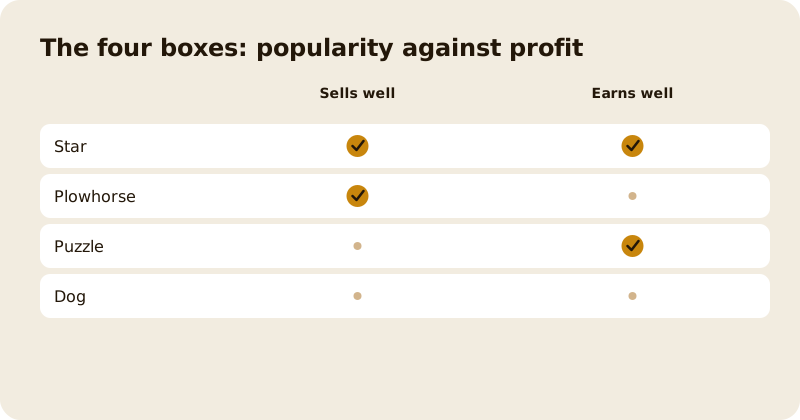
What are stars, plowhorses, puzzles and dogs?
The method was set out by two American academics in the early 1980s and is still the standard way to look at a menu. Each dish lands in one of four boxes.
- Stars sell well and earn well. Protect them: keep the recipe exact, keep them easy to find.
- Plowhorses sell well but earn little. They carry your menu and your regulars; improve their margin quietly.
- Puzzles earn well but sell little. Guests do not see them, or do not trust them. Promote them.
- Dogs sell little and earn little. Remove them or rebuild them.
The names are old and slightly rude. Use them in the kitchen office, not on the menu.
How do you calculate it?
You need two numbers for each dish over a period of at least four weeks.
- Gross profit per portion: the selling price before VAT, minus the cost of the ingredients in one portion. The food cost guide shows how to cost a dish properly, including trim and yield.
- Portions sold in the period, from your till or your order reports.
Then compare each dish with the average. The classic rule calls a dish popular if it sells at least 70% of what an average dish would sell if sales were shared evenly, and profitable if its gross profit per portion is at or above the weighted average across the menu.
Download the menu engineering sheet (spreadsheet, CSV)
The spreadsheet does the sorting. Fill in the price, the cost and the portions sold, and it labels each dish for you. If you want the cost side first, use the menu price calculator.
What do you do with each group?
Stars. Do nothing clever. Put them where the eye lands first, photograph them well, and make sure the kitchen never runs out. A dish photo with a clear name does more than a clever description.
Plowhorses. The dish people order without thinking. Raise the margin without raising the price: trim the portion by a small, honest amount, swap a pricey ingredient for a cheaper one that is as good, or pair it with a side that earns well. Raise the price by a small step if the dish is truly beloved, and watch the numbers for a month.
Puzzles. Good money, few orders. Rename it, describe it in one vivid line, move it to the top of its section, ask staff to recommend it, or make it the dish of the week. If it still does not sell after a month, it is most likely the wrong dish for your guests.
Dogs. Cut them, or rework them into something you can sell. Be careful with a dog that is a "must have" on the menu for a reason: a dish that earns little but brings a table of four in is a plowhorse in disguise. Judge it by the table, not the plate.
What does a worked example look like?
Take a cafe with five lunch dishes over four weeks. The soup of the day sells 400 portions at a gross profit of 3.10. The toasted sandwich sells 520 at 2.40. The salad bowl sells 180 at 5.20. The quiche sells 90 at 4.60. The pie sells 60 at 6.40.
That is 1,250 portions, so an even share is 250, and 70% of that is 175. Soup, sandwich and salad are popular; quiche and pie are not. The weighted average gross profit is about 3.38, so the soup (3.10) and the sandwich (2.40) fall below it, and the salad, quiche and pie clear it. The result: the sandwich and soup are plowhorses, the salad is a star, and the quiche and pie are puzzles. The next step writes itself. Nudge the sandwich price by a small step or trim the filling, move the salad to the top of the board, and give the pie a name and a photograph.
What should you be careful of?
Menu engineering is a lens, not a verdict. Three cautions keep it honest.
- Sales of one dish affect the others. Removing a dog can push guests to a cheaper alternative, not to a star.
- Price tiers matter. Judge starters against starters and mains against mains, not the whole menu in one lump.
- Do not engineer away the identity of the place. A cafe known for a particular pie keeps the pie, whatever the table says.
Also check the data. A dish added last week has no sales history, and a dish that ran out on Saturday looks less popular than it is.
Where does Mosey help?
Your menu is the page guests browse before they choose a place, so the order, photographs and descriptions matter on Mosey too. You can scan a paper menu into Mosey and then edit each dish, and diners rate and photograph the dishes they actually ate, which tells you which of your puzzles guests love and do not notice on your menu. Read the dish ratings alongside your numbers.
Once your menu is sorted, read how to write a menu that sells, the guide on pricing a set menu and the one on boosting sales on slow days.
Questions
Common questions
What is menu engineering?
It is a method that sorts each dish by popularity and gross profit into four groups: stars, plowhorses, puzzles and dogs. Each group has a standard action, so you know what to push, reprice, rename or remove.
How long a period of sales should I use?
Four weeks is a sensible minimum, and more is better. Avoid a period with a one-off event, a closure or a heavy seasonal swing, and compare like with like when you repeat it.
Should I remove every dog from the menu?
Not automatically. A dish that sells little and earns little might still bring in large groups or complete a balanced menu. Judge it by the whole table, and rework it before you drop it.
Can I use menu engineering for a small cafe?
Yes. A cafe with twenty items benefits as much as a restaurant with sixty. Group drinks, food and baked goods separately so you compare similar things.
Does Mosey calculate this for me?
No. The spreadsheet in this guide does the sorting from your own prices, costs and sales. Mosey helps with the menu itself and with dish ratings and photos from your guests.
More like this
Read next
How to run a supper club or tasting night that sells out
A supper club is a fixed menu, a fixed number of seats and a fixed night, sold as tickets paid in advance. Here is how to cost it, sell it and make it a habit.
How to add catering to your restaurant or café
Office lunches, platters and parties, quoted properly, with a deposit up front, the balance before the day and a prep sheet for the kitchen.
How to make a quiet Monday or Tuesday pay
First decide whether the quiet day should open at all. If it should, shrink it to the hours that trade and give it a reason to come that only exists on that day.
How to get more ratings and reviews for your restaurant, honestly
Ask, at the right moment, every customer, and make it easy. Never offer anything in return. A steady stream of honest ratings is worth more than any burst you could buy.
Get started
Claim your business free
Free to list, no set-up fee, and Order Ahead is 1.5% commission when you start taking orders.