
For businesses
Cash flow for Irish restaurants: the 13-week view that stops surprises
Mosey · 23 October 2026 · 5 min read

A restaurant can make a profit on paper and still be unable to pay its suppliers on a Friday. Cash flow is the timing: when money arrives, when it leaves, and what is left in the bank in between. The tool that prevents surprises is a 13-week forecast: a table of the next three months, week by week, showing money in, money out and the closing balance. It takes an hour to build and a few minutes a week to keep.
Why do profitable restaurants run short?
Because costs arrive in lumps and sales arrive in a stream. Rent is due on a date, payroll on a date, VAT on a date, and the supplier on terms. Meanwhile takings depend on the weather, the match and the month. Add a refit, a stock build for Christmas, or a slow January, and the balance can fall below zero in a week that looked fine on the profit and loss account.
Three habits cause most trouble: paying suppliers faster than you are paid, forgetting that VAT collected is not your money, and building stock before a season without checking the cash.
How do you build the 13-week forecast?
Download the 13-week cash flow sheet (spreadsheet, CSV)
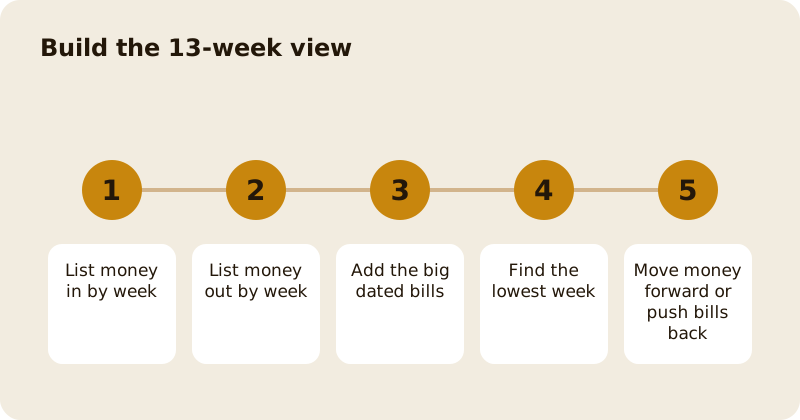
The sheet has the weeks across and the lines down, and the closing balance of each week opens the next. Fill it in this order.
- Opening cash. The bank balance today, not the accounts figure.
- Money in. Card takings paid out to you, cash banked, deposits, voucher sales and any other income, by the week you expect it in the bank, not the week you earned it.
- Money out. Suppliers, wages and payroll tax, rent and rates, loan repayments, insurance, energy, and the VAT you will have to pay.
- The big dated bills. Put each one in its exact week.
- Closing cash. The sheet works it out.
Be cautious about money in and generous about money out. If you are unsure, take the lower sales figure and the later receipt.
Which Irish dates matter most?
- Rent. Commercial rent is often paid quarterly in advance, which makes one week very heavy.
- Payroll tax. Tax withheld from wages is due after each month. The payroll basics guide has the dates.
- VAT. Returns are usually every two months, and the payment lands in a single week. Check the dates and the amount on Revenue's website, and do not treat the VAT in your till as spendable. The VAT guide explains.
- Commercial rates. Your local authority bills rates on a schedule.
- Seasonal stock. The Christmas food and drink order, paid before the trade arrives.
Look for the lowest week. If the balance dips below a safe cushion, that is the week to plan around.
What does a worked example look like?
A forty-seat cafe takes about 6,000 euro a week in January and 9,000 in July. In week four its quarter's rent of 7,500 euro falls due, and in the same week the bi-monthly VAT payment of 4,200 euro is also due. Wages and suppliers run at 4,600 a week. Opening cash is 5,000.
In weeks one to three the cafe takes 18,000 and spends 13,800, so it reaches week four with 9,200. In week four it takes 6,000, pays 4,600 for wages and suppliers, then 7,500 rent and 4,200 VAT, ending the week at minus 1,100 euro, even though the cafe is profitable over the quarter. The fix is found in a spreadsheet and not in a panic: ask the landlord to split the quarter into months, sell 30 vouchers in the run-up to the week, or order less stock in week three. Doing it a month ahead is free; doing it on the day is not.
How do you bring money forward?
Several tools turn future sales into cash today, and each has a cost in margin or in obligation.
- Deposits and tickets. A deposit on a large booking or a ticket for an event is paid before the night. On Mosey, reservation deposits carry no commission and event tickets carry the event commission shown on the pricing page.
- Gift vouchers. Sold in the weeks before Christmas, they bring cash in before January. Remember that a voucher is a promise to serve food later, so do not spend all of it; the voucher guide explains the liability.
- Memberships. A yearly plan paid in advance is a lump of cash and a commitment to serve.
- Pre-orders. A festive set menu paid at booking.
None of these is free money. Each one is a promise, so record what you owe as well as what you were paid.
How do you push money out?
Ask suppliers for longer terms once you have a record of paying on time. Swap one monthly bill for a smaller weekly one if it helps. Spread an equipment purchase over a lease rather than paying cash. Talk to the landlord early if a quarter is hard: a landlord who hears in advance is more flexible than one who finds out on the due date.
What do you do with the forecast each week?
Update it every Monday. Replace last week's guess with the real number, add week 14, and look at the lowest week again. If it moves, act now: delay a purchase, run a promotion for the quiet days, call a supplier. The seasons guide shows which weeks to expect to be tight, and the waste guide shows where cash leaks.
Questions
Common questions
What is a 13-week cash flow forecast?
It is a week-by-week table of the next three months showing money in, money out and the closing bank balance for each week. It highlights the weeks when bills cluster and the balance could dip.
Is VAT in my till my money?
No. VAT you collect is owed to Revenue and is due on the date of your return. Keep it out of your spending cash and show the payment in the right week of your forecast.
How do deposits and vouchers help cash flow?
They bring money in before the service. A deposit or ticket arrives before the night and a voucher before the visit. They are promises to serve later, so record what you owe as well as what you received.
How often should I update the forecast?
Weekly. Replace last week's estimate with the real figure, add a new week at the end and look again at the lowest week. A forecast that is not updated is out of date within a month.
What if the forecast shows a week below zero?
Act early. Delay a purchase, ask a supplier for terms, bring cash forward with deposits or a promotion on quiet days, or talk to your landlord or bank before the week arrives.
More like this
Read next
How to run a supper club or tasting night that sells out
A supper club is a fixed menu, a fixed number of seats and a fixed night, sold as tickets paid in advance. Here is how to cost it, sell it and make it a habit.
How to add catering to your restaurant or café
Office lunches, platters and parties, quoted properly, with a deposit up front, the balance before the day and a prep sheet for the kitchen.
How to make a quiet Monday or Tuesday pay
First decide whether the quiet day should open at all. If it should, shrink it to the hours that trade and give it a reason to come that only exists on that day.
How to get more ratings and reviews for your restaurant, honestly
Ask, at the right moment, every customer, and make it easy. Never offer anything in return. A steady stream of honest ratings is worth more than any burst you could buy.
Get started
Claim your business free
Free to list, no set-up fee, and Order Ahead is 1.5% commission when you start taking orders.