
For businesses
Restaurant payroll basics in Ireland: PAYE, USC, PRSI and payslips
Mosey · 23 October 2026 · 5 min read

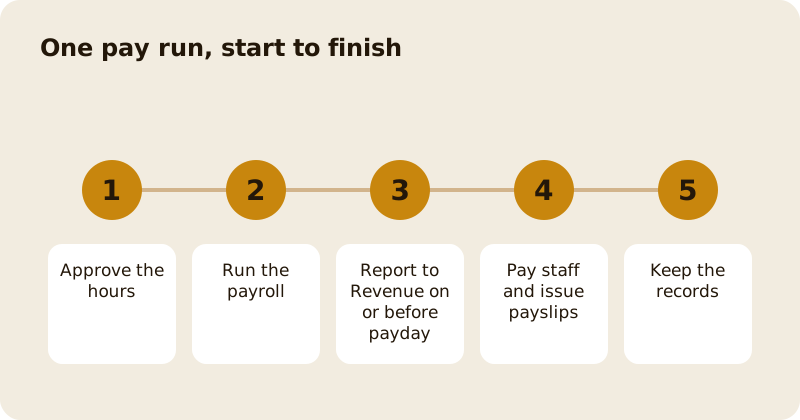
To run payroll for an Irish restaurant you register as an employer with Revenue, take each new starter's details and tax information, work out pay and deductions every pay period, report the figures to Revenue on or before the day you pay, give each person a payslip and keep the records for six years. Most owners use payroll software or an accountant for the calculation; your job is to get the hours right and the registration done.
What do you need to set up before the first pay run?
Register as an employer with Revenue before the first person starts, so that Revenue can issue you a registration number and give you access to the systems you report through. For each new employee, collect their name, address, date of birth, PPS number and bank details, and register them with Revenue as a new starter. Revenue then issues you a notice for that employee that tells you which tax credits and rate band to apply. You do not guess the tax; you apply the notice.
Choose how you will run the calculations. Small independents tend to pick between three routes: payroll software they run themselves, a bureau, or their accountant. All three produce the same output. What changes is who is responsible for making sure the hours going in are right, and that is always you.
What gets deducted from an employee's pay?
Three deductions apply to most employees, and each has a matching employer side that you pay on top.
- PAYE income tax, worked out from the employee's tax credits and rate band notice.
- USC, the universal social charge, which has its own bands.
- PRSI, social insurance, paid by the employee and by you as the employer. The class of PRSI depends on the type of employment.
The rates and bands change in the annual Budget, so get the current ones from Revenue and make sure your payroll software has updated.
What do you have to report, and when?
Since 2019 employers report payroll information to Revenue in real time, on or before the date employees are paid. This means each pay run produces a submission with gross pay, deductions and the date, not a year-end return. Get the submission wrong and Revenue's records for that employee are wrong, which shows up as tax problems for them months later.
Pay Revenue what you withheld by the due date, which is usually the 14th of the following month for most employers (the 23rd if you file and pay online). Check the current date and method on Revenue's site.
Which records should you keep?
Keep, for six years, everything that supports a payroll figure: contracts, starter forms, the Revenue notices, time records and payslips. Irish law also expects you to give employees a payslip showing gross pay and each deduction. Records of working time must be kept too, so that you can show breaks, rest and hours if there is ever a dispute. The rota guide covers the working-time side.
How do you get the hours right?
The commonest payroll mistake in a restaurant is wrong hours: a shift that ran an hour over, a swap nobody told you about, a tip that was paid twice. The fix is a simple routine.
- Staff clock on and off in the same place every time.
- A manager approves the hours at the end of each pay period.
- Nobody approves their own hours.
- Only approved hours go to payroll.
Mosey's Staff area follows that routine. People clock on from the till or a kiosk, a manager approves sessions in Time and pay, and nobody can sign off their own pay. At the end of a period you download one file of hours and tip shares. Mosey has layouts for several common payroll packages as well as a plain file; each layout is the most faithful version we could write from public information, and the dashboard says so beside the choice, so import a test week before you rely on one. Mosey does not run your payroll, pay anyone or send anything to Revenue.
What else catches restaurant owners out?
- Tips. Card tips are paid through the payroll in most places; the tips guide explains the written policy the law asks for.
- Holiday pay. Leave accrues on hours worked, and the calculation on irregular hours is where mistakes hide.
- Sick pay. Statutory sick pay has been phased in since 2023, rising by year; confirm the current number of days and the rate with gov.ie.
- Pensions. A state auto-enrolment scheme is being introduced; check gov.ie for the latest start date and your duties.
- Contractors. A person who works your rota under your direction is very likely an employee, whatever the invoice says. Ask your accountant before treating someone as self-employed.
Download the new starter checklist (spreadsheet, CSV)
The new starter checklist helps you collect the right information on the first day, so the first payroll is clean. For the next steps see the VAT guide, the cash flow guide, or the staff hiring and training overview. To see which parts of the dashboard cost what, read our pricing.
Questions
Common questions
Do I need to register as an employer before I hire someone?
Yes. Register as an employer with Revenue before the first person starts, then register each new employee as a starter so Revenue can send you their tax credit and rate band notice.
When do I report payroll to Revenue?
On or before the day you pay your employees, for every pay run. Payment of the tax withheld follows by a monthly due date, so check the current date and method with Revenue.
How long must I keep payroll records in Ireland?
Six years is the standard period for payroll and tax records. Keep contracts, starter details, Revenue notices, time records and payslips together so you can answer any query from Revenue or an employee.
Can Mosey run my payroll?
No. Mosey records and approves hours, works out tip shares and exports a file in a layout your payroll package can import. You or your accountant run payroll and pay your staff.
Is a kitchen porter paid cash in hand allowed?
No. Everyone who works for you as an employee must be on the payroll and reported to Revenue. Cash in hand is a tax and employment law problem for you as the employer, not only for the person paid.
More like this
Read next
How to run a supper club or tasting night that sells out
A supper club is a fixed menu, a fixed number of seats and a fixed night, sold as tickets paid in advance. Here is how to cost it, sell it and make it a habit.
How to add catering to your restaurant or café
Office lunches, platters and parties, quoted properly, with a deposit up front, the balance before the day and a prep sheet for the kitchen.
How to make a quiet Monday or Tuesday pay
First decide whether the quiet day should open at all. If it should, shrink it to the hours that trade and give it a reason to come that only exists on that day.
How to get more ratings and reviews for your restaurant, honestly
Ask, at the right moment, every customer, and make it easy. Never offer anything in return. A steady stream of honest ratings is worth more than any burst you could buy.
Get started
Claim your business free
Free to list, no set-up fee, and Order Ahead is 1.5% commission when you start taking orders.