
For businesses
Restaurant rotas and working time rules in Ireland
Mosey · 23 October 2026 · 5 min read

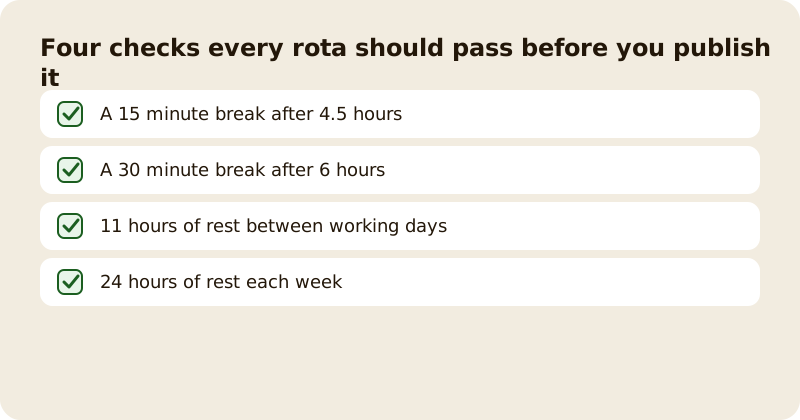
An Irish restaurant rota must give staff a 15 minute break after four and a half hours, a 30 minute break after six hours, 11 hours of rest between working days, and a weekly rest period of 24 hours. These come from the Organisation of Working Time Act 1997. Build the rules into the rota template once, and the rota stops being the thing that causes a complaint on a Saturday night.
What are the main working time rules?
The 1997 Act sets the minimum protections for most employees. The ones that bite in a restaurant are:
- Breaks. A 15 minute break after 4.5 hours of work, and a 30 minute break after 6 hours (which can include the first 15). The employer decides when, but not "never".
- Daily rest. 11 consecutive hours of rest in every 24-hour period. A close at 1am and an open at 9am the same day breaks it.
- Weekly rest. A rest period of 24 hours each week, in addition to the daily rest, or equivalent rest in a fortnight.
- Maximum average week. An average of 48 hours a week, averaged over a reference period (usually four months for most staff).
- Sunday and public holidays. There are separate rules on Sunday work and on pay or time off for a public holiday.
- Night work. Special limits apply to night workers.
There are some exemptions and exceptions, including some in the hospitality industry for particular situations, so check the Workplace Relations Commission's pages before you rely on one.
What does the employment law say about hours and written terms?
Employees are entitled to a written statement of core terms within five days of starting. Under the Employment (Miscellaneous Provisions) Act 2018, an employee with unpredictable hours has protections too: the written terms must set out the contractual hours, and an employee whose contract promises a minimum of hours but regularly works more may be entitled to be placed in a band that reflects the actual hours. These rules matter to restaurants with "zero hours" habits, so check them with the WRC before you finalise contracts.
The practical lesson is to write the standard week into the contract and agree changes in writing, even on WhatsApp, rather than relying on "he knows the roster".
How do you build a rota that holds up?
Rotas break when they are built from the week before. Build from demand.
- Forecast sales by day and daypart. Last year's same week, adjusted for events and weather.
- Set the labour target. Many owners aim for a labour cost percentage of sales that suits their format; calculate yours from last year's accounts.
- Place the fixed shifts first. Opening, closing, prep, the pass.
- Add the variable shifts. Floor and bar cover for the busy half hours.
- Check the rules. Breaks, rest between shifts, the weekly rest.
- Publish early. A rota published a week ahead means fewer swaps and fewer last-minute absences.
Download the weekly rota template (spreadsheet, CSV)
The spreadsheet has one row per person and a column for each day. It totals hours and cost and shows labour as a share of the sales you forecast, so you can see if a Tuesday is overstaffed before you publish it.
Where does Mosey fit?
The Staff area in the Mosey dashboard has a rota, time and pay, leave and tips in one place. You can publish the rota, staff see their shifts, and the hours go into a pay-period export your own payroll can read. Mosey does not run payroll or pay anyone, and you can see what each part costs. It exports hours and tips; your payroll software or accountant does the paying.
Staff can also offer their availability and pick up open shifts, so the rota gets filled without a group chat. Mosey's overtime figure is advisory, a number to show and warn about, never one to pay from, so check the rules with the WRC and your accountant.
Rest and breaks are a person-by-person question. When you build the rota, scan each person's run of shifts for the 11 hour gap, which is the one most often broken after a late service.
How do you handle a late finish followed by an early start?
This is the shift pattern that breaks the 11 hour rule. A cook who closes at 1am cannot open at 9am. Two fixes work in practice: give a late finisher a later start the next day, or keep a short list of people who only do closing runs for the week. When the rota software or sheet shows a gap under 11 hours, treat it like a double booking and change it before you publish.
Also write down every swap that staff agree between themselves. A swap that leaves one person with a short rest is still your responsibility as the employer.
What about holidays and sick leave?
Annual leave is accrued by hours worked; the amount and the pay are set in the Act and in Workplace Relations Commission guidance, and the leave year runs from April. Statutory sick pay has been phased in since 2023, rising each year to ten days in 2026, with a pay rate set as a percentage of normal pay up to a daily cap; confirm the details with gov.ie and Revenue.
Keep the full picture in the payroll basics guide, set up the tips pool so everyone knows how tips are shared, and read the staff hiring and training guide for the next step.
Questions
Common questions
What breaks must an Irish restaurant give its staff?
A 15 minute break after 4.5 hours of work and a 30 minute break after 6 hours, which can include the first 15 minutes. Check the Workplace Relations Commission for any exceptions and the latest guidance.
How much rest must there be between shifts?
Employees are entitled to 11 consecutive hours of rest in each 24-hour period, plus a weekly rest period of 24 hours. A close and an open the next morning can break this rule, so check the gap on every rota.
Can I run a rota with zero hours contracts?
The law restricts zero-hours arrangements for most employees. Contracts must state the contractual hours, and workers who regularly work more may be entitled to a band reflecting actual hours. Ask the WRC before you finalise contracts.
Does Mosey pay my staff?
No. Mosey records hours and tips and exports them in files your payroll can import. You or your accountant run payroll and pay staff through your own bank and software.
How far ahead should I publish a rota?
Publishing at least a week ahead is good practice and reduces swaps and no-shows. Check your contracts and any collective agreements for a required notice period for changes.
More like this
Read next
How to run a supper club or tasting night that sells out
A supper club is a fixed menu, a fixed number of seats and a fixed night, sold as tickets paid in advance. Here is how to cost it, sell it and make it a habit.
How to add catering to your restaurant or café
Office lunches, platters and parties, quoted properly, with a deposit up front, the balance before the day and a prep sheet for the kitchen.
How to make a quiet Monday or Tuesday pay
First decide whether the quiet day should open at all. If it should, shrink it to the hours that trade and give it a reason to come that only exists on that day.
How to get more ratings and reviews for your restaurant, honestly
Ask, at the right moment, every customer, and make it easy. Never offer anything in return. A steady stream of honest ratings is worth more than any burst you could buy.
Get started
Claim your business free
Free to list, no set-up fee, and Order Ahead is 1.5% commission when you start taking orders.