
For businesses
Tips and tip pools in Irish restaurants: the law and a fair split
Mosey · 23 October 2026 · 5 min read

Irish employers must distribute tips and service charges fairly and in accordance with a written policy, and must display a notice that tells staff how it works. The law behind this is the Payment of Wages (Amendment) (Tips and Gratuities) Act 2022, in force from December 2022. If you pool tips, the safe route is a written policy, a split method you can explain to a new starter in two minutes, and a record for each pay period.
What does the 2022 tips law ask of an employer?
In short, four things. Tips and gratuities that customers pay by card or cash belong to the staff, not the business. You must distribute them in a fair way. You must have a written policy that says how you do it, and you must display a notice setting out the policy where staff and customers can see it. And you must keep records of the tips received and how they were paid out, so you can show your sums if a staff member or an inspector asks.
The Workplace Relations Commission is the body that handles complaints, and its website explains the detail. Confirm the current text there before you write your policy, because a law this new may have been guidance-tweaked since this guide was written.
A mandatory service charge is different from a tip. If you add 12.5% to a table of eight, the customer did not choose it, and whether it counts as a tip for the purposes of the law depends on how it is described and used. Ask your solicitor or the WRC before you rely on a service charge as a business income line.
How do you decide who shares?
Decide the principle first, then the list. Ask what the guest pays the tip for: usually the whole experience, the kitchen included. Common groupings are:
- Floor only. Simple, and fair where the front of house is the whole customer-facing team.
- Floor and bar. Keeps the bar team inside the pool when they serve the same guests.
- Everyone who worked the shift. Includes the kitchen and porters. Tends to keep a team together.
Managers and owners who work the floor are a legal and a cultural question. Many policies exclude owners and keep working managers out of the pool, because the pool exists to top up staff pay. Whatever you choose, write it down.
Which split methods work in a small restaurant?
Three are common, and all are fair when explained.
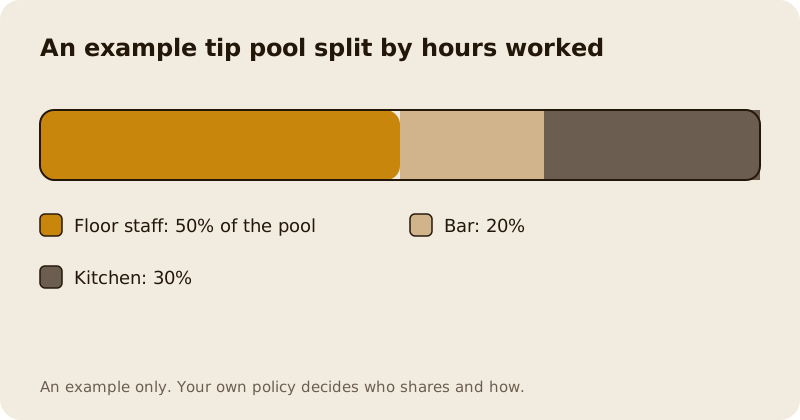
- By hours worked. Each person's share is their hours divided by everyone's hours in the period. It is the simplest and the hardest to argue with.
- By role points. A head chef gets 3 points, a waiter 2, a kitchen porter 1. Each point is worth the same amount. It rewards seniority and needs the points written down.
- Equal shares. Everyone who worked gets the same. It works for a very small team and is easy to hold.
An example: a pool of 1,200 euro for the month, three people with 160, 120 and 80 hours. Total hours 360. Shares are 533.33, 400 and 266.67. The cents add up to the pool exactly, and if they do not, the spare cent goes to the person with the largest remainder, the same way every time.
How does Mosey help with a tip pool?
Mosey's Staff area has a Tips tool. It works out how your tips are shared, records it, and exports each person's share with the hours export, so your own payroll can pay them. No money moves through Mosey and there is no fee on tips.
- Card tips from the till, Mosey Pay tips and tips on collection orders are counted for you, line by line, on your own calendar days. Cash tips you add by hand with a note. Delivery tips go to the driver, not the pool.
- You choose a split by hours, by role share or by hand, and the preview shows exactly what will be saved. The shares always add up to the pool to the cent.
- A written policy is stored with a date and version, and the tool warns you if you have none or if a manager is in the pool. It warns; it never blocks.
- When you finalise a period the shares are locked. Later edits to a timesheet do not change them.
- Each person sees only their own share and the policy that applied, in the jobs site.
The Tips tool sits in the Staff area, which is part of the same dashboard as your orders and bookings; see what it costs. The tool does not tell you that a policy is lawful. It prompts you to check, and the dates it shows for paying tips out are labelled unconfirmed until the owner checks them with the official text.
What goes in the written policy?
Download the tips policy outline (text file)
The outline lists the ten points a policy should cover: what counts as a tip, how card tips are recorded, who shares, the method, when it is paid, what is deducted, how staff see their share, who to ask, where it is displayed and when it is reviewed. Fill it in, have a solicitor or an HR adviser read it, and give every new starter a copy.
For the rest of your staffing set-up, see the rota and working time guide, the payroll basics and the staff hiring and training overview.
Questions
Common questions
Do Irish restaurants have to share tips with staff?
Yes. Tips and gratuities paid by customers belong to staff, and employers must distribute them fairly under a written policy and display a notice about it. Check the Workplace Relations Commission for the current detail.
Can an owner or manager take part of the tip pool?
The law requires fair distribution, and many employers exclude owners and keep supervisory managers out of the pool. Whatever you decide must be in the written policy and applied the same way each time.
Is a service charge the same as a tip?
Not necessarily. A tip is voluntary and goes to staff. A mandatory service charge is a charge by the business, and how it is treated depends on how it is described and used. Ask the WRC or a solicitor.
Does Mosey take a fee on tips?
No. The Tips tool works out and exports each person's share. No money moves through it and there is no fee line, because the place pays tips through its own payroll.
How often should tips be paid out?
Your written policy should state it, and the law expects fair and timely distribution. Many places pay with the next pay run. Check the WRC guidance for any set deadline before you publish your policy.
More like this
Read next
How to run a supper club or tasting night that sells out
A supper club is a fixed menu, a fixed number of seats and a fixed night, sold as tickets paid in advance. Here is how to cost it, sell it and make it a habit.
How to add catering to your restaurant or café
Office lunches, platters and parties, quoted properly, with a deposit up front, the balance before the day and a prep sheet for the kitchen.
How to make a quiet Monday or Tuesday pay
First decide whether the quiet day should open at all. If it should, shrink it to the hours that trade and give it a reason to come that only exists on that day.
How to get more ratings and reviews for your restaurant, honestly
Ask, at the right moment, every customer, and make it easy. Never offer anything in return. A steady stream of honest ratings is worth more than any burst you could buy.
Get started
Claim your business free
Free to list, no set-up fee, and Order Ahead is 1.5% commission when you start taking orders.