
For businesses
Allergen information for Irish restaurants: the 14 allergens in writing
Mosey · 23 October 2026 · 5 min read

Irish and EU food law names 14 allergens that a food business must be able to tell a customer about, for every dish it serves: celery, cereals containing gluten, crustaceans, eggs, fish, lupin, milk, molluscs, mustard, tree nuts, peanuts, sesame, soybeans, and sulphur dioxide and sulphites. The Food Safety Authority of Ireland expects the information to be available in writing for food that is not prepacked, and the one thing that must never happen is a guess.
What does the law ask of a restaurant?
The rules come from EU food information law, applied in Ireland by national regulations. For food served loose, as in a restaurant, cafe or takeaway, you must be able to give the customer allergen information for every dish. The FSAI asks businesses to provide it in writing, on the menu, a sheet or a board, or to display a clear sign saying where it can be found. The information has to be accurate, it has to be easy to find, and it has to be available before the customer orders.
Several details trip people up:
- Ingredients of ingredients count. The stock cube, the sauce from the tub, the spice blend and the oil in the fryer all carry allergens.
- "May contain" is not a shrug. If a dish is cooked where gluten flour is airborne, or shares a fryer with fish, say so as cross-contact information, not as an ingredient.
- Staff must be able to answer. A matrix on the wall is no use if the person at the table says "I'll check", and nobody does.
- Information changes. A supplier changes a product; the matrix has to change that day.
Check the current detail with the FSAI, which publishes guidance and templates for food businesses.
How do you build an allergen matrix?
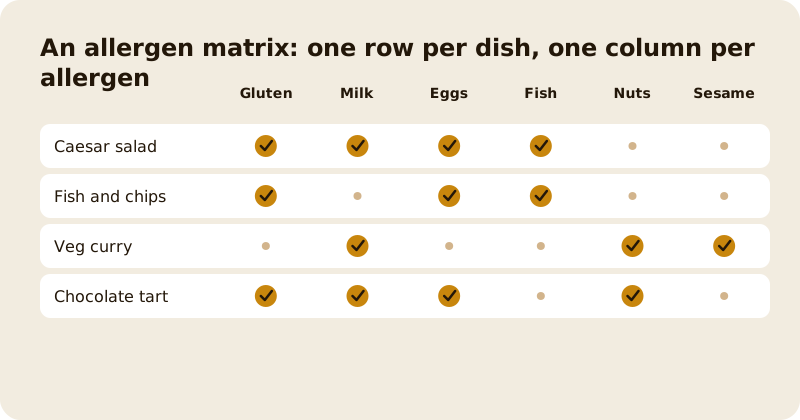
A matrix is a grid: dishes down the side, allergens across the top, a mark where the dish contains one. It is the simplest tool that works, and it is the one inspectors recognise.
- List every dish, side, sauce, special and children's meal.
- For each, write the recipe down to the level of jars and packets, and read every label.
- Mark the allergens, including the ones inside ingredients.
- Have the cook who makes the dish check the row, then a second person sign it off.
- Date it, and name who checked it.
- Re-check whenever a recipe, brand or supplier changes.
Download the allergen matrix (14 allergens) (spreadsheet, CSV)
The spreadsheet has all 14 columns, a column for cross-contact notes, and a place for the name and date of the person who checked each row.
How does Mosey help you tell guests the right thing?
Mosey does not decide what is in your food. It records what you declare and then repeats it faithfully everywhere a guest or a cook reads it.
- You declare per dish. In the menu builder, open a dish and set what it contains and what it may contain, add a note, and add the ingredients. A dish you have not declared says so to the guest: "The place has not listed allergens for this dish. Ask them before you order." A declared dish with nothing in it says "The place lists no allergens for this dish." Mosey never says "allergen free" or "safe".
- Every change is kept. Each edit to a declaration is stored with who made it and when, so you can show what a dish said on a given day.
- The declaration is frozen on each order line. If you re-declare a dish tomorrow, yesterday's kitchen ticket and receipt still say what the guest was shown when they ordered.
- It prints where the kitchen looks. The declared allergens appear on the kitchen ticket, the kitchen display and the receipt, and in the allergen block of the order confirmation email.
- The A4 sheet and the labels come from the dashboard. One click produces an allergen sheet for the wall, and labels for food you pack on site to sell over the counter, with the 14 allergens in bold in the ingredient list.
Two limits to know. The native till app does not show allergen chips on its order screen yet, so use the web till or the kitchen display where allergens matter most. And Mosey has no Irish-language allergen text yet.
What do you do about the guest who says "I am allergic"?
Build a routine that does not depend on anyone's memory. Whoever takes the order asks which allergy, writes it on the ticket, and the cook who makes the dish reads the ticket and checks the matrix. Use clean boards, knives and pans, change gloves, and carry the plate to the table yourself, naming the allergy as you put it down. The new starter checklist puts this briefing on every new person's first day.
If there is any doubt, the answer is "I cannot guarantee it", said kindly. A guest remembers the honesty.
Which guides should you read next?
Allergen information sits inside your wider food safety system, so read the food safety and HACCP guide next, and the menu costing guide if you are about to change recipes anyway. To put the declarations on your ordering menu, see Mosey's menu tools, and to see the rest of the dashboard, what it costs.
Questions
Common questions
What are the 14 allergens that must be declared in Ireland?
Celery, cereals containing gluten, crustaceans, eggs, fish, lupin, milk, molluscs, mustard, tree nuts, peanuts, sesame, soybeans, and sulphur dioxide and sulphites at more than ten milligrams per kilo or litre.
Does allergen information have to be in writing in Ireland?
The FSAI asks businesses to provide it in writing for food that is not prepacked, or to display a clear sign saying where it can be found. Check the latest FSAI guidance because it is updated from time to time.
Is it enough to tell customers verbally?
A verbal answer on its own is not enough guidance for a business to rely on. Have it available in writing, and use the conversation at the table to check the specific need of the guest.
Does Mosey guarantee a dish is free of an allergen?
No. Mosey shows only what your venue declared, and it never describes a dish as allergen free or safe. The accuracy of the declaration is the responsibility of the business that made it.
How often should I review my allergen matrix?
Every time a recipe, a brand or a supplier changes, and at least every few months as a routine check. Date every row and record who checked it so you can show your process.
More like this
Read next
How to run a supper club or tasting night that sells out
A supper club is a fixed menu, a fixed number of seats and a fixed night, sold as tickets paid in advance. Here is how to cost it, sell it and make it a habit.
How to add catering to your restaurant or café
Office lunches, platters and parties, quoted properly, with a deposit up front, the balance before the day and a prep sheet for the kitchen.
How to make a quiet Monday or Tuesday pay
First decide whether the quiet day should open at all. If it should, shrink it to the hours that trade and give it a reason to come that only exists on that day.
How to get more ratings and reviews for your restaurant, honestly
Ask, at the right moment, every customer, and make it easy. Never offer anything in return. A steady stream of honest ratings is worth more than any burst you could buy.
Get started
Claim your business free
Free to list, no set-up fee, and Order Ahead is 1.5% commission when you start taking orders.