
For businesses
A pub that does food: making the kitchen pay
Mosey · 22 November 2026 · 11 min read
A pub kitchen pays when the gross profit on its food covers its own wages and running costs, and when the people it brings in would not have come for a pint alone. That takes a short menu you have costed, two or three services you fill on purpose, a way to book the big days and food offers that never touch the price of drink.
Does a pub kitchen have to make money, or only break even?
It has to earn, and the honest test is whether it earns on its own numbers. The bar is the part of the business you understand. The kitchen is the part that hides its costs: wages across long shifts, waste in the bin, a chef's hours that do not follow the till.
A kitchen that only breaks even can still be worth having if it brings in people who stay for a second round. Treat that as a bonus you can measure, not as a reason to stop counting. Keep two figures apart: what the food earns after its own costs, and what the bar takes from the same tables. Mixing them hides a kitchen that loses money behind a bar that does not.
A good kitchen does not need to be big. It needs to be counted.
How do you know whether your kitchen pays?
Take one ordinary week and write down four numbers. Food sales excluding VAT. What the ingredients cost. What the kitchen team was paid, including the hours of anyone who cooks or washes up. And the running costs that belong to food: gas and electricity for the kitchen, cleaning, packaging, linen and card fees on food sales.
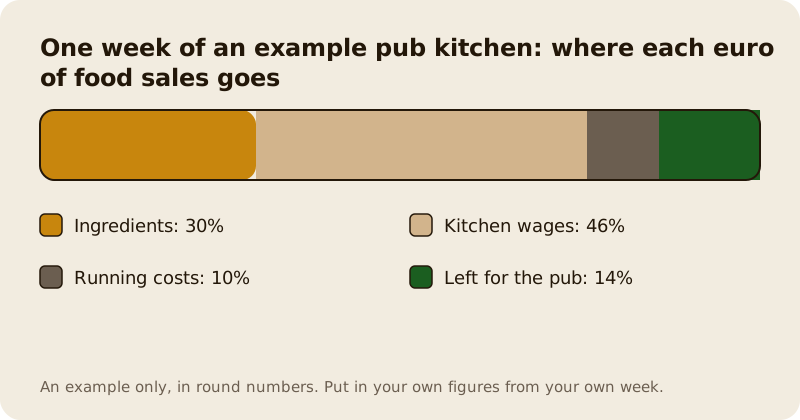
Here is an example, in round numbers, so you can see the shape. It is not a benchmark: your week will differ.
| Example week | Euro | Share of food sales |
|---|---|---|
| Food sales, excluding VAT | 5,000 | 100% |
| Ingredients | 1,500 | 30% |
| Gross profit on food | 3,500 | 70% |
| Kitchen wages | 2,300 | 46% |
| Kitchen running costs | 500 | 10% |
| Left for the pub | 700 | 14% |
In this example the kitchen earns a modest amount on food alone, and the people it feeds are also at the bar. Change one number and the story changes. If wages rise by a few hundred euro because the kitchen is open on slow nights, the 700 vanishes.
The food cost and gross profit guide shows how to cost a dish properly, including the trim and the garnish nobody counts. Do that for your five biggest sellers before you change anything else.
What should a pub menu look like?
Short enough that the kitchen can do every dish well on a Friday with two people on. A pub kitchen is rarely a restaurant kitchen: it works with a small team, a compact pass and one fryer that everything seems to go through.
A few rules hold up on many pub menus:
- Use the same ingredients more than once. A stew, a pie and a sandwich that share a braise cut waste and prep time.
- Cook in batches you can sell. A pot of soup, a roast and a stew hold well between orders. A dish that has to be cooked from raw to order takes a whole station.
- Put a pub classic where the eye lands. Guests come for what they know. A dish you can make quickly at a margin you have checked is worth more than a long list.
- Mark every allergen you declare, and every drink. The allergen guide covers what you must tell guests. Never describe a dish as allergen free.
When the menu has settled, rank each dish by how often it sells and how much it leaves. The menu engineering guide gives you four groups and a next step for each. Drop the dishes that sell rarely and leave little. The kitchen gets easier and the average margin rises.
Which services earn the most for a pub kitchen?
Many pubs have a few services that carry the food side, and a few that cost more than they bring. Find which are which from a month of till and booking data, then spend your effort on the ones that pay.
| Service | What usually fills it | What helps |
|---|---|---|
| Weekday lunch | Regulars and local workers | A short, quick menu and a fast pass |
| Early evening food | After-work and family trade | A food-only offer in the early hours |
| Sunday lunch | Families and groups | Bookings for the big tables, a queue for the door |
| Match day | People who came to watch | A simple menu and food served before the match starts |
| Functions | Funerals, communions, birthdays | A quote, a deposit and a prep sheet |
For the big fixtures, the match-day guide covers bookings, menus and staffing for a full room.
Check the services you assumed were dead. A weekday lunch with a loyal local crowd can out-earn a late kitchen that runs for three customers.
Mosey's walk-in queue is free on every plan and works without bookings. A guest scans the code on the door, joins from their phone and you call the next party that fits. It suits a Sunday when the booked tables sit empty while a crowd waits.
How do you fill the quiet hours with food, not cheaper drink?
Discount the food, not the drink. The reason is partly commercial and partly legal.
On the commercial side, a cheap pint draws drinkers, not diners. A food offer in a quiet hour draws people who order a plate, a soft drink and a dessert. On the legal side, regulations limit alcohol price offers.
The Public Health (Alcohol) Act 2018 regulations (S.I. No. 4 of 2020) set three limits that matter to a pub with a food menu:
- Regulation 4 says a person shall not sell or supply an alcohol product at a reduced price or free of charge to any person on the purchase of one or more other alcohol products, or any other product or service.
- Regulation 3 says bonus points, loyalty card points or any similar benefit count as a reduced price when they are earned by buying alcohol, or used to get alcohol cheaper or free.
- Regulation 5 says alcohol shall not be sold for a period of three days or less at a price below the one charged the day before. Regulation 6 says a person shall not advertise or promote the sale or supply of alcohol in a manner specified in regulation 4 or 5.
Ask your solicitor how these apply to your offer before you print a flyer. A food offer keeps the drink out of it: a plate and a soft drink at a set price, an early menu, a midweek lunch deal, with drink at its normal price.
Mosey has its own check. A Deal Hour in Ireland takes money off the food on a bill and leaves any line you have marked as alcohol at its menu price, so mark every drink in your menu. The deal hours guide and the Deal Hours page show how to set a window for a quiet afternoon.
How do you handle a Sunday lunch or a function without losing your head?
With a deposit, a quote and a plan for each. These are the days a pub kitchen can earn most, and the days a no-show or a vague headcount costs most.
Sunday lunch. Book the large tables and keep the rest for the door. Guests book from the app or a link. The paid Starter reservations plan at €79.99 a month (see pricing) adds booking deposits and the waitlist, so a party of ten that does not arrive no longer leaves a hole you cooked for. See table bookings with deposits.
The back room. A communion, a christening, a retirement or a 21st is a room, a menu and a headcount. On Mosey, a customer sends a request, you quote a package per head or a flat hire fee, they accept or counter, and a deposit holds the date. A link collects each guest's dietary needs into a total for the kitchen. Mosey takes 4.5% of the deposit, plus VAT on Mosey's fee, and the quote, calendar and prep sheet are free. The private hire guide and the Gatherings page cover the set-up.
Food for a funeral or a house. A funeral tea for a large crowd is catering, not table service. Mosey's catering requests let you quote from your own pricing rules, take a deposit and then the balance. Mosey takes 3% of a catering job, and the customer pays a catering booking fee.
Your solicitor and your licence decide what drink you can serve at a function. Mosey sells the booking and the deposit, not the drink.
How do you keep staff costs from eating the kitchen?
Staff hours are the largest line in the example above, so they are where the most money is won or lost. Three habits help.
First, plan hours against sales, not against habit. If Tuesday dinner takes little, a chef on a full shift is the first cost to question. The guide to planning staff hours around sales walks through it.
Second, cross-train. A bar person who can plate a sandwich and a kitchen porter who can cover the pass make a thin team resilient on a Sunday.
Third, stop waste before it becomes cost. Every dish that goes in the bin was paid for in wages, gas and ingredients. The food waste guide covers measuring it and selling what would be thrown out.
Check pay against the current rules for your staff: the minimum wage guide sets out what applies.
How do you turn a food customer into a regular?
Give them a reason to come back that is not a cheaper drink. A pub already has regulars. The aim is to have them eat as well.
- Reply to what people write. A guest who rates a dish on Mosey and gets a reply from the owner sees a real person behind the pass. Replying is free.
- Offer food-led membership. A mug club or wine club can carry a reserved table, no booking deposit, a members' night or a food perk. The mug club guide shows what to put in it. In Ireland, Mosey keeps member discounts, loyalty rewards and promotions off items you mark as alcohol. Mosey takes 8% of membership payments. See memberships.
- Let people order the roast to take home. Sunday dinner for collection fills the kitchen on a day the dining room is already full. Mosey takes 1.5% commission on a collection order, plus VAT on Mosey's fee, and the guest pays a small booking fee. The money goes to your own Stripe account. See Order Ahead.
- Sell a ticket to a supper night. A quiz night with a meal, or a ticketed tasting night, sells out ahead. Mosey takes 4% of the ticket price, and the guest pays a booking fee. See event tickets.
Loyalty cards are free on every plan, and in Ireland a reward can be a food or soft drink item, not a drink.
How does Mosey fit a pub that does food?
Mosey does not run your kitchen or your bar. It fills the tables and days that make the kitchen pay.
- A menu page led by the food. Guests on Mosey find a pub by the dish, rate what they ate and see the allergens you declare. They find you for the plate, not the pint.
- The queue and the bookings. A free walk-in queue for the door, and bookings with deposits for the days that matter.
- Deal Hours and promotions that leave drink alone. A quiet-hour food offer, with alcohol lines at menu price.
- Memberships, vouchers and loyalty. Gift vouchers sold up front, a food-led club and free loyalty stamps.
For the software side, with the round and the roast on one bill, read software for pubs that serve food. For the pricing of each tool, see pricing.
What should you do this month?
Work down this list in order. Each step costs little and tells you something.
- Pick one ordinary week and fill in the four numbers in the example table.
- Cost your five best sellers and check each against its menu price.
- Rank every dish by sales and gross profit, and cut the weakest.
- Mark every drink in your menu as alcohol and every allergen you declare.
- Choose one quiet hour and give it a food-only offer.
- Set up bookings or the queue for your busiest service.
- Put your next function, supper or Sunday on a quote, a deposit and a prep sheet.
- Repeat step one in a month and compare.
If the week's numbers say the kitchen earns, Host on Mosey free, add your menu and open the queue or bookings for your next Sunday. Every other guide for Irish food businesses is on the business guides page.
This guide is general information, not legal, tax or financial advice. Rules change and depend on your business and where it is, so check the current rule with the official body named in the guide and take advice from a solicitor or accountant in your area before you act.
Questions
Common questions
Is it worth serving food in a pub in Ireland?
It is worth it when the gross profit on food covers the kitchen's wages and running costs, and when diners add bar sales you can measure. Count one ordinary week before you decide. A short menu, a Sunday you fill and a back room you quote for are the usual ways a pub kitchen earns.
How do I work out whether my pub kitchen makes money?
Take one ordinary week and write down food sales excluding VAT, the cost of ingredients, kitchen wages and the running costs of the kitchen. Subtract the last three from sales. Keep the bar's takings separate, so a kitchen that loses money does not hide behind drink sales.
Can I give a free pint with a meal?
Keep the offer on the food. Regulation 4 of S.I. No. 4 of 2020 says a person shall not sell or supply an alcohol product at a reduced price or free of charge on the purchase of any other product or service. Offer a food deal with drink at its normal price, and ask your solicitor to check your offer.
Can I run a drinks happy hour in my pub?
Regulation 5 of S.I. No. 4 of 2020 bars selling alcohol for three days or less below the price charged the day before, and regulation 6 bars advertising an offer of that kind. Ask your solicitor before you plan any drinks offer. A food offer in a quiet hour, with drink at its normal price, keeps the drink out of it.
How do I fill a pub's quiet afternoons with food?
Offer a food-only deal in a set window, such as an early plate and a soft drink, and tell your regulars. On Mosey, a Deal Hour takes money off the food on a bill and leaves lines marked as alcohol at menu price in Ireland. Check the results after a month.
How do I handle Sunday lunch bookings and no-shows?
Take bookings for the large tables, keep the rest for the door, and ask for a deposit on big parties. On Mosey the walk-in queue is free on every plan. The paid Starter reservations plan at €79.99 a month adds booking deposits and the waitlist.
Can I do this on Mosey?
Yes. A pub that serves food can host a menu page, run the free walk-in queue, take bookings and deposits, quote functions and catering, sell Order Ahead for collection, sell event tickets and gift vouchers, and run a food-led membership. Fees are on the [pricing page](/pricing/).
Will Mosey discount drinks for my members?
No. In Ireland, Mosey keeps member discounts, loyalty rewards and promotions off any item you mark as alcohol, and refuses a free-item perk that is a drink. Mark every drink in your menu. A club built on food, tables and events suits a pub.
More like this
Read next
A hotel restaurant that locals use too
A hotel dining room earns local trade when it acts like a restaurant of its own. Here is why locals stay away, how to set the dining room up on Mosey beside your hotel, and which offers fill it.
An alcohol-free drinks menu that still makes margin
More guests are drinking less, in January and the rest of the year. Here is how to cost, price, name and sell an alcohol-free menu so it earns as well as the wine list, with the Irish VAT and offer rules checked.
Auto-enrolment pension for Irish restaurants and cafés: what you pay and do
Since 1 January 2026 an Irish employer matches the pension contribution of each eligible employee. Here is who counts, what it costs on a wage bill, the payroll steps and what staff can opt out of.
Buying an existing café or restaurant in Ireland: what to check
Buying a café or restaurant means buying its debts, staff and paperwork as well as its regulars. Here is what to check at the CRO, Revenue, the council and the HSE, and what the staff transfer rules mean.
Get started
Host your business on Mosey. It is free to claim.
Free to list, no set-up fee, and Order Ahead is 1.5% commission when you start taking orders.