
For businesses
How to cost a recipe for a restaurant menu
Mosey · 15 November 2026 · 7 min read
To cost a recipe, write down every ingredient on the plate with the amount used, price each one from your latest invoice after trim and waste, add them up, and divide by the portions the recipe makes. That plate cost, set against the price before VAT, gives the food cost of the dish and tells you whether the price on the menu still works.
Why does a dish that sells well still lose money?
Plenty of small kitchens price a dish once, when it goes on the menu, and never again. The butter went up, the supplier changed the pack size, the chef added a garnish guests love. The dish still sells and the room still looks busy, but every plate now leaves less than it did, and the best seller is quietly the worst earner.
A costed recipe is the only way to see it. The food cost guide explains what food cost and gross profit mean; this page is the worked sheet.
How do you cost a dish ingredient by ingredient?
Work from a written recipe, for one portion or one batch. For each line, write four things: the ingredient, the amount used, the price you pay per unit, and the cost of the amount used.
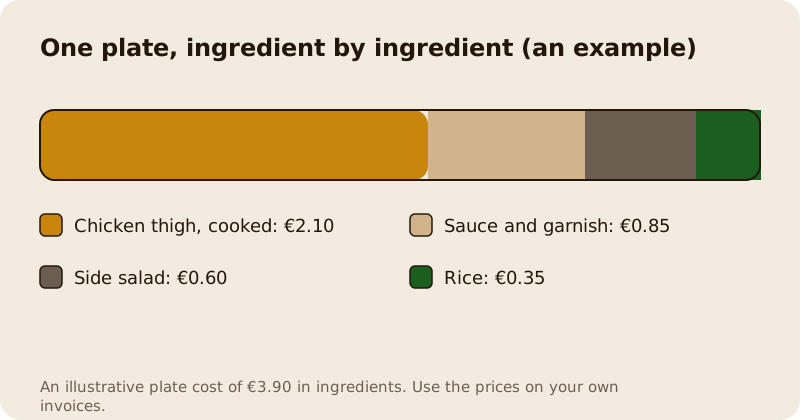
Take an illustrative chicken dish. Say the cooked chicken thigh on the plate costs €2.10, the sauce and garnish €0.85, the side salad €0.60 and the rice €0.35. The plate costs €3.90 in ingredients. These are example figures; use your own invoices.
Price from the latest invoice, not last year's price list, and convert every unit to the one the recipe uses. If you buy oil by the 20-litre drum and use 30 millilitres a plate, cost 30 millilitres.
Do not forget the small things: the oil in the pan, the butter on the bread, the salt, the lemon wedge, the sauce in the ramekin. Each is tiny, and together they add up. Put a line for seasoning and sundries on every sheet rather than leave them out.
Keep the costing sheet beside the recipe card in the kitchen, so the cook who plates the dish knows what it costs. A cook who knows the garnish costs more than the potato on the plate treats it differently.
What do you do about yield and trim?
You pay for the whole fish, the whole onion, the whole leg of lamb. You serve less. The difference is yield, and leaving it out is the most common mistake in a recipe cost.
Measure it once. Say you buy a five-kilogram side of salmon and, after skinning, trimming and portioning, you have three and a half kilograms of portions. Your yield is seventy in every hundred, so the real cost of a kilogram of portioned salmon is the invoice price per kilogram divided by 0.7. Do the same for each ingredient where trim matters: meat, fish, whole vegetables, herbs. Cooking loss counts too: a joint that loses weight in the oven costs more per cooked portion than per raw kilogram.
Use what you trim. Salmon trim becomes fishcakes and onion ends become stock, and every use you find lowers the real cost of the first dish. The food waste guide has more.
How do you cost a batch recipe like a sauce or a cake?
Cost the whole batch, then divide. A pot of tomato sauce or a tray of brownies is costed exactly like a plate: every ingredient, its amount and its cost, added up. Then count what the batch really gives you, not what the recipe says it should. If the recipe says twelve slices and the kitchen cuts ten, the cost per slice is the batch cost divided by ten.
Once a batch is costed, it becomes one line on the dishes that use it: the sauce on the pasta, the brownie on the dessert plate. Re-cost the batch and every dish that uses it updates with it, which is why a spreadsheet with one tab for batches and one for dishes saves time.
How do you turn a plate cost into a menu price?
Pick a target food cost for the dish: the share of the price before VAT that you want the ingredients to take. Write the target on the costing sheet, so whoever reprices the dish next uses the same one. Divide the plate cost by that share to get the price before VAT, then add VAT at the rate that applies and round to a price that reads well.
With the illustrative €3.90 plate and a target of thirty in every hundred, the price before VAT is €13.00. Add VAT, round up, and check the real food cost at the rounded price. The menu price calculator does those steps for you and shows the gross profit each plate leaves. The VAT guide covers which rate applies to what. Then check the price against the room: a dish costed perfectly at a price nobody nearby would pay needs a different recipe, not a braver menu.
Not every dish needs the same target. A side that costs little can carry a lower food cost; a premium steak may run higher and still leave more cash per plate. The menu engineering guide shows how to balance the menu as a whole.
How often should you re-cost a menu?
Re-cost a dish whenever one of its main ingredients changes price noticeably, whenever the recipe or the portion changes, and whenever a supplier changes a pack size. Re-cost the whole menu at each menu change, and at a set point in the year even if nothing seems to have moved.
Make it a routine, not a crisis. Keep each sheet in one folder or spreadsheet with the date and the invoice price used, so updating one takes minutes. When a price on an invoice jumps, look up which sheets use that ingredient and re-cost those first. Read every invoice line against the last one before you file it, too: a price that crept up on a delivery docket is the one nobody re-costs.
Then check the sheets against reality. A costed recipe says what a plate should cost. A stock take says what the kitchen actually used. If the two drift apart, portions have grown or waste has crept in; the stock take guide shows how to find which.
What should you do when a dish no longer pays?
You have four honest choices: raise the price, change the recipe, change the portion, or take the dish off. Raising the price is often right, and the guide to raising prices without losing regulars shows how. Changing the recipe works if the swap does not change what guests come for. A smaller portion is fair if the old one was more than people finished.
Keeping a dish that loses money can still make sense if it brings in people who order other things. Decide that on purpose, with the numbers, not by default.
Talk to the chef before you decide. The person who cooks the dish often knows a cheaper cut, a better supplier or a garnish nobody eats, and the dish can keep its price without losing what makes it good.
How does Mosey help you price with confidence?
Mosey is Irish-built and Irish-run, and the menu price calculator on our site is free to use: put in the plate cost, your target food cost and the VAT rate, and it gives the price before VAT, the menu price rounded up to the next 50 cent, the gross profit per plate and the real food cost at that price.
When the price is right, put it on your menu in Menu Builder, where each dish carries its price and VAT rate, and the same menu runs your online ordering and your page in the app. If a VAT rate changes, Mosey proposes the change and you choose whether to keep the shelf price or what you earn. For what Mosey itself charges, see pricing.
Where should you start?
Cost your three best sellers this week, from today's invoices, with yield measured. If one is under water, fix it before the weekend. When you want your menu, prices and ordering in one login, Host on Mosey free and build your menu.
More in the guides for food businesses.
This guide is general information, not legal, tax or financial advice. Rules change and depend on your business and where it is, so check the current rule with the official body named in the guide and take advice from a solicitor or accountant in your area before you act.
Questions
Common questions
How do you calculate the cost of a recipe?
List every ingredient with the amount used, price each from your latest invoice after trim and cooking loss, add the lines up, then divide by the number of portions the recipe really gives. That is the plate cost.
What is yield in recipe costing?
Yield is how much usable food you get from what you buy, after skinning, trimming, portioning and cooking. Divide the price per kilogram you paid by the yield to get the real cost of a kilogram you can serve.
How do I turn a plate cost into a menu price?
Divide the plate cost by your target food cost to get the price before VAT, add VAT at the rate that applies, round to a price that reads well, then check the real food cost at the rounded price.
How often should I re-cost my menu?
Re-cost a dish when a main ingredient changes price, when the recipe, portion or pack size changes, and the whole menu at each menu change and at a set point every year, even if nothing seems to have moved.
Is there a free menu price calculator?
Yes. The menu price calculator on the Mosey site is free to use. Enter the plate cost, your target food cost and the VAT rate to see the price before VAT, a rounded menu price and the gross profit per plate.
More like this
Read next
A hotel restaurant that locals use too
A hotel dining room earns local trade when it acts like a restaurant of its own. Here is why locals stay away, how to set the dining room up on Mosey beside your hotel, and which offers fill it.
An alcohol-free drinks menu that still makes margin
More guests are drinking less, in January and the rest of the year. Here is how to cost, price, name and sell an alcohol-free menu so it earns as well as the wine list, with the Irish VAT and offer rules checked.
A pub that does food: making the kitchen pay
A pub kitchen pays when its gross profit covers its own wages and running costs. Here is how to count it, which services to fill, what the alcohol rules say and how Mosey fits.
Auto-enrolment pension for Irish restaurants and cafés: what you pay and do
Since 1 January 2026 an Irish employer matches the pension contribution of each eligible employee. Here is who counts, what it costs on a wage bill, the payroll steps and what staff can opt out of.
Get started
Host your business on Mosey. It is free to claim.
Free to list, no set-up fee, and Order Ahead is 1.5% commission when you start taking orders.