
For businesses
Full in July, empty in November: fixing the tourist-season cliff
Mosey · 15 November 2026 · 12 min read

Your restaurant or café goes quiet in the quiet season because summer trade comes from visitors who leave, while your rent, wages and insurance stay the same. The cliff is not a verdict on your food. Fix it by finding which weeks fall furthest, then filling them with locals: regulars, workers, families and groups who book a reason, not a table.
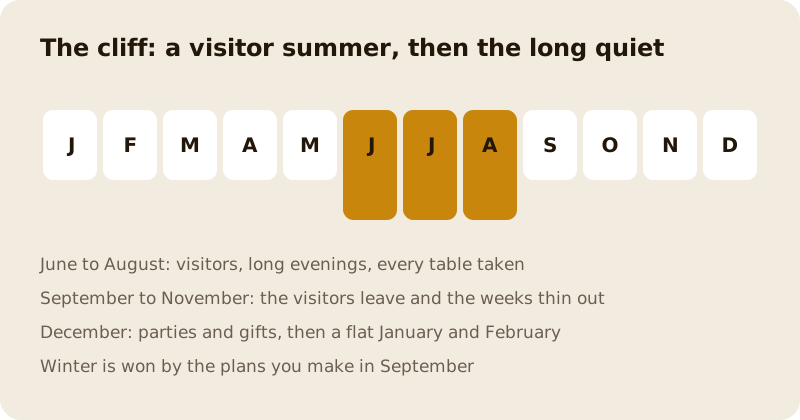
Why does a restaurant or café go quiet when the tourists leave?
July is the month you build the year on, and November is the month you pay for it. The visitors who filled every table go home. Your costs do not follow them. The lease, the energy bill, the insurance and most of your payroll are the same in a dead week as in a full one.
Summer also hides a second problem. When every table is taken, locals get turned away: the couple who wanted a Friday, the regular who could not get a seat at the counter. Some find somewhere else, and by October you are quiet and your own neighbours have got out of the habit.
Staff feel it too. Hours shrink, good people look for steadier work, and the team you rebuild next spring is a smaller one.
None of this means you cooked badly or priced wrongly. Your business is tuned for one crowd, and the crowd moves on. The job is to build a second crowd, the people who live and work within reach of your door, and give each a reason to come on a Tuesday.
How deep is your own cliff, and which weeks hurt most?
Find out what the cliff looks like for you before you change anything. The bad weeks are often fewer, or a different part of the week, than memory says, and a discount aimed at the wrong window costs margin when you were busy anyway.
Do this in an hour:
- Pull last year's sales by week, from the first week of June to the end of February.
- Mark the three weakest weeks and the three weakest days of the week. Many businesses find the drop is Monday to Wednesday and the weekend holds.
- Split each day into lunch, the gap, early evening and late evening. The empty slot is usually narrower than the whole day.
Mosey's analytics show your sales by weekday and hour, and your bookings by hour, so the quiet windows come from your own trade, not a guess, and the analytics guide shows how to read them. Then put the thin weeks into a 13-week cash forecast. The cash flow guide builds one, and it tells you how many empty weeks you can carry before you must act.
Which locals can fill the quiet months?
Summer visitors are one crowd. Winter needs several smaller ones, and each wants something different from your restaurant or café. Write down who lives or works within a short walk or drive, then match them to a slot.
- Regulars. The people who already know you. They need a reason to come one more time a week.
- Workers nearby. Offices, shops, a school, a hospital, a depot, a college. They need a fast, fair lunch or a coffee that is ready when they are.
- Families. They need an early sitting, a children's menu and a table that does not feel like a favour. Mid-term breaks and school holidays fall in the quiet months, so they are a winter crowd.
- Retired and flexible diners. They can come on a Tuesday afternoon when the room is empty, if you give them a price and a quiet table.
- Clubs and groups. A walking group, a book club, a sports club, a choir, a work team. One organiser brings eight people, and a group is the quickest way to fill a Wednesday.
- Neighbouring businesses. The people who work beside you eat out too, and they pass your name on.
Pick two crowds, not all six. A café on a high street might choose workers and retired diners. A seaside restaurant might choose families and groups. For each, ask what would make a Tuesday easy, and build one offer.
How do you win back the locals you turned away in summer?
Start with the cheapest job: be visible to the people who already know you. Locals rating your dishes in November is the evidence a visitor reads in June, so it pays twice.
On Mosey, claiming your page is free, diners rate individual dishes and you can reply to every rating in your own name. Ask your regulars to rate the dish they love, by name, while the meal is fresh. The Reviews page lets you ask your recent customers for a rating once a week with one button, and you see how many were asked, never who. See why great reviews don't fill tables on their own for what happens between a good rating and a booking.
Tell the people who follow you. When something worth announcing arrives, such as a winter menu or a new midweek deal, Mosey Boost sends a notification to your followers and members who agreed to hear from you, and to nearby customers who agreed to nearby offers. You see how many people each group reaches and the exact price before you pay, and only people who said yes are reached. Nobody can pay for Gold or a higher position on a town list, so the money buys an announcement, never a ranking.
Then give regulars a reason to return. Loyalty is free to run on every plan, with no commission on the spend it rewards. You can reward spend or visits, and for most cafés visits are the better fit, because the habit is the whole business. A visit is counted when a customer pays through Mosey, with no card to stamp, and a reward with a lifetime reminds the customer a few days before it ends. Make the first reward easy to reach. The loyalty programme guide has the steps.
How do Deal Hours fill the empty hours?
A Deal Hour is a pricing rule with a window. You set a percentage or a fixed amount, the items it applies to, the days and hours it runs and the channels: in your restaurant or café, for collection, for delivery, or any mix. Inside the window the menu costs less. Outside it, nothing has changed. There is no code to give out and nothing for a customer to remember.
That makes it the sharpest tool for the cliff, because the cliff has a shape. If your Tuesday dies between three and five, put a price on exactly that window.
A few rules that keep it profitable:
- Choose items, not the whole menu. A blanket discount cuts the price of dishes that were selling anyway. Offer the margin-rich dish, or the one that uses food you have already prepped.
- Match the channel to the problem. A quiet dining room and a busy collection queue are different problems. A deal that fixes one and eats the margin on the other is worse than none.
- Set the real window, not a rounder one, using your own numbers.
- Keep it under the ceiling. A restaurant or café can run ten active rules, and past that nobody on your team can say what anything costs on a Wednesday.
For a table-booking business, an Early Bird offer does the same job on the first sitting. It attaches a perk to a quiet booking slot, shows it on the slot at the moment the diner picks a time, and is honoured at the table. The wording is copied onto the booking, so your floor team sees what was promised, even if you change the offer later. Choose a specific thing, such as a glass on arrival or a dessert, before you reach for a percentage off the bill. See the Deal Hours guide and the Early Bird guide.
How do memberships carry the winter?
A membership turns a one-off visit into a monthly habit, and money that arrives every month does not care what the weather is doing. It suits the cliff because the members you sign in September are paying through January.
Mosey's plan editor starts you from six templates, each a pre-filled form you can change before you save:
- Mug club, a small monthly fee for a mug of their own and money off visits, up to a few times a month. Suits cafés and pubs with regulars.
- Coffee pass, a set number of free coffees a month for one price.
- Supper club, priority tables, a free event ticket each month and a birthday treat.
- Founding member, a limited run at a launch price.
- Credit pass, where the member pays a set amount and receives that amount plus a bonus as credit.
- Family plan, one membership for up to four people, with the price rising a little for each person added.
The discipline is the cap. The member who loves you most uses a perk the most, so every perk needs a quota, a cap per visit or a ticket-price cap. The editor runs a margin check on your own prices and warns you before you save a plan that could lose money. Read the membership pricing guide before you set a price.
A founding run suits the autumn well. You choose the number of seats and the launch price, open a waiting list, and schedule the opening. The people on the list are told once when it opens, and the page counts the seats left. A founding run gives your best regulars a reason to act now, and it caps your risk, because you choose how many seats there are. The founding membership guide has the set-up, and a join link lets members sign up and cancel online. When a member pays, Mosey takes 8% of the subscription.
How do events and gift vouchers give people a reason to book ahead?
A quiet Wednesday has no story. A supplier dinner, a tasting, a cooking class or a quiz night has a date and a number of seats, so a local has something for the diary and you have a known head count.
On Mosey, event tickets carry 4% of the ticket price, with a waitlist and check-in at the door. Cost the evening line by line first and find the number of tickets at which you break even. The ticketed event guide walks through it, and selling event tickets covers the set-up.
Two events earn their place in the winter diary. The first is the Christmas party season, which starts in November. Group bookings with split deposits let one person organise a table for a work team while everyone pays their own share, and taking deposits comes with the Starter bookings plan at €79.99 a month. The second is a quiet-month night for your regulars, such as a members' supper, which they will bring a friend to.
Gift vouchers move cash forward. Mosey takes 4.5% of a voucher's value when one is sold, whether it is sold in the app, on the website or at your counter, and the money goes to your own Stripe account. Sold in November and December, a voucher is a reason to return in January, when the room is quietest. A company that buys vouchers for staff or clients is a bulk sale in the middle of the cliff, and the guide to selling vouchers to local companies covers it.
How do you keep your team through the quiet months?
A thin rota loses people, and rehiring in spring costs more than keeping them in winter. Tell your team the plan before the hours drop.
Use quiet shifts for the work that never gets done in July: training, deep cleaning, menu testing, photographing dishes and the paperwork. If hours must fall, spread the cut fairly and tell people early. The guide to keeping good staff through the quiet season goes through the options, and the seasonal calendar guide shows how the Irish year falls so you can roster around it.
If you run with neighbours, a shared plan costs less than a solo one. A food trail is a route between several of you, with a stamp at each stop, and it gets its own page on the Mosey website. A trail weekend in a quiet month gives a local, or a visitor who stays on, a reason to walk your street. Start with the food trail guide.
What should you plan in September?
September is the last month the summer is still paying for the plan. Do these in order, and write each one in your diary with a date:
- Week one: pull last year's weekly sales and mark the weakest weeks, as above.
- Week one: choose two local crowds and one offer for each.
- Week two: set up two Deal Hours on your weakest windows, and an Early Bird offer if you take bookings.
- Week two: draft your membership, run the margin check and decide whether to open with a founding run.
- Week three: put your Christmas party menu, group terms and vouchers on sale, and choose the dates of one winter event.
- Week three: tell your team the plan and the hours.
- Week four: ask your regulars to rate their favourite dish, reply to every rating and send your first Boost.
- Every Monday after: look at the week against last year, and change one thing at a time.
Change one thing, wait a fortnight and look at what moved. Offers that work stay on; the rest come off.
If you only do one thing this week, open your sales for the last quiet month, find the one window with the fewest tables and put a Deal Hour on it tonight. Then ask the next ten regulars through the door to rate the dish they ordered, by name.
To have the tools for the cliff in one login, Host on Mosey free and claim your page. The pricing page lists every rate, and the guides for food businesses carry the rest of the plan. For the visitors who do come, read why visitors walk past your restaurant and how to reach them.
This guide is general information, not legal, tax or financial advice. Rules change and depend on your business and where it is, so check the current rule with the official body named in the guide and take advice from a solicitor or accountant in your area before you act.
Questions
Common questions
Why is my restaurant quiet in November?
Summer trade comes from visitors who leave, while your costs stay put, so the drop feels sharp. Check last year's weekly sales to see which weeks and which days fall furthest, then fill them with locals. On Mosey, analytics show your sales by weekday and hour so you can aim an offer at the quiet ones.
How can a restaurant get more customers in the quiet season?
Build a second crowd from local regulars, workers, families and groups, and give each an easy reason to come midweek. Deal Hours, early sittings, a membership, a ticketed night and gift vouchers each fill a different gap. Mosey puts all of them in one login.
What are Deal Hours on Mosey?
A Deal Hour is a discount with a window: a percentage or fixed amount on items you choose, on days and hours you choose, in your restaurant, for collection or for delivery. It switches on and off by itself, and a restaurant or café can run up to ten at a time.
Do memberships work for a restaurant or café?
They can, when every perk has a cap and the worst case still leaves you a margin. Mosey starts you from six templates, including a coffee pass and a supper club, and its margin check warns you before you save a plan that could lose money. Mosey takes a share of each subscription payment.
Can I fill quiet nights with events?
Yes, if you cost the night first. A supper club, tasting or quiz gives locals a date and gives you a known head count. On Mosey, event tickets carry a waitlist and check-in at the door, and the ticketed event guide helps you find your break-even.
How do I keep staff through the quiet months?
Tell them the plan before hours drop, use quiet shifts for training, deep cleaning and menu work, and cross-train so one person covers two jobs. If hours must fall, spread the cut fairly and give notice early. Rehiring in spring usually costs more than keeping good people in winter.
Are gift vouchers worth selling in winter?
They bring cash in early and bring people back in January. On Mosey, a voucher can be sold in the app, on the website or at your counter, and the money goes to your own Stripe account. Local companies buying vouchers for staff or clients are a useful bulk sale.
How do I let my regulars know about winter offers?
Reply to their ratings, ask them to rate dishes by name and announce offers where they will see them. On Mosey, a Boost notification reaches followers and members who agreed to hear from you, and you see the audience size and exact price before you pay.
More like this
Read next
A hotel restaurant that locals use too
A hotel dining room earns local trade when it acts like a restaurant of its own. Here is why locals stay away, how to set the dining room up on Mosey beside your hotel, and which offers fill it.
An alcohol-free drinks menu that still makes margin
More guests are drinking less, in January and the rest of the year. Here is how to cost, price, name and sell an alcohol-free menu so it earns as well as the wine list, with the Irish VAT and offer rules checked.
A pub that does food: making the kitchen pay
A pub kitchen pays when its gross profit covers its own wages and running costs. Here is how to count it, which services to fill, what the alcohol rules say and how Mosey fits.
Auto-enrolment pension for Irish restaurants and cafés: what you pay and do
Since 1 January 2026 an Irish employer matches the pension contribution of each eligible employee. Here is who counts, what it costs on a wage bill, the payroll steps and what staff can opt out of.
Get started
Host your business on Mosey. It is free to claim.
Free to list, no set-up fee, and Order Ahead is 1.5% commission when you start taking orders.