
For businesses
Price a venue membership so it pays: templates, caps and the margin check
Mosey · 23 October 2026 · 5 min read

A membership pays when the most a member can take in a month is comfortably less than what they pay you, and when the members who use it most are still customers you are glad to serve. Choose a shape that fits your trade, put a cap on every perk, and test the worst case before you save. Mosey's plan editor does the worst-case test for you, and warns you before you sell a plan that could lose money.
Which membership shape fits your business?
Mosey ships six starter templates. Each is only a pre-filled form: you can change every field before you save.
- Mug club. A small monthly fee for a mug of their own and money off their visits, up to a few times a month. Suits pubs, cafes and taprooms with regulars.
- Coffee pass. A set number of free coffees a month for one price. The cap is the whole point, so it is already set. Suits coffee shops and bakeries.
- Supper club. Priority tables, no booking deposit, a free event ticket each month and a birthday treat. Suits places that fill up and run events.
- Founding member. A limited run at a launch price, with the seats counted down on your page.
- Credit pass. A member pays a set amount and receives that amount plus a bonus as credit to spend.
- Family plan. One price for a household, with the total set for one, two, three or more people.
Pick the template nearest to your trade and change it. The example prices are only examples in your own currency; set your own.
Why does every perk need a cap?
Because the member who loves you most will use a perk the most. A free coffee a day sounds friendly until one regular takes thirty of them. A cap makes the worst case a number you know in advance. The editor offers three kinds:
- A quota: at most eight uses a month, or one a visit.
- A cap per visit: a percentage off, up to a fixed amount each time.
- A ticket-price cap: a free event place up to a stated ticket price.
Write the caps in the plan's terms in plain words, so the member and your staff read the same sentence.
What does the margin check tell you?
While you edit, the plan editor shows what a member could redeem in a month against what they pay. It uses a deliberately pessimistic model: a member visits 20 times a month, goods cost 40% of the menu price, discounts are taken at full value, a family plan multiplies by the household, and a credit pass costs only its bonus. It then says one of three things: fine, watch it, or over. If it says over, it suggests a cap that brings the plan back to fine, and you can apply it with one tap.
Two points matter. The check is a warning, never a block: you can save any plan, because you know your trade better than a model. And the figure is an estimate built on the model's assumptions, not on your accounts, so treat it as a smoke alarm and not a forecast.
How should you price the terms?
Plans can be sold monthly, quarterly or yearly. The editor suggests a yearly price of ten months and a quarterly price of three months less 5%, but you set the prices, and they must not exceed the cost of the same months paid monthly. A price you have set is then fixed for that term, so decide with care; you can add a term later. Longer terms bring cash forward, and a member on a yearly plan is far less likely to drift away.
Decide at creation whether a prepaid term is refundable. The two options are none (the term runs out) or a pro rata refund of the whole unused months. Choose now, because it cannot be changed for a term already sold, and say it in the terms.
What does a worked example look like?
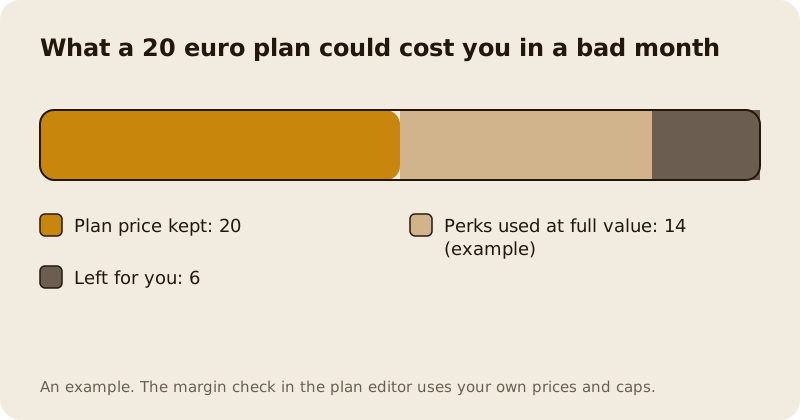
A coffee shop sells a Coffee Pass at 20 euro a month: eight free drinks, one a visit. A drink costs the shop 0.90 to make and sells at 3.50. If a member takes all eight, the menu value is 28 euro and the real cost is about 7.20. Mosey takes 8% of the 20 paid. The margin check sees 28 euro redeemable against a 20 euro price and flags the plan as over, because it counts free items at menu price. Counting at cost, the shop keeps well over half the fee even in the worst month, and members who visit and buy a pastry with the drink add margin on top. That is the judgment only you can make, which is why the check warns and does not block.
The same shop then tests a cheaper plan: five drinks a month at 14 euro. Fewer drinks, a lower ceiling, a smaller promise. Run both through the editor and pick the one you would be happy to see a hundred people take.
How do you test it before you sell it?
- Take the plan price and subtract Mosey's 8% commission.
- Add up the most a member can redeem in a month under your caps.
- Multiply by your real food cost for free items, not the menu price.
- Compare the result with what the member pays.
- Ask whether the member who gets the most out of it is still a customer you want.
Then run a small first group, such as your thirty best regulars, for a month. Mosey takes 8% of what members pay, with no set-up fee and nothing to pay if nobody joins.
Where do you go next?
Once the plan is priced, plan how you will launch it: the founding member guide covers a limited run with a waiting list. Learn how to keep members with letters in the member letters guide, and read the overview of running a venue membership. The pricing page lists every rate in one place.
Questions
Common questions
What is a good price for a cafe membership?
There is no single price. Work backwards from the most a member can redeem under your caps, add your real cost of goods, and set a price that leaves a margin on that worst case. The plan editor shows the check as you type.
Does the margin check stop me saving a plan that loses money?
No. It warns you with a level of fine, watch or over, suggests a cap, and lets you save anyway. It is built on a cautious model, not on your accounts, so treat it as a warning.
Can I change a plan's price after members have joined?
Prices set for a term are fixed, though you can add a new term later and stop selling one. A price rise needs the member's fresh consent in some markets, so plan the first price carefully.
How much commission does Mosey take on memberships?
Mosey takes the commission shown on the pricing page from what members pay. There is no platform fee, and nothing to pay if nobody joins.
Should a prepaid annual term be refundable?
You choose either no refund after the cooling-off period, or a pro rata refund of the whole unused months. Pick one when you create the plan, state it in the terms, and apply it the same way every time.
More like this
Read next
How to run a supper club or tasting night that sells out
A supper club is a fixed menu, a fixed number of seats and a fixed night, sold as tickets paid in advance. Here is how to cost it, sell it and make it a habit.
How to add catering to your restaurant or café
Office lunches, platters and parties, quoted properly, with a deposit up front, the balance before the day and a prep sheet for the kitchen.
How to make a quiet Monday or Tuesday pay
First decide whether the quiet day should open at all. If it should, shrink it to the hours that trade and give it a reason to come that only exists on that day.
How to get more ratings and reviews for your restaurant, honestly
Ask, at the right moment, every customer, and make it easy. Never offer anything in return. A steady stream of honest ratings is worth more than any burst you could buy.
Get started
Claim your business free
Free to list, no set-up fee, and Order Ahead is 1.5% commission when you start taking orders.