
For businesses
Work out if a ticketed food event pays before you sell a ticket
Mosey · 23 October 2026 · 5 min read

A ticketed event pays when the tickets sold at your price cover every cost of the evening and leave a margin for the risk you took. Work backwards: add up the food, drink, staff, music, licences, decoration and fees, divide by the number of tickets you can sell well, and add your margin. If that number is a price guests will pay, the event pays. If it is not, change the event, not the sums.
Why do events lose money?
Because they are costed like a normal service and run like a special one. Typical leaks:
- Pricing from the menu. A five-course tasting is not five times a main. It needs more prep, more plates and a longer staff shift.
- Counting the tickets, not the costs. A sold-out room is a good sign and a poor measure.
- Forgetting the extras. Music licences, a performer, printing, flowers, a hired sound system.
- No cap. Selling to the fire limit and running a poor night.
- No cost for your own time. The owner's eight hours of prep are worth something.
How do you build the budget?
Download the event budget sheet (spreadsheet, CSV)
The sheet has an estimate column and an actual column, so you can compare after the night. Fill in:
- Ticket income: number of tickets times price.
- Food cost: from your recipe cost sheets. The food cost guide shows how.
- Drink cost: what you pour per head, at cost.
- Staff: hours, including prep and clear down, at full cost.
- Music or a speaker: the fee, plus the licence if you play or perform music. See the music licence guide.
- Decoration, printing and hire.
- Payment and platform fees. On Mosey, event tickets carry a commission shown on the pricing page; the money reaches your own Stripe account when each ticket is bought.
The sheet totals the cost and shows the profit or loss and the profit per guest.
How do you find break-even and set the price?
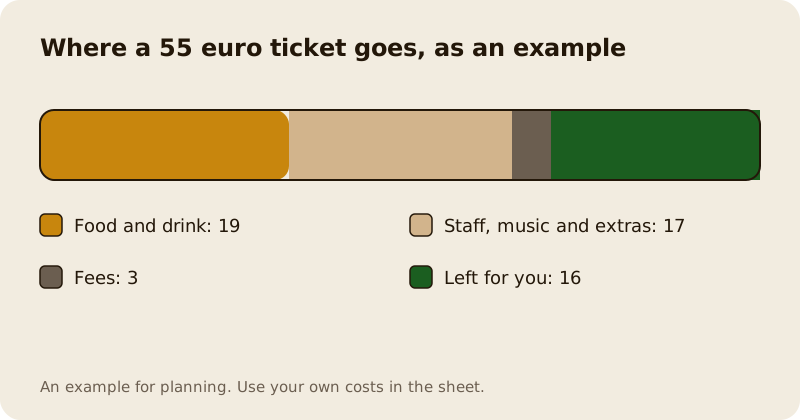
Divide the total cost by the number of tickets to find the cost per guest. Add the margin you want. An example: an evening for 30 guests costs 1,090 euro in food, drink, staff, a musician and fees. The cost per guest is about 36. At a ticket price of 55 euro, the margin is about 19 per guest, or about 560 for the night. Break-even is the number of tickets at which income equals cost: 1,090 divided by 55 is about 20 tickets. That is the number to watch. If you have not sold 20 a week out, change the plan.
Test the price against what a comparable night costs in your area and what your regulars spend. A ticket that includes a welcome drink and a printed menu feels fairer at the same price.
What does a first event look like in practice?
A wine bar plans a Thursday tasting for 30 guests: five wines, a cheese board and a talk from the importer. The wine costs 280, the food 240, the importer's fee 150, the staff 320 for four people across prep and service, printing and candles 40, and fees about 60. That is 1,090. The owner sets the ticket at 55, opens sales five weeks ahead with an early-bird price for the first 12, and tracks the count each Monday. By week three, 14 tickets are sold, above the break-even of 20 on pace. She posts a short reminder, writes to members, and by the Tuesday before the night it is sold out, with six on the waitlist. After the night, she enters the actuals: the wine ran 20 over because two bottles were corked, and the staff cost came in 40 lower. She notes both for next time.
The lesson is not the numbers but the habit: estimate, watch, record, compare.
How many tickets should you sell?
Set the capacity you can host well, not the fire limit. A quieter room gives better service and better ratings. Offer an early-bird price with a deadline about a fortnight out, because a deadline makes people decide. When it sells out, use the waitlist; cancelled places go to people who wanted in.
What happens if you have to cancel?
One action tells and refunds every ticket holder, so you can cancel cleanly. Decide your own policy for guests who cannot come: a transfer to a friend, a refund up to a date, or no refund after. State it on the ticket page. Check the consumer rules on cancelling events with your solicitor.
What should the ticket page promise?
Say what is included, how long it runs, who is hosting, what you will serve, how to tell you about allergies and what the cancellation rule is. A ticket page that is specific sells better than one that is vague, and reduces the emails you answer by hand. Ask for dietary needs at purchase, not on the night. If the event is outdoors or has a seating plan, say so. If the menu depends on supply, say that substitutions may be made, and what you will do if you must.
How do you make the second event cheaper?
Repeat the format. A monthly supper club has the same shopping, the same prep and a list of everyone who came last time. Send the next date to people who came, and to your members. Keep notes on what sold out, what was wasted and what guests said. The numbers on the second event are almost always better.
See how to publish the event in the event tickets guide, and how to price the food in how to price a set menu.
Questions
Common questions
How do I price a ticketed dinner?
Add the food, drink, staff, music, licences, printing and fees for the whole night, divide by the number of guests you can serve well, and add the margin you want. Test the result against what guests will pay.
What is break-even for an event?
It is the number of tickets at which ticket income equals the total cost of the night. Divide total cost by the ticket price. If you are below that number a week before, change the plan.
How many tickets should I cap an event at?
The number you can host well, not the fire limit. A quieter room means better service and better ratings. Use a waitlist if it sells out, so cancelled places are filled.
Do I need a licence for live music at my event?
Live music generally needs a public performance licence from the music rights body. Include it in the event budget and ask the body what applies to a one-off night.
What commission does Mosey take on event tickets?
Event tickets carry the commission shown on the pricing page, and the money goes to your own Stripe account when each ticket is bought, so you know numbers before you shop.
More like this
Read next
How to run a supper club or tasting night that sells out
A supper club is a fixed menu, a fixed number of seats and a fixed night, sold as tickets paid in advance. Here is how to cost it, sell it and make it a habit.
How to add catering to your restaurant or café
Office lunches, platters and parties, quoted properly, with a deposit up front, the balance before the day and a prep sheet for the kitchen.
How to make a quiet Monday or Tuesday pay
First decide whether the quiet day should open at all. If it should, shrink it to the hours that trade and give it a reason to come that only exists on that day.
How to get more ratings and reviews for your restaurant, honestly
Ask, at the right moment, every customer, and make it easy. Never offer anything in return. A steady stream of honest ratings is worth more than any burst you could buy.
Get started
Claim your business free
Free to list, no set-up fee, and Order Ahead is 1.5% commission when you start taking orders.