
For businesses
Music licences for Irish venues: PPI, IMRO and what you actually need
Mosey · 23 October 2026 · 5 min read

Playing recorded music in a cafe, restaurant, bar or shop in Ireland is a public performance, and it usually needs two licences: one from Phonographic Performance Ireland (PPI), which licenses the sound recording, and one from the Irish Music Rights Organisation (IMRO), which licenses the song itself. Live music needs IMRO too. Contact both before you open, because a surprise invoice a year later is more expensive than a quote now.
Why are there two licences?
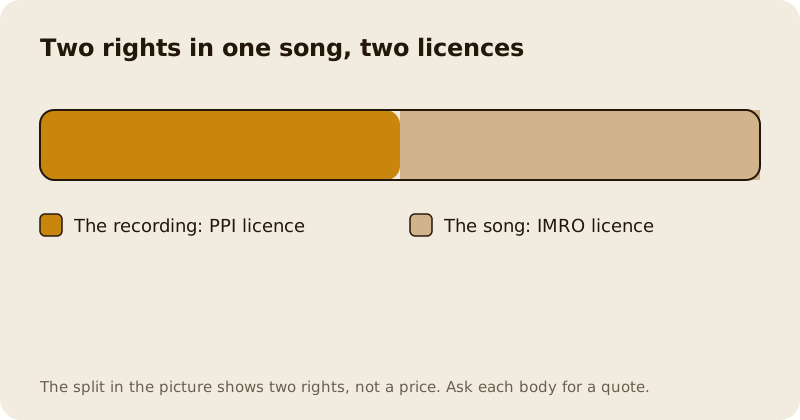
A song on a playlist has two kinds of copyright. The recording belongs to the performer and the record label, and PPI collects the fee on their behalf when it is played in public. The composition, meaning the words and music, belongs to the writers and publishers, and IMRO collects on their behalf. They are separate organisations with separate tariffs, and paying one does not cover the other.
The licence is for playing music to the public in your business, not for the music itself. Having a Spotify or Apple Music account for your home does not cover a cafe; their consumer terms are for personal use, and a business needs a service whose terms allow commercial use, plus the public performance licences on top. Check your music service's terms, and ask PPI and IMRO what they require for the way you play music.
What affects the fee?
Both bodies publish tariffs that depend on the type of premises, its size, how much music you play and the hours you operate. A small cafe with background music pays far less than a bar with a late-night DJ. Live music, a dance floor, a television showing music videos and a background radio can each change the category. Ask for a quote based on your actual use, and ask whether there are discounts for small premises or for paying annually.
Do not guess, and do not copy a competitor's answer, because their premises and their use are not yours. If you do not play music, say so, and keep the dining room quiet on purpose. Some places choose not to play music, or to use only music that is licensed for business use under a separate agreement. Ask the bodies for the rules that apply.
What about live music and events?
Live performance needs an IMRO licence, even if the musician is a friend playing for free. A venue that holds regular live music often takes an annual licence; one that holds an occasional night can ask about a one-off. If a performer plays their own original songs, the position can differ; ask IMRO. If you are selling tickets to a night of music, work out the licence cost in your event budget, using the event budget sheet in that guide.
What happens if you do not have one?
Both bodies check licences and write to businesses that appear to be playing music without one. A letter usually asks you to take out a licence and may seek fees for the period you were unlicensed. Ignoring it makes it worse. The cheaper course is to answer early, ask what you owe and agree how to pay.
Which situations catch small venues out?
A few come up again and again. A background playlist in the dining room is a public performance even at low volume. A speaker in the toilets or the garden counts too. A television showing a music channel in the bar can need a licence of its own. A party room hired out for a wedding with a DJ may need the organiser to arrange cover, or you to hold the licence that covers the room; ask both bodies who is responsible. And a venue that changes hands should not assume the old licence transfers: ask.
If you only play music some days, say so when you ask for the quote, and ask whether the fee can reflect it. If you rarely have live music, ask about occasional licences. The cheapest answer is the honest one.
How do you set it up?
- Decide what you will play, and where: background in the dining room, a speaker in the toilets, a TV in the bar, live music on Fridays.
- Ask PPI and IMRO for a quote, describing your premises and use honestly.
- Choose a commercial music source whose terms allow business use.
- Keep the paperwork with your other licences, and note the renewal dates.
- Tell your team who is allowed to change the music and what is off limits.
Put the licence cost into your overheads (the pricing page shows what your other tools cost, for comparison) when you work out your prices; the food cost guide shows where overheads sit in the price. Music is also part of your atmosphere, which guests mention in their ratings and which affects whether they stay for a second drink: a room that is too loud costs you the people who wanted to talk. Pair this with the accessibility guide, which asks you to be able to turn the music down.
For the rest of your opening list, go to the opening checklist guide, and see the cash flow guide for where annual licences sit in your year.
Questions
Common questions
Do I need a licence to play the radio in my cafe?
Playing music to customers is a public performance, and a radio or playlist in a customer area is usually covered. Ask PPI and IMRO what applies to the way you play it, and get a quote.
Why do I need two music licences?
A song has two copyrights: the recording, licensed through PPI, and the song itself, licensed through IMRO. They are separate bodies with separate fees, and paying one does not cover the other.
Does a Spotify subscription cover my restaurant?
Consumer streaming accounts are normally for personal use only. A business needs a music source whose terms allow commercial use, and the public performance licences on top. Check the terms and ask PPI and IMRO.
Do I need a licence for a friend playing for free?
Live music generally needs an IMRO licence regardless of whether the performer is paid. Ask IMRO about regular and occasional live music and what applies if the performer plays their own songs.
What happens if I have been playing music without a licence?
The bodies check and write to businesses. It is better to answer early, ask what you owe and agree how to pay, than to ignore it, which usually makes the cost and the tone worse.
More like this
Read next
How to run a supper club or tasting night that sells out
A supper club is a fixed menu, a fixed number of seats and a fixed night, sold as tickets paid in advance. Here is how to cost it, sell it and make it a habit.
How to add catering to your restaurant or café
Office lunches, platters and parties, quoted properly, with a deposit up front, the balance before the day and a prep sheet for the kitchen.
How to make a quiet Monday or Tuesday pay
First decide whether the quiet day should open at all. If it should, shrink it to the hours that trade and give it a reason to come that only exists on that day.
How to get more ratings and reviews for your restaurant, honestly
Ask, at the right moment, every customer, and make it easy. Never offer anything in return. A steady stream of honest ratings is worth more than any burst you could buy.
Get started
Claim your business free
Free to list, no set-up fee, and Order Ahead is 1.5% commission when you start taking orders.