
For businesses
Make your restaurant or cafe accessible: practical steps for Irish venues
Mosey · 23 October 2026 · 5 min read

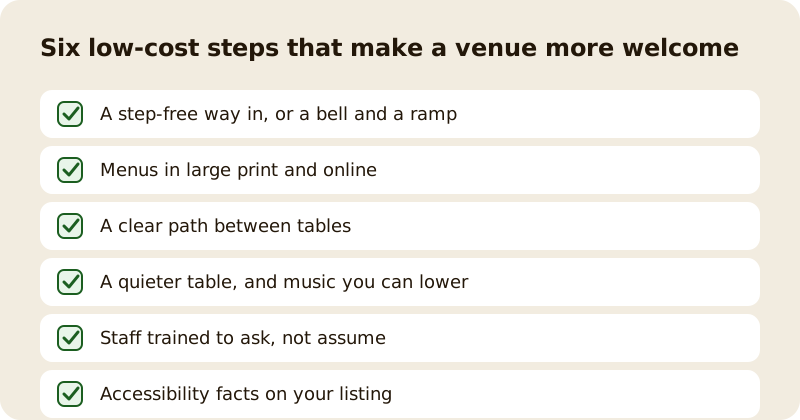
A welcoming venue works for guests who use a wheelchair, who are blind or partially sighted, who are deaf or hard of hearing, who are autistic or find noise hard, who have a learning disability, or who are pushing a pram. Irish equality law asks service providers not to discriminate on grounds of disability and to make reasonable accommodation, and most of what makes a place accessible is cheap: a clear path, a readable menu, a quiet table, and staff who ask what would help.
What does the law ask of a food business?
The Equal Status Acts prohibit discrimination in the provision of services, including food and drink, on nine grounds, disability among them. A service provider must do all that is reasonable to accommodate a person with a disability, which can include changes to how the service is provided, where the cost is not more than nominal. The detail of the duty, including what counts as nominal and what the exceptions are, is for the Workplace Relations Commission and a solicitor to explain. Building regulations also set access standards for new buildings and some changes of use. Check both with the WRC and your local authority before a refit.
This guide is practical advice, not legal advice. When in doubt, ask the National Disability Authority's Centre for Excellence in Universal Design, which publishes free guidance for the sector.
What should you look at first?
Walk your venue as a guest would, starting on the street.
- Getting in. Is there a step? If so, can you add a ramp, or a bell with a staff member who will bring a portable one? Is the door heavy, and does it open easily?
- Moving around. Is there a clear path wide enough to turn a wheelchair or push a buggy, or are chairs and delivery boxes in the way? Can a guest reach the till or the counter?
- Sitting. Do you have at least one table that works for a wheelchair, and chairs with arms for guests who find rising hard?
- The toilet. If you have an accessible toilet, is it used for storage? Keep it clear and the alarm cord hanging to the floor.
- Lighting and noise. Is it bright enough to read the menu? Is the music so loud that a person who is deaf, or autistic, or in a hurry cannot talk?
Write down what you find and the cheapest fix for each. Do the cheap ones this week.
How do you make the menu work?
A menu that people can read gets orders. Keep a large-print version (18 point or more, high contrast, no fancy fonts), keep the menu online as real text and not only as an image so a screen reader can read it, and describe dishes plainly. Scanning your menu into Mosey puts every dish as text with a price. Add allergens to every dish: the allergen guide explains.
What should your staff know?
Train every new starter in four things, on the first day:
- Ask, do not assume. "Is there anything that would make this easier?" is the right question; guessing is not.
- Talk to the guest, not the companion.
- Assistance dogs are working, not pets. Do not distract them.
- Offer, then wait. Offer to read the menu, move a chair or carry a tray. Do it only if the guest says yes.
Add a "quiet hour" if you can: a time on a weekday with lower music and lighting, which helps autistic guests and others who find a busy room hard. Tell people when it is.
How do guests find out before they come?
People plan. A wheelchair user will check the step before the journey. Put the facts on your listing and your website: step-free entry or not, toilet, parking nearby, noise level, a quiet table, assistance dogs welcome. Diners on Mosey can tag a place "Wheelchair accessible" when they rate it, and a "wheelchair accessible" page lists places in a city that have enough such tags. An honest description of what you offer and what you lack earns more trust than silence.
If you offer something specific, say it plainly: "Ramp at the side entrance, ring the bell." A short message that says what you have is better than a promise that you cannot keep.
What would a simple first-month plan look like?
Week one: walk the venue with a colleague who uses a wheelchair or with a friend from a local disability group, and ask them what they notice. Week two: fix the free things, such as clearing the path, putting the large-print menu on the counter and keeping the toilet clear. Week three: write the accessibility facts on your listing and your website and train the team in the four habits above. Week four: set a budget for one improvement a quarter, starting with the one the walk-through ranked highest. A venue that does this for a year is a different place.
Ask guests directly, too. A card on the table that asks "Is there anything that would make your visit easier?" produces more usable answers than any audit.
What if you cannot change the building?
Many Irish venues are in old buildings with steps that cannot be moved. The answer is not to do nothing. Offer table service outside, a portable ramp where the step is low, a reserved ground-floor table, a phone number to call ahead, and honest information. Document what you tried. Then make a plan for the next refit.
For the other half of welcome, see the onboarding guide and the opening checklist. To get the facts onto your Mosey listing, claim your business free.
Questions
Common questions
Does Irish law require a restaurant to be accessible?
Equal status law prohibits disability discrimination in services and asks providers to make reasonable accommodation, within a cost limit. Building regulations also set access rules for new builds and some changes of use. Ask the WRC and your local authority.
What is the cheapest way to improve accessibility?
Clear the path, offer a large-print menu, keep an accessible toilet free of storage, lower the music on request, and train staff to ask what would help. None of these needs building work.
Can I refuse an assistance dog?
Assistance dogs are working animals, and guests who rely on them should be welcome. Check the current law and guidance with the Workplace Relations Commission, and tell your staff before it comes up.
How do I tell guests about my accessibility?
Put plain facts on your website and listing: step-free entry or not, toilet, parking, noise and quiet hours. Diners on Mosey can also tag a place Wheelchair accessible when they rate it.
What if my building has a step I cannot remove?
Offer what you can: a portable ramp, outdoor tables, a phone number to call ahead and an honest description. Record what you tried and plan the next improvement for your next refit.
More like this
Read next
How to run a supper club or tasting night that sells out
A supper club is a fixed menu, a fixed number of seats and a fixed night, sold as tickets paid in advance. Here is how to cost it, sell it and make it a habit.
How to add catering to your restaurant or café
Office lunches, platters and parties, quoted properly, with a deposit up front, the balance before the day and a prep sheet for the kitchen.
How to make a quiet Monday or Tuesday pay
First decide whether the quiet day should open at all. If it should, shrink it to the hours that trade and give it a reason to come that only exists on that day.
How to get more ratings and reviews for your restaurant, honestly
Ask, at the right moment, every customer, and make it easy. Never offer anything in return. A steady stream of honest ratings is worth more than any burst you could buy.
Get started
Claim your business free
Free to list, no set-up fee, and Order Ahead is 1.5% commission when you start taking orders.