
For businesses
How to grow a bakery's pre-orders and collection trade
Mosey · 22 November 2026 · 11 min read
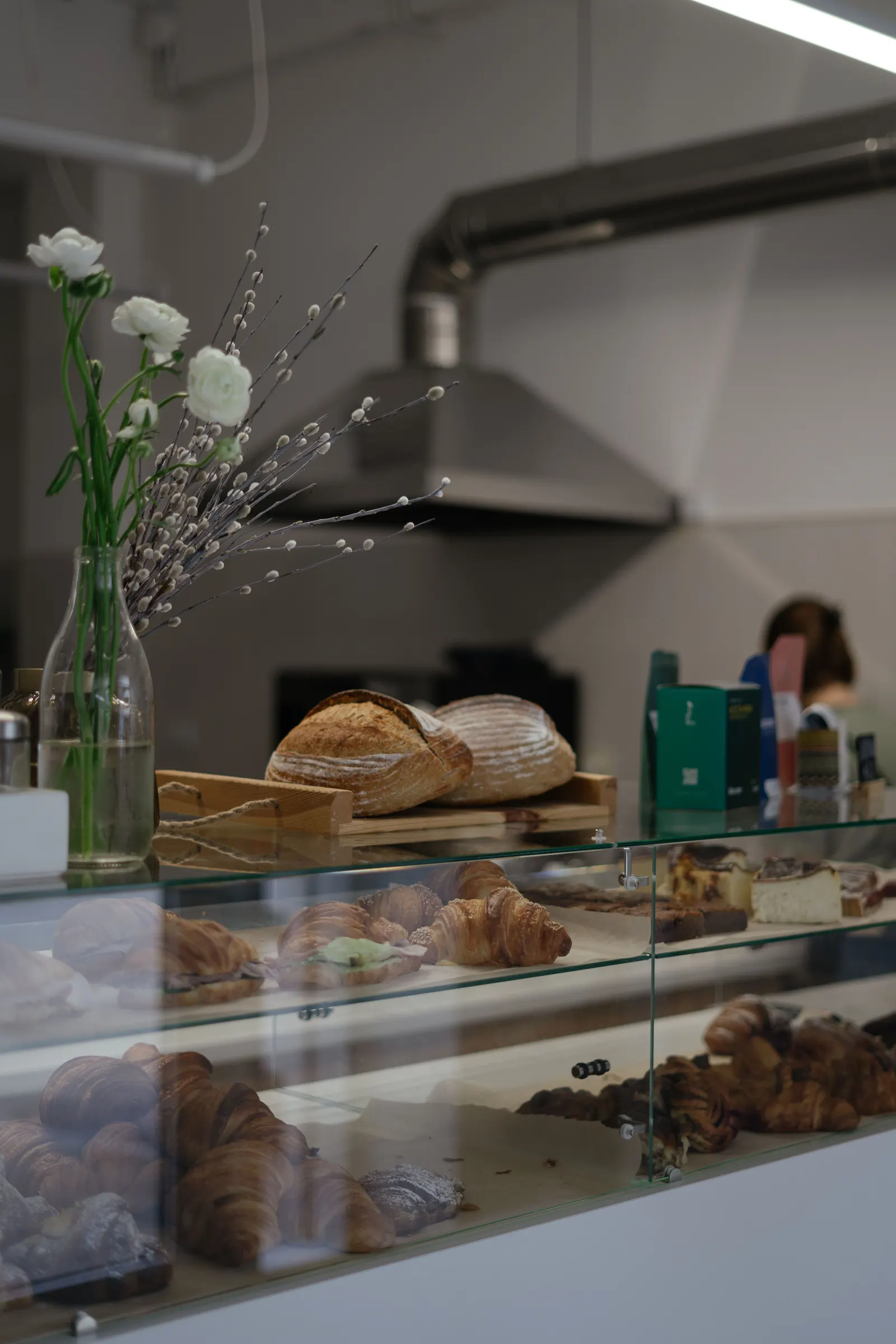
To grow a bakery's pre-orders and collection trade, put what you already sell on pre-order first: Saturday loaves, boxes and trays, and celebration cakes. Take payment at the order, close each order window before you plan the bake, and let the orders set the oven. Collection then becomes a steady base you bake to, not a guess you hope to sell by the afternoon.
Why do pre-orders grow a bakery faster than a longer counter?
A counter sells what is baked. A pre-order sells what is promised, and a promise lets you bake the right amount.
The old bakery problem is the guess made in the dark: how much to bake for people who have not decided. Guess low and you turn away the Saturday sourdough crowd. Guess high and half a rack goes in the bin. A pre-order shrinks the guess. Every loaf that is already sold is a loaf you no longer have to forecast, and every one that is paid for is collected.
Pre-orders also grow trade in ways a bigger counter cannot:
- They sell to people who cannot call in at the right hour. An office, a family planning a weekend and a parent who needs a birthday cake for Friday all buy ahead.
- They raise the order size. A customer building a box adds a second item that a walk-in would skip.
- They protect your margin. A sold item is baked once, and an unsold one is the most expensive thing in the shop.
- They make quiet days pay. An order for a Thursday collection fills a day that walk-in trade leaves empty.
The short guide to software for bakeries covers the tools a bakery needs. This guide is the plan around them.
What should a bakery put on pre-order first?
Start with three kinds of order, in this sequence. Each is easier than the one after it.
- The daily bake, reserved. The loaves, rolls and pastries your regulars buy every week. List a small number of them for collection. You are not inventing a new product, only letting people be sure of it.
- Boxes and trays. A box of mixed pastries for an office, a tray of sausage rolls, a dozen scones, a loaf and a pot of jam. Boxes are easy to make in a batch and raise the spend.
- Celebration cakes. Standard cakes from your range, then bespoke work by enquiry. These need the most care, so add them once the first two run smoothly.
Choose products that keep their quality for a few hours after the bake, travel well and can be made in a batch. A delicate item that must be eaten within the hour is a poor first pre-order.
Name each item for what the customer sees: size, weight, number of portions, what is in the box. Add the allergens for each item: the FSAI says the 14 allergens must be declared in writing for food that is not prepacked, and where food is ordered online it must be there in writing before the order is placed. Mosey's menu builder holds the contains and may contain you declare, shows it beside each dish and carries it onto the order, and a dish with no declaration reads as not listed rather than as safe. See the allergen labels feature page.
How do you turn pre-orders into a bake plan?
Treat the pre-orders as the floor of the bake, then add a walk-in allowance on top.
Worked example (illustrative round numbers, not a promise). A bakery usually sells about 60 loaves on a Saturday. Late in the week 35 are already ordered and paid for. The baker plans 35 for the orders, adds 20 for the counter based on recent Saturdays, and keeps a buffer of 5 for a surprise rush. That is 60 loaves, with more than half of them sold before the oven is lit. If the orders reach 45, the walk-in allowance stays at 20 and the bake goes to 70. If they stall at 20, the baker bakes less and puts a deal on the rest. The bin shrinks because the first number is real.
A short routine makes it work:
- Read the orders at a fixed point each day. The evening before a bake is common, because ingredients and dough are decided then.
- Write the bake sheet from the orders. Orders first, walk-in allowance second.
- Compare the sheet with what sold. A line that is always gone by mid-morning needs a bigger allowance. A line that is always left needs a smaller one.
On Mosey an order can still be placed until thirty minutes before its collection time, so a few will land after you write the sheet. The walk-in allowance covers them, and a line that is truly finished can be marked unavailable for the day.
After a few weeks the allowances settle and the sheet takes minutes. Mosey puts every order on your dashboard, with collection times and allergens, so the sheet is built from one list and not from a phone, an inbox and a note by the till.
When should an order window close?
Close it when you need to decide, and no later. Different products need different notice.
- Bread and pastries. These need the shortest notice, because the dough is made the night before or on the morning. Close the window the day before.
- Boxes and trays. They need a few days if you buy in or prepare ahead, so close a few days out.
- Standard celebration cakes. They need more, because decorating takes time and the day can fill. Close about a week before the date.
- Bespoke and wedding cakes. They need weeks, and a design conversation first.
Set each window so you can still keep the promise on a bad day. A tighter window than you think you need costs a few orders. A loose window costs a missed collection.
On Mosey, a customer can schedule a collection order from thirty minutes to seven days ahead, and pays by card when they place it, so a scheduled order is a paid one. You cap how many collection orders each ten minutes can take, which limits what you can promise at the busiest times. The click and collect guide shows how to size those caps from your kitchen, and the pre-order guide covers cut-offs and the Christmas and Easter rush. Anything ordered more than a week out, and bespoke work, goes through the quote route in the next section.
How do you take cake orders that arrive by message and phone?
Give every order one front door. Today a cake order may arrive by phone, by a direct message, in person and on a scrap of paper, and the one that goes missing is the one for a christening.
Split the work in two:
- Standard cakes. Put your celebration range on your menu for collection, with sizes and extras and a notes box for the message on top. Customers choose a time, pay by card and the order lands on your dashboard. Nothing is baked on a promise.
- Bespoke cakes. Use the catering route: the customer sends a request with the date, the numbers and what they want, you answer with a quote, and the deposit and balance follow. Each business sets a minimum notice, so a request for a date that is too close is turned away before it reaches you. The guide to cake deposits sets out how much to take and when the balance falls due.
Say in writing what happens if a customer changes their mind. The Competition and Consumer Protection Commission says the statutory right to cancel an online purchase does not apply to personalised or made to order products. That does not mean you should keep every deposit. Set fair tiers, tell the customer when they pay, and check the current rule with the CCPC before you write yours. On Mosey you choose how long customers can cancel their own collection order for an automatic refund: with a window set, a scheduled order can be cancelled any time up to its collection time and for that window after it, and a window of zero means customers ask you instead.
How do you plan the bakery's year around its orders?
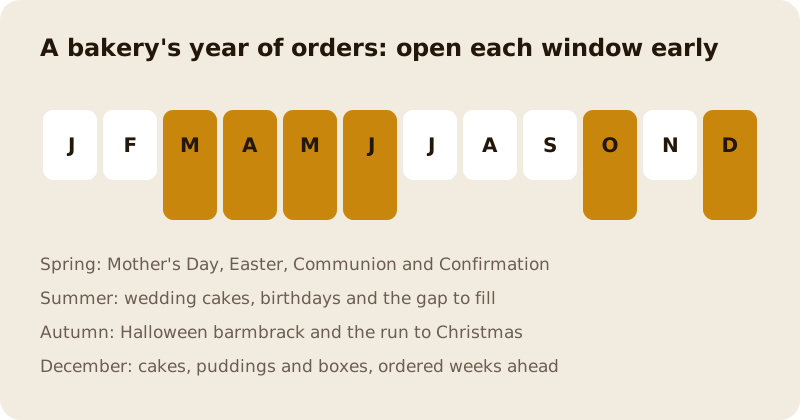
Open each order window before the rush, not during it. A bakery's calendar is predictable, and the best weeks are the ones where the orders were in before the stock was.
Spring carries Mother's Day, Easter, and the Communion and Confirmation season, when family orders for cakes and platters come in by the dozen. Summer brings birthdays and weddings, and a gap in everyday trade that suits a plan to fill it. Autumn brings Halloween barmbrack and the run to Christmas, and December is the month that pays for a quiet January in many bakeries.
A calendar habit is simple:
- List the seasons that matter to you. Use last year's order book, not a general list.
- Set an opening date for each. Tell customers weeks ahead when orders open, on your page and at the counter. Order Ahead takes collection orders up to seven days before the day, so earlier bookings for a big order go through a catering request.
- Set a closing date. After it, take the seasonal items off your menu so nobody orders one you cannot make.
- Plan the bake and the buying from the total. Flour, butter and boxes are ordered once the book is full, not before.
- Review afterwards. Note what sold out, what was left and what customers asked for that you did not list.
The guide to planning the restaurant year around the Irish seasons works through the calendar in more depth, and the guide to full in July and empty in November covers the slow months that follow.
How do you turn a weekly order into a habit?
A customer who orders once is a sale. A customer who orders every week is a business. Three Mosey tools help the habit stick, each from your own dashboard.
A weekly plan. A membership turns a weekly purchase into a paid commitment. Start from the nearest template in Memberships, such as a credit pass or a plan with a free item, and set a perk you can afford: one loaf a week, for example. A free item can be limited by day, week or month. Run the margin check before you publish, because a generous perk can cost more than the fee brings in. Members pay through your own Stripe account, and Mosey takes 8% of the subscription fee, with no monthly fee. See the memberships feature page.
A stamp card. Loyalty is free on every plan, with no commission. An order earns when it is completed, so a collected order counts towards the card without anyone stamping it. Give the first reward within reach of a month of weekly orders. See the loyalty feature page.
A gift voucher. A voucher sells a cake or a box to the person who wants to give one, and brings a new customer through the door. Mosey takes 4.5% of the value when a voucher is sold, and the buyer pays a booking fee of €1.29, VAT inclusive. See the gift vouchers feature page.
How do you cut the afternoon bin without cutting your price for good?
Use a time-limited price, not a permanent one. A deal that runs only inside a window teaches nobody to wait, because the window is the only time it exists.
Deal Hours on Mosey is a price rule that applies by itself inside a window you choose. You pick the days and the hours, a discount such as a percentage, an amount off or a set price, and the items it covers, and you choose whether it applies to collection, delivery, in store or any mix. Menu prices stay at full price and the discount comes off at checkout. For a bakery, that can be an afternoon window on the items that always remain, such as bread and pastries. A guest with a collection order sees a Deal on now banner while the window is open.
Two rules keep the margin: apply a deal only to items you would otherwise bin, and read your sheet each week. If an item is in the deal every day, the problem is the bake, not the price. Cut that line first. See the promotions and Deal Hours feature page.
How does Mosey help a bakery grow its pre-orders?
Mosey does not bake, plan your ingredients or give advice on consumer law. It takes the order, holds the money and keeps the list in one place.
- Order Ahead for collection. Customers order and pay from your Mosey page, pick a slot you have capacity for and are told when the order is ready. Mosey takes 1.5% of the food, ex-VAT, and the customer pays a small booking fee on top. See online ordering for collection.
- Catering for bespoke cakes. A request, a quote, a deposit and a balance, with a minimum notice you set. Catering carries 3% of the job, and the customer pays a booking fee of 3%, capped at €120. See catering and company orders.
- Found by the dish. Diners search by what they want to eat, so a good loaf can bring a new customer who has never walked past you.
- Your money, your customers. Payments go to your own Stripe account, and you keep the relationship.
Pick one product, put it on pre-order this week and watch the first bake plan form. Host on Mosey free, add your menu and take your next order with the money already in. Every figure is on the pricing page, and every guide for Irish food businesses is on the business guides page.
This guide is general information, not legal, tax or financial advice. Rules change and depend on your business and where it is, so check the current rule with the official body named in the guide and take advice from a solicitor or accountant in your area before you act.
Questions
Common questions
How can a bakery get more pre-orders?
Start with what you already sell: reserve the Saturday loaves, offer boxes and trays, then add standard celebration cakes. Take payment at the order, show a clear collection time and tell regulars at the counter. A paid order is collected, so it also cuts waste.
What should a bakery sell for collection first?
Choose items that travel well, keep their quality for a few hours and can be made in a batch: loaves, rolls, boxes of pastries and standard cakes. Leave delicate items that must be eaten fresh until the routine works, and add bespoke cakes last.
How far ahead should a bakery take orders?
It depends on the product. Bread needs the least notice, boxes a few days, standard cakes about a week and bespoke cakes weeks. On Mosey a collection order can be scheduled from thirty minutes to seven days ahead, and a catering request carries a minimum notice you set.
Can customers cancel a made-to-order cake?
The CCPC says the statutory right to cancel an online purchase does not apply to personalised or made to order products. Set your own fair cancellation tiers, tell the customer when they pay, and check the current rule with the CCPC before you write your terms. On Mosey you also set how long customers can cancel an order themselves.
How do I stop cake orders getting lost?
Give every order one front door. Put standard cakes on your menu for paid collection, and take bespoke cakes as a request and quote with a deposit. Orders then arrive on one dashboard, with the date, the details and the allergens, instead of in messages and notes.
Can a bakery run a weekly bread subscription on Mosey?
Yes. Start from a membership template, such as a credit pass or a plan with a free item, and set a perk like one loaf a week. Run the margin check before you publish. Members pay through your own Stripe account, and Mosey takes 8% of the fee.
How do I reduce unsold bread at the end of the day?
Plan the bake from the orders, then add a walk-in allowance you adjust each week. For what is left, set a Deal Hour on those items for a time window. It applies at checkout, so your menu prices stay at full price the rest of the day.
What does Order Ahead cost a bakery on Mosey?
Mosey takes 1.5% of the food on a collection order, ex-VAT. The customer pays a small booking fee on top, scaled to the order size. Money goes to your own Stripe account, and tips carry no Mosey fee. Every figure is on the pricing page.
More like this
Read next
A hotel restaurant that locals use too
A hotel dining room earns local trade when it acts like a restaurant of its own. Here is why locals stay away, how to set the dining room up on Mosey beside your hotel, and which offers fill it.
An alcohol-free drinks menu that still makes margin
More guests are drinking less, in January and the rest of the year. Here is how to cost, price, name and sell an alcohol-free menu so it earns as well as the wine list, with the Irish VAT and offer rules checked.
A pub that does food: making the kitchen pay
A pub kitchen pays when its gross profit covers its own wages and running costs. Here is how to count it, which services to fill, what the alcohol rules say and how Mosey fits.
Auto-enrolment pension for Irish restaurants and cafés: what you pay and do
Since 1 January 2026 an Irish employer matches the pension contribution of each eligible employee. Here is who counts, what it costs on a wage bill, the payroll steps and what staff can opt out of.
Get started
Host your business on Mosey. It is free to claim.
Free to list, no set-up fee, and Order Ahead is 1.5% commission when you start taking orders.