
For businesses
Valentine's and Mother's Day for restaurants: two weekends, one plan
Mosey · 22 November 2026 · 11 min read

Valentine's Day and Mother's Day are not one busy season. Valentine's fills your room with tables of two in the evening. Mother's Day fills it with families at Sunday lunch. Plan them together on one calendar, but run each as its own format: a fixed-sitting set menu and a small deposit for the first, bigger tables, pre-orders and a clear group price for the second.
Why do these two occasions need different plans?
Because the guests want different things from the same room. A couple on Valentine's Day wants a table that feels chosen, a menu that feels like an occasion and a pace that lets them talk. A family on Mother's Day wants a table big enough for a grandmother, a toddler and an uncle who arrives late, a menu everyone can find something on and a bill that can be split.
The kitchen sees it too. Valentine's arrives in two evening waves of small tickets, many of them the same dishes. Mother's Day arrives as one long lunch of mixed plates, children's portions and a few special requests. A menu that works for one will not work for the other without a re-cut.
The sums differ as well. A no-show on Valentine's is a table of two. A no-show on Mother's Day can be a table of ten, and the kitchen has prepped for all of them. Treat them as two jobs and you can price, protect and staff each properly. Treat them as one "busy weekend" and you will under-protect the big tables and over-complicate the small ones.
The Christmas and Valentine's booking guide covers the season in general. This guide goes deeper on these two weekends.
What does each occasion need from your restaurant?
| Valentine's Day | Mother's Day | |
|---|---|---|
| Who books | Mostly tables of two, some groups of friends | Families, often with three generations |
| When | Evening, sometimes a weekday | Sunday lunch |
| Format | Two fixed sittings, one set menu | One main lunch service, a set menu or a short menu |
| What goes wrong | A two-top no-show, a rushed second sitting | A late table of ten, a dietary need nobody told you |
| What to ask in advance | Dietary needs, any occasion note | Numbers, dietary needs, children, a high chair |
| Best tool | A small deposit per person | A deposit, a pre-order and a group quote |
A pattern you can use: the earlier you fix the format, the less you improvise on the day. Write the format down once, decide the price and the terms, and the rest is booking and reminding.
It helps to name one person for each day. Whoever owns Valentine's owns the sitting times, the table plan for twos and the waitlist. Whoever owns Mother's Day owns the group replies, the numbers list and the high chairs. Two named people beat a shared to-do list, because each knows which question lands on their desk.
When do the two days fall, and when should you start selling?
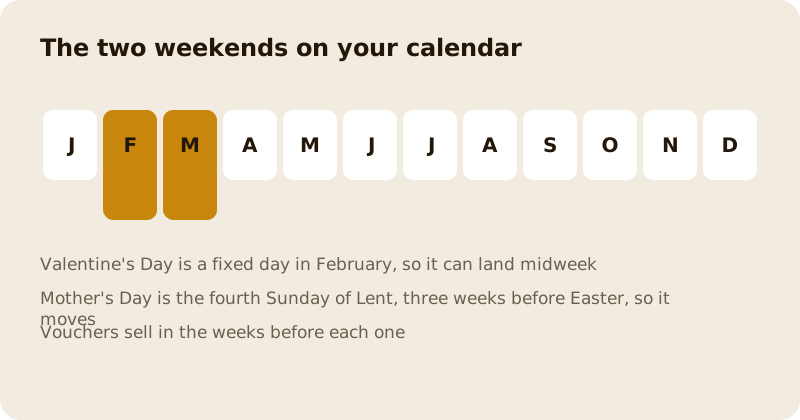
Valentine's Day is a fixed day in February. Some years it falls on a weekend and some years on a weekday, so decide in January whether you will run the night itself, the nearest weekend or both. Mother's Day in Ireland is the fourth Sunday of Lent, three weeks before Easter, so it moves from year to year. Check the date against a calendar before you print anything, and do not copy last year's date into this year's page.
Start selling earlier than feels natural, then work backwards:
- Early January: fix both menus, prices and terms. Write the cancellation wording once.
- Mid January: open Valentine's bookings and put the gift voucher in front of people.
- A month before Valentine's: follow up anyone who enquired and has not booked.
- Valentine's week: confirm, remind and watch the waitlist.
- After Valentine's: open Mother's Day, because the people who ate with you in February are the ones booking a family lunch.
- A fortnight before Mother's Day: final numbers for large tables, dietary lists and pre-orders.
The point of the calendar is that Valentine's feeds Mother's Day. A guest who liked the room in February is the easiest booking you will get in March.
How do you build one base menu for both?
Cost it once and cut it twice. Start from the dishes you cook best and can cook in volume, then shape each menu around the room it is for.
- Valentine's: three courses, two choices each, one of them vegetarian by design. Keep the plates easy to eat and attractive on the table. A shared dessert or a welcome bite says "occasion" better than a price jump. Keep drink off the set price and sell it from its own list at its own prices.
- Mother's Day: a short lunch menu with plates that hold well, a roast or a fish that scales to forty, a vegetarian main and a children's plate.
Price both on the dearest plate, not the average. The guide to pricing a set menu has the five steps. An example with round figures, not a benchmark: if the dearest three-course combination costs €15 in ingredients, a 30% food cost target gives €50 before VAT, which you then add VAT to and round. A table of eight that all choose the dearest main still leaves you your margin.
If you run an early window as well, the early bird guide shows how to keep each cover paying. Do not discount an occasion that was going to fill anyway.
If Valentine's Day lands midweek, a Tuesday or a Wednesday behaves differently from a Saturday: guests may want an earlier table because of work the next morning, and you may be staffed more thinly. Look at your own bookings for a comparable weekday before you decide how many sittings to open. If it lands on a weekend, expect the pressure to be heavier and the later sitting to go first.
Allergens belong on the menu guests book from. Say what is in each dish, and never describe a dish as allergen free. The allergen guide sets out what you must declare.
Where do deposits help, and where do they get in the way?
They help where a no-show is expensive and a table cannot be refilled. On both days, it can't.
Valentine's. Tables of two are small, so a per-person deposit is small, and that is the point: enough that a guest thinks twice, not enough to feel like a ticket price. An example with round figures: 24 tables of two at a €60 set menu is €2,880 of sales across two sittings. Three no-shows is €360 gone, plus the other bookings you turned away. A deposit of €15 a head would have held €90 of it back and made cancelling early the easier choice.
Mother's Day. The risk sits in big tables. A party of ten that arrives as seven has left three covers empty on the busiest lunch of the season. A deposit per person, due at booking, with a final-numbers date a week out, protects you without a fight on the day.
On Mosey, reservation deposits come with the paid Starter bookings plan (€79.99 a month; see pricing). You set the deposit per person or per booking, the free cancellation window and a partial refund. Mosey takes no commission on a deposit; Stripe's card fee still applies. On the Host plan you can set a different deposit for a larger party or a peak window, and a card hold where the guest is charged only if they do not turn up. See table bookings with deposits.
Where deposits get in the way: a deposit that is unclear. Write it as a promise: "Your deposit comes off your bill, and you can cancel free up to a week before." The policy guide has wording that guests accept, and the no-show cost guide works out what an empty table costs you.
How can gift vouchers help with both occasions?
Both days send people looking for a present, and a voucher is a present that needs no wrapping. It also moves your sales forward: the buyer pays at once, and the person who receives it eats with you later, often in a quiet week.
- For Valentine's: a voucher for two, sold in the weeks before, suits a partner who wants a present that is more than flowers.
- For Mother's Day: a voucher for a family lunch, bought by a son or daughter who lives far away, is a present they can send in minutes.
Mosey vouchers carry 4.5% commission, and the buyer pays a flat booking fee of €1.29 including VAT. On Mosey, a buyer can usually cancel an unused voucher bought online within 14 days of buying it and is refunded automatically, so treat the money as owed until the voucher is spent. It is a meal you still owe, not free money. The gift voucher guide covers values and wording, and funding your slowest months shows how to steer redemptions into quiet weeks. See gift vouchers.
Build the occasion around food. S.I. No. 4 of 2020 says a person shall not sell or supply alcohol at a reduced price or free of charge on the purchase of another product or service, and Mosey keeps promotions, member discounts and loyalty rewards off items you mark as alcohol, so a dessert to share or a starter on the house works where a free drink would not.
How do you handle a big family table on Mother's Day?
A family of ten rarely fits a booking form, because it starts as a conversation: who is coming, can the little ones eat early, is there a step into the dining room. Answer it once, in writing, with a price.
- Reply the same day with the menu, the price a head, the deposit and the final-numbers date.
- Get one list, not ten messages. The group pre-order guide shows how. On Mosey, the person who sent a group request can share one dietary form with the family, and each guest fills in their own allergens and needs without signing up.
- Ask the practical questions: children and their ages, a high chair, anyone who needs step-free access, any dietary needs.
- Confirm a week out and again two days out.
On Mosey, group requests let a customer send the date, numbers and occasion, and you reply with a quote and your terms. A deposit on a group request is there where you ask for one, and a family can split it between them. See group bookings and private hire. On the Host plan, a guest can also tell the kitchen what they would like to eat before they arrive. It is a preference for your prep sheet, not an order or a payment. The set menus for large groups page shows how to offer a fixed price for a big table.
What do you do on the days themselves?
Keep it plain.
- Brief the team on the menu, the allergens, the sittings and the turnaround time, and say who holds the book.
- Seat from the book. On Valentine's, put the two-tops that arrive late into the second sitting rather than squeezing the first.
- Use the waitlist. On the Starter plan, a freed table is offered to the next party that fits. Last-Minute Tables, on every plan, let a guest or your restaurant post a table that is no longer needed, and the next guest who claims it pays the deposit.
- Keep one person for the door at Mother's Day lunch, because late groups arrive in clusters and a calm welcome sets the tone.
- Write it down after: covers, no-shows, what ran out, what sold best. It is next year's plan.
How do you turn two busy weekends into regulars?
The weekends fill the room. What you do next fills it again in April.
- Reply to every rating, the warm ones and the sharp ones. See the rating replies guide.
- Thank people who booked, and tell them what is on next, such as a spring menu or an early window on a quiet midweek.
- Offer a reason to return on a quiet day. Loyalty is free on every plan, and the win-back guide helps with the ones who stopped.
A first visit on Valentine's Day becomes a regular table when the second visit is easy to say yes to.
How do you set this up on Mosey?
Three steps, in the order you will use them.
- Host on Mosey free and add your menu, with the allergens you declare.
- Open table bookings, set your deposit and cancellation terms, and add the gift voucher.
- Keep Mother's Day for families: take group requests, set a final-numbers date and send the pre-order list a week before.
Mosey does the bookings, the money and the reminders. You do the cooking and the welcome. For the rest of the year, the other guides for Irish food businesses are on the business guides page.
This guide is general information, not legal, tax or financial advice. Rules change and depend on your business and where it is, so check the current rule with the official body named in the guide and take advice from a solicitor or accountant in your area before you act.
Questions
Common questions
How should a restaurant plan Valentine's Day and Mother's Day together?
Run them as two formats on one calendar. Valentine's Day suits fixed evening sittings, a set menu and a small deposit for tables of two. Mother's Day suits Sunday lunch, bigger tables, a final-numbers date and a pre-order. Fix menus and terms in January, then open each in turn.
When is Mother's Day in Ireland?
Mother's Day in Ireland is the fourth Sunday of Lent, three weeks before Easter Sunday, so it moves each year and usually falls in March. Check the date on a calendar each year before you print a menu or open bookings, and do not reuse last year's date.
Should a restaurant take a deposit for Valentine's Day?
It helps, because a table of two that does not arrive is a table you could not refill. Keep the deposit per person and modest, say the terms before the guest pays and allow free cancellation up to a clear date. Booking deposits come with the paid Starter plan on Mosey.
How do you price a Valentine's Day set menu?
Price on the dearest plate, not the average. Cost the most expensive choice in each course, add what goes on every table, divide by your food cost target and add VAT. A shared dessert or a welcome bite says occasion better than a price jump.
How do you handle large family bookings on Mother's Day?
Reply the same day with a price, a deposit and a final-numbers date, and collect one list of choices and dietary needs. On Mosey, group requests let you quote and set terms, and on the Host plan a guest can tell the kitchen their choices ahead as a preference.
Do gift vouchers sell for Valentine's Day and Mother's Day?
Both days send people looking for a present, and a voucher needs no wrapping. Treat the money as a meal you still owe. Mosey vouchers carry 4.5% commission, the buyer pays a booking fee, and on Mosey a buyer can usually cancel an unused voucher within 14 days.
Can I give a free drink as a Valentine's offer on Mosey?
Keep it off drink. S.I. No. 4 of 2020 says a person shall not sell or supply alcohol at a reduced price or free of charge on the purchase of another product or service, so ask a solicitor before any offer that touches drink. In Ireland Mosey keeps promotions, member discounts and loyalty rewards off items you mark as alcohol. Build the offer around food instead, such as a dessert to share or a starter on the house.
What if a table cancels at the last minute?
Offer it again. On Mosey, Last-Minute Tables are on every plan: a table can be posted, and the next guest who claims it pays the deposit. On the Starter plan, the waitlist offers a freed table to the next party that fits, which is not always the person at the front.
More like this
Read next
A hotel restaurant that locals use too
A hotel dining room earns local trade when it acts like a restaurant of its own. Here is why locals stay away, how to set the dining room up on Mosey beside your hotel, and which offers fill it.
An alcohol-free drinks menu that still makes margin
More guests are drinking less, in January and the rest of the year. Here is how to cost, price, name and sell an alcohol-free menu so it earns as well as the wine list, with the Irish VAT and offer rules checked.
A pub that does food: making the kitchen pay
A pub kitchen pays when its gross profit covers its own wages and running costs. Here is how to count it, which services to fill, what the alcohol rules say and how Mosey fits.
Auto-enrolment pension for Irish restaurants and cafés: what you pay and do
Since 1 January 2026 an Irish employer matches the pension contribution of each eligible employee. Here is who counts, what it costs on a wage bill, the payroll steps and what staff can opt out of.
Get started
Host your business on Mosey. It is free to claim.
Free to list, no set-up fee, and Order Ahead is 1.5% commission when you start taking orders.