
For businesses
Write a cancellation and deposit policy guests will accept
Mosey · 23 October 2026 · 5 min read

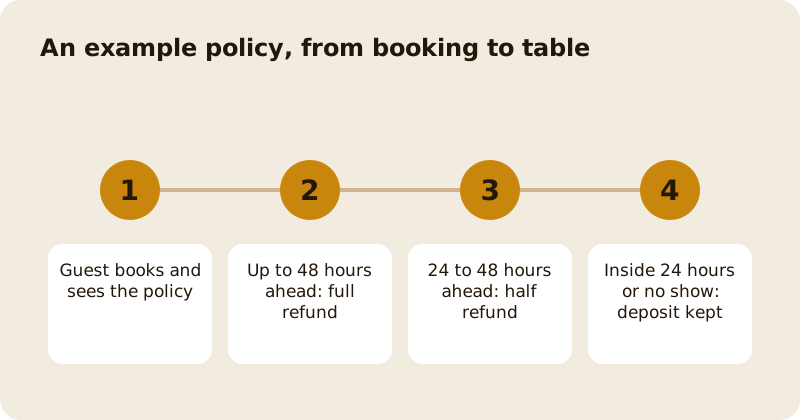
A cancellation and deposit policy has three settings: how much you take (the deposit), how late a guest can cancel for a full refund (the free window) and what happens after that (a partial refund or none). The version that works for most independent restaurants is a small deposit per guest on busy nights, a free window of 24 to 48 hours, and a clear sentence on the booking page and in the confirmation. State it before the guest pays, in the guest's own language, and apply it the same way every time.
Why do you need a policy at all?
Because an empty table at 8pm on a Saturday costs you the sale you could have made. A booking with no commitment gives a guest the option to forget, and a share of guests forget. A deposit changes that: people remember what they have paid for. It also lets you say no to a request for a table you cannot afford to hold open without worrying that you are being unfriendly.
If you want the numbers for your own room, the no-show cost calculator shows what a few empty tables a week cost across a year, and the guide to reducing no-shows covers the other tools.
How big should the deposit be?
Set it so that it matters to the guest and covers a real part of your loss, but does not feel like a ticket price. Many independent restaurants charge a modest amount per cover, and a larger amount per cover for large parties or tasting menus where a no-show hurts most. Apply it where it is needed: on the busiest nights, for large parties, or for specific slots, and leave quiet weeknights free so you do not turn away walk-in-style bookings.
A card hold is a gentler option. The guest authorises a card and is charged only if they do not turn up. Many guests prefer it to paying in advance, and it protects you in the same way. On Mosey, the card hold is part of the Host reservation plan.
How long should the free window be?
The window should give you time to refill the table. For a small room that takes bookings on the day, 24 hours may be enough. For a place that fills weeks ahead, 48 hours or more makes sense, and for events or set menus you may need a week. A guest who cancels inside the window loses some or all of the deposit, and you tell them so in advance.
Add a middle step if you want to be kind: for example, a half refund between 24 and 48 hours and no refund inside 24 hours. The partial refund softens the edge for guests whose plans really did change.
What should the policy say?
Keep it to a few sentences on the booking page, the confirmation and the reminder.
- What the deposit is, and whether it comes off the bill.
- The free cancellation deadline, as a time, not as "a day before".
- What happens after: how much is refunded, or that it is kept.
- How to cancel or change a booking, in one step.
- Any exception, such as illness or an emergency, if you will honour one.
Write it as a promise, not a threat. "Your deposit comes off your bill, and you can cancel free up to 24 hours before" lands better than "Failure to cancel will result in forfeiture".
How does this work on Mosey?
On Mosey you set the deposit per cover or per booking, choose when it applies, and set the free cancellation hours and the partial refund. Mosey takes no commission on reservation deposits, so every cent a guest puts down reaches you through your own Stripe account. Deposits are part of the Starter plan at €79.99 a month and above; the Host plan at €169.99 a month adds the card hold. The guest sees your policy on the deposit screen, and the booking cancels under it. A guest can also offer the slot to someone else, and if somebody claims it the original deposit goes back in full.
A guest's late cancellation never counts against them in the no-show record; only a real no-show does. That makes it easy to be firm on the deposit and kind on the relationship. The full tour is in the reservations and deposits guide.
What are the common mistakes?
- Hiding the policy. A rule the guest first sees on the receipt is a rule they will fight.
- Changing it by mood. Waiving it for the loud guest and enforcing it on the quiet one teaches everyone to be loud.
- Charging the same deposit for every night. A Tuesday does not need what a Saturday does.
- Forgetting groups. A table of ten that vanishes costs ten covers, so large parties deserve their own, firmer rule.
- No way to cancel. If cancelling means a phone call during service, guests will not, and the table stays empty.
Review the policy every few months against the numbers: no-shows, late cancellations, refilled tables. Loosen it if guests are put off, tighten it if tables are still going empty.
What if a guest complains?
Decide in advance what you will do, and who decides. Honour real emergencies, and say so; it costs little and builds loyalty. Refuse politely when someone forgot, quoting the policy they accepted. Never argue in the dining room. If a guest posts about it, reply once, factually and kindly.
When the policy is working, you will see fewer no-shows and more cancellations early enough to refill the table. Pair it with a waitlist or the cancellations page so the freed table fills. For a stronger view on the whole booking system, read the walk-in queue guide and the early bird guide.
Questions
Common questions
How much deposit should a restaurant take?
Enough to matter without feeling like a ticket price, often a modest amount per cover and more for large parties or set menus. Apply it only where a no-show hurts most, such as busy nights.
How long should the free cancellation window be?
Long enough for you to refill the table, which for many independents is 24 to 48 hours and longer for events or set menus. State the deadline as a clock time in the booking confirmation.
Is a card hold better than a deposit?
Many guests prefer it because they are only charged if they do not turn up, and it protects you in the same way. On Mosey the card hold is part of the Host reservation plan.
Does Mosey take a cut of reservation deposits?
No. Mosey takes no commission on reservation deposits, and they reach your own Stripe account. Reservation features are on plans, which you can see on the pricing page.
Should late cancellations count as no-shows?
No. Treat a late cancellation as a cancellation, apply your refund rule, and keep no-show for people who do not come at all. This encourages guests to cancel early so you can refill the table.
More like this
Read next
How to run a supper club or tasting night that sells out
A supper club is a fixed menu, a fixed number of seats and a fixed night, sold as tickets paid in advance. Here is how to cost it, sell it and make it a habit.
How to add catering to your restaurant or café
Office lunches, platters and parties, quoted properly, with a deposit up front, the balance before the day and a prep sheet for the kitchen.
How to make a quiet Monday or Tuesday pay
First decide whether the quiet day should open at all. If it should, shrink it to the hours that trade and give it a reason to come that only exists on that day.
How to get more ratings and reviews for your restaurant, honestly
Ask, at the right moment, every customer, and make it easy. Never offer anything in return. A steady stream of honest ratings is worth more than any burst you could buy.
Get started
Claim your business free
Free to list, no set-up fee, and Order Ahead is 1.5% commission when you start taking orders.