
For businesses
How to fund your slowest months with Christmas gift vouchers
Mosey · 15 November 2026 · 12 min read

To fund your slowest months with Christmas gift vouchers, sell them hard from late November, keep every euro of unspent value in a separate pot because it is food you still owe, and use the cash to cover January's fixed costs while the vouchers bring guests in on your quiet nights. Vouchers do not create money. They move spring's meals into December's bank balance.
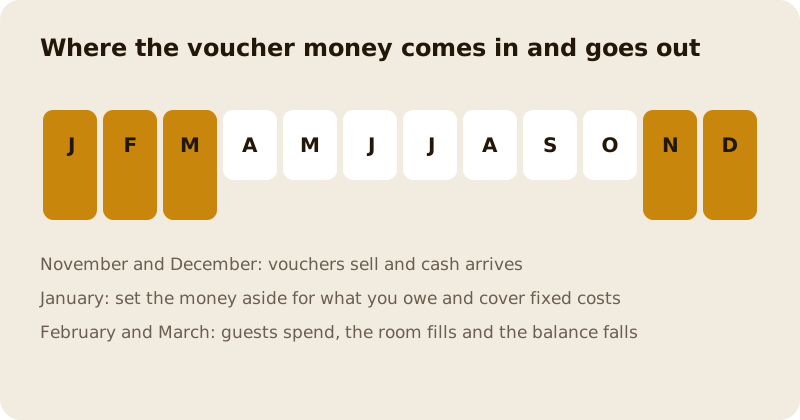
Why do gift vouchers help in your slowest months?
Your quietest weeks are usually the ones straight after Christmas. Guests have spent, the weather is poor and your rent, wages and suppliers do not take a break. That gap is where a lot of independent restaurants and cafés feel the squeeze.
A gift voucher moves the money to the other side of it. The buyer pays in the busiest weeks of the year. The person who receives it comes in later, usually in the weeks when you would like the room full. You get cash before the work and guests when you need them.
It works for a second reason. A voucher is bought for someone else, so the guest is often new, and you are not discounting to get them in.
Be clear about what it is not. It is not a loan and it is not income you can spend freely. A voucher is a promise to serve a meal. The pay now, redeem later guide covers the idea, and the guide to raising money without a bank loan puts vouchers beside memberships, deposits and tickets.
How much cash can December vouchers actually bring in?
You cannot know until you try, so plan from your own numbers, not a target you saw elsewhere. Here is a worked example. The figures are made up to show the arithmetic. Replace them with yours.
The example is a 40-seat café selling vouchers in November and December.
| Step | Example figure |
|---|---|
| Vouchers sold | 200 |
| Average face value | €40 |
| Face value sold | €8,000 |
| Guests who spend more than the voucher | assume a quarter of the vouchers' value again on top |
| Food and drink cost of the meals | assume 30% of what is served |
Out of the €8,000 you take in, the voucher commission, VAT on that commission and Stripe's card fee come off, so the amount that reaches your account is less than €8,000. Your Vouchers page and Stripe show the exact figures per sale. What you still owe the guests is the full €8,000 of value, because the fee is your cost of selling, not a reduction in what the voucher is worth.
That is the point of the example. You are holding €8,000 of meals that cost you roughly €2,400 in food and drink to produce, plus the wages that would have been paid anyway on a quiet night. The cash is not profit. It is the funding for the weeks it takes to serve those meals.
Run the sum for your own business with three questions. How many bills in a typical December carry a gift or a present purchase? What would you sell if every regular bought one for someone? How many tables can you serve in the quiet weeks without hiring more staff? The answers set a sensible number.
What does Irish law say about gift vouchers and expiry?
This is the part owners most want to get right. The rules are in the Consumer Protection (Gift Vouchers) Act 2019, which added them to the Consumer Protection Act 2007 as sections 66A and 66B, and the Competition and Consumer Protection Commission (CCPC) explains them for businesses.
- Expiry. A voucher must either have no expiry date or one at least five years from the date it was sold. A shorter date is replaced by five years (section 66B(1)).
- Say it in writing. The voucher, or a durable medium given with it such as an email, must state the expiry date, or the date of sale and how long it lasts, or that there is no expiry (section 66B(2)).
- No single-transaction rule. Your terms cannot require the full value to be spent in one transaction (section 66B(3)), and they cannot limit how many vouchers a guest uses in one transaction (section 66B(7)).
- Balances. The cash rule is narrower than many owners think. Only where your terms stop a remaining balance being spent in another transaction, and €1 or more is left after part use, must you pay the balance back in cash, by electronic transfer or as a new voucher with an expiry no earlier than the original (sections 66B(4) and (5)). A voucher that keeps its balance for the next visit does not trigger it. The CCPC's summary says that if more than €1 remains the balance can be refunded, so if a guest asks, check the Act with your adviser rather than refuse.
- Named vouchers. If a voucher must be used by a named person, a mismatch with their ID cannot stop them, and the name can be changed free (section 66B(6)).
- Scope. The rules apply to vouchers sold on or after 2 December 2019. They do not cover everything with "voucher" on it: the Act leaves out, among others, loyalty scheme vouchers, promotional vouchers, refund vouchers for returned goods and discount vouchers for a set date or a period of three months or less.
Breaking these rules is an offence under the 2007 Act. Read the Act and the CCPC page on gift vouchers yourself before December, because they, not this guide, are the authority. If your terms say anything different, ask your adviser to read them.
Two practical consequences follow. First, a 12-month expiry is not allowed: it is read as five years. Choose a five-year expiry or none. Second, you may be carrying a voucher liability for a long time, so you need a way to see it. Both are covered below.
How do you stop December's voucher money becoming a hole in March?
The sale that goes wrong is the one where the cash is spent on rent and stock and the meals still have to be served. The fix is a habit, not software.
- Open a voucher pot. A separate savings or current account is enough. Each week, move into it the cost of serving the vouchers sold that week, food and wages, and keep a note of their full value as what you owe.
- Fund January from what is left, not from the pot. The cash you can use freely is what remains after you set the pot aside against what you owe. In a quiet month, that is usually nothing like the full sales figure. That is not bad news. It is the real number.
- Use the pot to buy the food and pay the wages for voucher meals. As guests spend vouchers, the food and labour costs are real. They come out of cash you hold against that value.
- Reconcile monthly. Compare the pot with the total of unspent voucher balances. If the pot is smaller, you have spent food you owe.
Do not treat voucher money as December's profit. Your accountant decides how it is treated in your accounts, and how VAT applies is a question for them or for Revenue, so ask before the year end. The VAT guide for Irish restaurants and cafés is a starting point, and cash flow for Irish restaurants shows how to read the weeks ahead. If you want a week-by-week frame for January to March, the 13-week cash flow plan has one.
Which vouchers sell best, and when should you push them?
A voucher nobody buys funds nothing. Three things move sales.
Offer a small range. Two or three values, named for what they buy, such as "coffee and cake" or "dinner for two". A buyer who is unsure leaves. A buyer who sees a meal for two buys. The gift voucher guide covers values and gifting days. This guide is about the money, so go there for the selling detail.
Time the push. Buyers are gift hunting from the middle of November. Put the link on your website and your social profiles by the last week of that month, mention it on the bill and the counter card, and tell regulars once, early. Add a reminder in the final fortnight before Christmas, when last-minute buyers arrive.
Add a bonus for a short window, if you can afford it. A small bonus on the value, such as a bonus for a voucher bought before a set date, gives buyers a reason to act. But a bonus is value you owe, not a free extra, so cost it before you offer it.
Should you sell to companies as well as individuals?
Yes, if you can. A company that buys 40 staff gifts is one conversation and one payment, and it puts 40 people on your list. The company voucher guide covers who to ask and what to say, and it is the guide to read in October.
On Mosey, a company can buy staff gift vouchers through Mosey for Teams: it picks your business, an amount per person and a list of staff, pays once on the company's card and each person receives their own voucher. The company pays a corporate service fee of 3% on top, and the voucher sale carries the same voucher commission as any other. Cash comes in once, in a single payment, which suits a quiet January.
If you want a year-round version of the same idea, the gift and company memberships guide covers memberships as gifts.
How do you serve voucher guests so they come back?
The voucher guest did not choose you. Someone chose you for them. How you look after them decides whether you get a second visit paid for with their own money.
- Tell them where they stand. Staff should know how to see a voucher's balance and say it aloud, and they should know that any balance left stays on the voucher for next time.
- Steer them to your quiet nights. When someone books with a voucher, suggest Tuesday, Wednesday or an early Thursday, and keep some tables free for that. You fill the slow nights and they get a better evening.
- Give them a reason to return. A loyalty card, a mention of the next menu change or an invitation to join your list.
How does selling gift vouchers work on Mosey?
Mosey is Irish-built and Irish-run, and vouchers sit in the same login as your bookings, orders and till. Here is what is there, checked against the product.
- Sell. Switch vouchers on, set a minimum and a maximum, and choose up to six amount buttons. Guests buy in the app for themselves or as a gift with a message, and they can schedule a gift for a day up to a year ahead, delivered at 9:00 in the morning on that day. The website sells a voucher after an email sign-in link.
- Bonus. You can set a bonus with a start and end date, and a separate bonus for your members.
- Sell in person. Your staff can sell a voucher at the counter, paid with Mosey Pay, cash or your own card machine, and send it by email or give a printed code. A voucher sold in person carries no 14-day cancellation, because it was not bought at a distance.
- Expiry. You can leave expiry blank. If you set one in Ireland, Mosey refuses anything shorter than five years, so you cannot save a term the law does not allow.
- Your own Stripe account. The money goes to your Stripe account. Mosey takes 4.5% of the voucher's value when it is sold, and Stripe's card fee is passed on at cost. On a sale in the app or on the website the buyer pays a flat booking fee of €1.29 on top, VAT included. See pricing for every rate.
- Redeem. At the web till your staff enter the voucher's code and apply it to the bill, and a guest can use it on an order or a Mosey Pay bill. If it covers a whole Mosey Pay bill, the bill settles with no card charge. Whatever is left stays on the voucher for the next visit.
- See what you owe. The Vouchers page lists every voucher and the balance on each. A liability report shows what you owe in total, how old it is and what is about to lapse.
- The 14-day cancel. On online purchases a buyer can cancel within 14 days if the voucher is wholly unspent and, if it was a gift, the recipient has not yet been told. Mosey refunds the voucher's value, never the booking fee. Plan for a few December sales to come back.
Mosey does not give legal or tax advice and does not file your VAT. It keeps the record of what you sold and what is left.
A note on part-used vouchers: on Mosey the balance stays on the voucher and can be spent on later visits until any expiry, which is the multi-visit use the Act protects. If a guest asks for the balance back in money instead, check the Act with your adviser before you answer.
For the full feature, read about gift vouchers on Mosey.
What can you do before the end of November?
Do these in order:
- Decide your two or three values from your own bills, and name them for what they buy.
- Choose your expiry. Five years or none, never shorter, and state it in writing with each sale.
- Open the voucher pot and set a weekly habit for filling it.
- Tell your staff how to sell and redeem a voucher, and run a test.
- Put the link on your website, your profiles, your counter and your bills.
- Write to five local companies with a one-page note and a date to order by.
- Book your January quiet nights as the ones you will suggest to voucher guests.
When you are ready, Host on Mosey free, connect Stripe and switch vouchers on before the Christmas rush. More in the guides for food businesses.
This guide is general information, not legal, tax or financial advice. Rules change and depend on your business and where it is, so check the current rule with the official body named in the guide and take advice from a solicitor or accountant in your area before you act.
Questions
Common questions
Can a gift voucher in Ireland have an expiry date?
Yes. The CCPC says a voucher with an expiry must last at least five years from the date of purchase, a shorter period is treated as five, and a voucher with no expiry is also allowed. On Mosey, leave expiry blank or set five years or more.
Is gift voucher money mine to spend as soon as it arrives?
No. The cash is in your account, but every unspent voucher is a meal you still owe. Keep the unspent total set aside, reconcile it monthly and ask your accountant how it is treated in your accounts and for VAT.
How do gift vouchers help a restaurant in January?
They bring cash in during your busiest weeks and send guests in during your quietest. The cash covers fixed costs, and the guests fill slow nights, provided you keep the money you owe set aside until the meals are served.
Do I have to give cash back for a part-used voucher?
The Act says a guest must be able to spend a voucher over more than one transaction. Only if your terms stop the balance being used again, and €1 or more is left, must you pay it back in cash, by transfer or as a new voucher. On Mosey the balance stays for the next visit. Ask your adviser if unsure.
Can a customer cancel a gift voucher they bought online?
On Mosey, a buyer can cancel within 14 days if the voucher is wholly unspent and, for a gift, the recipient has not been told. Mosey refunds the voucher value, never the booking fee. A voucher sold in person has no such cancellation.
Should I give a bonus on Christmas vouchers?
Only if you have costed it. A bonus is extra value you owe, so work out the food cost of serving it first. A short bonus window gives buyers a reason to act. On Mosey you set a start and end date for it.
Can companies buy gift vouchers from my café?
Yes. A company can buy staff gift vouchers through Mosey for Teams, paying once for a list of people, and each person receives their own voucher. The company pays a corporate service fee on top. Ask local firms in October.
What does it cost to sell gift vouchers on Mosey?
There is no monthly fee for vouchers. Mosey takes a commission on the voucher value when it is sold, Stripe passes on its card fee at cost, and the buyer pays a flat booking fee. The pricing page shows each current rate.
More like this
Read next
A hotel restaurant that locals use too
A hotel dining room earns local trade when it acts like a restaurant of its own. Here is why locals stay away, how to set the dining room up on Mosey beside your hotel, and which offers fill it.
An alcohol-free drinks menu that still makes margin
More guests are drinking less, in January and the rest of the year. Here is how to cost, price, name and sell an alcohol-free menu so it earns as well as the wine list, with the Irish VAT and offer rules checked.
A pub that does food: making the kitchen pay
A pub kitchen pays when its gross profit covers its own wages and running costs. Here is how to count it, which services to fill, what the alcohol rules say and how Mosey fits.
Auto-enrolment pension for Irish restaurants and cafés: what you pay and do
Since 1 January 2026 an Irish employer matches the pension contribution of each eligible employee. Here is who counts, what it costs on a wage bill, the payroll steps and what staff can opt out of.
Get started
Host your business on Mosey. It is free to claim.
Free to list, no set-up fee, and Order Ahead is 1.5% commission when you start taking orders.