
For businesses
How to raise money for your restaurant without a bank loan
Mosey · 15 November 2026 · 11 min read

You can raise money for your restaurant or café without a bank loan by selling meals before you serve them. Customers pay today for a membership, a gift voucher, an event ticket, a booking deposit or a catering order, and you cook later. It is not borrowed money, but it is money for a service still owed, so it needs a plan.
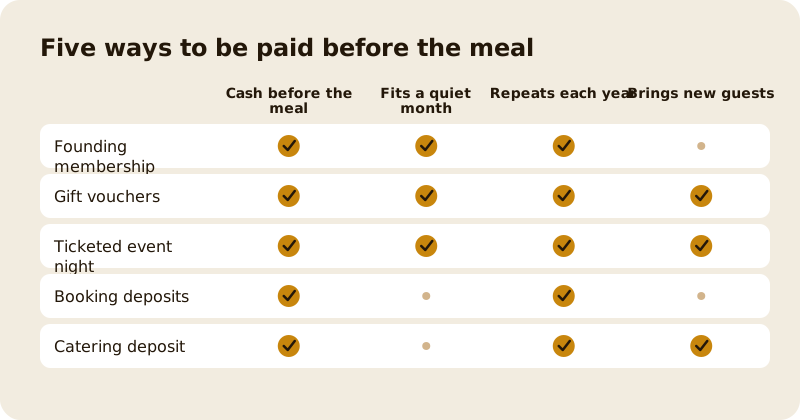
How can a restaurant or café raise money without a bank loan?
There are five routes that put customer money in your account before the plate leaves the pass. Each suits a different gap, so most businesses end up using two or three.
| Route | What the customer buys | When the cash lands | What you owe |
|---|---|---|---|
| Founding membership | A limited run of memberships at a founding price | When they join | Perks for the term |
| Gift vouchers | Credit to spend later, or as a present | When they buy | The meals, at face value |
| Event tickets | A seat on a dated night | When they book | The night itself |
| Booking deposits | A held table or a group menu | When they book | A table, or a refund |
| Catering deposit | A booked date and a quote | On accepting, balance before the day | The job |
On Mosey each of these is taken by card and paid to your own Stripe account, and Stripe's payout schedule moves it to your bank. Nothing waits in a Mosey balance. Mosey takes a commission on the sale, shown on the pricing page, and a booking deposit carries no Mosey fee at all.
The shorter guide on pay now, redeem later explains the idea in a page. This guide is the plan around it: how much, when, and how to keep your word.
Is money paid ahead really not a loan?
It is not a loan, and it is not income yet either. A loan is repaid in euros, with interest, on a date. Money paid ahead is repaid in meals, with no interest, whenever the customer chooses to come. Until they do, it is a liability: you hold their money against a promise.
That difference decides how you should use it. Pre-sales are good at moving cash earlier, so they fix a timing gap: January rent after a quiet month, a deposit on a new oven, stock for a summer terrace. They do not fix a business that loses money on every plate. If you spend voucher money on last month's wages and the meals arrive in March, you have borrowed from March without any paperwork.
The test is simple. Can you cook every meal you have sold, at today's food and wage costs, from the money you will have on the day? If yes, selling ahead is a smart way to smooth a year. If no, talk to your accountant before you sell another voucher. This is general guidance, not financial advice.
How much could you realistically raise?
Here is a worked example. The numbers are round and invented, for a 40-seat café, so replace them with your own.
- A founding membership run. 50 founding members join on a quarterly plan at 70 euros a quarter: 3,500 euros in the first week.
- December vouchers. 120 vouchers at an average of 50 euros: 6,000 euros, mostly bought in the last three weeks of the year.
- One ticketed night in February. 30 seats at 55 euros: 1,650 euros, a month before the night.
- Two catering bookings. 1,200 euros each, with a 30 percent deposit on accepting: 720 euros, then the balances before each job.
That is about 11,900 euros in cash before the meals, roughly 5,900 from vouchers and the rest from members, tickets and deposits. In this example the meals owed at menu price add up to the same figure, and if your goods cost about 30 percent of menu price, the food for them costs roughly a third of it. The cash is real. The profit arrives as each meal is served.
So split the example in two. The goods and the labour to honour it are not spendable. The margin is spendable only as the meals are served, unless you have a reserve. A fair rule: spend on a timing gap you can name, such as one month's rent, and keep the rest in your account until it is redeemed.
Which route suits which gap?
Match the money to the problem, not the other way round.
- A slow January and February. Christmas vouchers, bought in December and spent after it. The Christmas voucher guide plans that season in full.
- A one-off cost, such as new equipment. A founding membership run raises a lump sum from your best regulars in a week.
- A quiet weekday. A prepaid offer for that slot, or a ticketed night, fills it and pays before you buy stock. The prepaid offers guide covers pricing it so the food still pays.
- A busy weekend you cannot afford to lose to no-shows. Booking deposits.
- A gap between big jobs. A catering booking with a deposit, or a company order for staff gifts.
If you only try one, start with the one your customers already ask about. Regulars often ask whether you do vouchers before they ask about anything else.
How does a founding membership drop raise cash?
A membership turns your most loyal customers into a funded base. A founding drop is a limited number of early memberships at a founding price, so the offer has an edge and a reason to act now.
On Mosey, you start from a template, such as a coffee pass, a mug club, a supper club or a founding member plan, and a margin check warns you when the most a member could redeem in a month would cost you more than they pay. It warns and never blocks, so the choice stays yours. While a guest checks out, their spot is held for ten minutes, and when the run sells out guests can join a waiting list and are told once if a spot opens. While a plan is live you can send your members up to four letters a month at no charge, and one of them can also go as a push.
Cash arrives when they join, and a quarterly or yearly term lands more of it up front than a monthly one. Set the term to the gap you are filling. The step-by-step plan is in the founding drop guide, and the maths of the plan is in pricing a membership and checking the margin. Mosey's commission on a membership is 8% of the subscription price. More on the decision itself is in should your restaurant launch a membership, and on pre-paid credit in prepaid credit passes.
How do vouchers, tickets and deposits fill the other months?
These three work all year, and each earns something more than cash.
Gift vouchers bring in people who have not eaten with you yet, because the buyer is often a regular and the guest is new. Offer two or three round values, name them for what they buy, and make one cover a real evening for two. Mosey takes 4.5% of the value, and the buyer pays a small booking fee of €1.29 on top, so the guest, not you, carries that fee. Stripe's card fee is passed to you at cost. The gift voucher guide covers values and timing.
Event tickets give you a dated number to buy and roster for. A supper club or a tasting night with 30 seats sold is a known night. Mosey takes 4% of the ticket price, the guest pays the booking fee, and there is no monthly charge.
Booking deposits protect the tables you cannot refill. Deposits start on the Starter bookings plan at €79.99 a month, and the deposit itself carries no Mosey fee on any plan. The deposit is taken at booking, goes to your own Stripe account, and is refunded in full when the guest cancels in time. The deposits guide has the set-up.
How do you get paid ahead by companies and big groups?
Large orders are where a deposit matters most, because the cost of getting it wrong is a day of food.
For catering, a customer sends a request, you quote, they accept and pay a deposit, and the balance falls due before the job. Mosey's commission to you is 3%, and the customer pays a catering booking fee of 3%, capped at €120. The catering payment guide sets out terms to put in the quote.
For a large party, a set menu with a deposit per head holds the room, and the booker can split the deposit with their guests so nobody chases friends. Set menus are taken in the Mosey app, not through your website widget.
For companies, staff gift vouchers at Christmas are a bulk order paid in advance. The company voucher guide covers the approach. Your usual voucher commission applies, and the company pays a corporate service fee of 3% on top, so that fee never comes out of your share.
What do you owe the customer, and what does the law say?
Selling ahead creates duties. Four matter.
- Gift vouchers last at least five years. The Competition and Consumer Protection Commission says a voucher with an expiry date must have one at least five years from purchase, and a shorter term is treated as five. The expiry must be given in writing, and a guest cannot be made to spend the whole voucher in one go. Mosey will not save a shorter expiry, and a part-used voucher keeps its balance for the next visit.
- Many online buyers can cancel within 14 days. The Commission says a consumer who buys a service online, by phone or on the doorstep can cancel within 14 days without giving a reason, and may pay for what was already supplied. On Mosey, this applies to vouchers, promotion tickets, online courses and the first cycle of a membership. A membership refund is automatic only while that first cycle is untouched. The guide to taking payment before the customer comes in sets each kind side by side.
- Dated bookings are different. The same guidance says the right does not apply to contracts for a specific date or period, such as catering or leisure activities. So an event ticket, a booked table and a catering date follow your own cancellation terms. Write them before you sell.
- Tell people what they are buying. If a trader does not tell the consumer about the right to cancel, the Commission says the period can stretch to twelve months. Put your terms where the guest buys.
Ask your accountant how to record unspent balances and when VAT falls due, as that depends on what each sale covers.
How do you keep the promise, and what do you do this month?
The risk in selling ahead is not the sale. It is spending the cash and then being unable to serve what you sold. Four habits prevent it.
- Keep a running total of what is owed. Mosey's Vouchers page shows what you owe in unspent voucher credit, how old it is and what lapses soon. Add members and ticket holders to the same sheet.
- Ring-fence the cost of the food. Keep roughly your goods cost, plus the wages for the covers, in a separate account until the meals are served.
- Cap what you sell. Limit founding spots, tickets per person and offers per month, so redemption stays within what the kitchen can do.
- Spread the redemption. Dates, per-person limits and quiet-hour windows stop 100 vouchers landing on one Saturday.
Review the sheet on the first of the month. If owed meals are growing faster than you serve them, slow the selling down.
Here is the ring-fence on the example café. Of the 11,900 euros raised, keep goods and wages for the meals owed in a separate account, then release the margin month by month as meals are served. If 100 of the 120 vouchers are redeemed by the end of March, release the margin on those 100 and leave the rest where it is. The example is round on purpose. Your own food cost and wage bill set the real reserve, so work them out from last quarter's figures before you sell.
Tell customers what they are buying, too. A line on the voucher page, such as "valid for five years, one visit or several", saves a phone call later. The same goes for a membership: say what the perks are, what the cap is and how to cancel. People who understand the offer spend it, and people who spend it come back.
Then act this month:
- Write down the gap you are filling, in euros and in weeks.
- Pick the route that matches it from the list above.
- Check the margin: what does one redeemed meal cost you?
- Write your cancellation terms before you sell.
- Set a cap, a date and a reserve rule.
Then set it up. When you are ready, Host on Mosey free, connect your Stripe account and switch on the route you chose. Compare the Starter bookings plan on the pricing page, see gift vouchers on Mosey for how selling and redeeming work, and plan the weeks ahead with a 13-week cash flow plan. More guides are on the business page.
This guide is general information, not legal, tax or financial advice. Rules change and depend on your business and where it is, so check the current rule with the official body named in the guide and take advice from a solicitor or accountant in your area before you act.
Questions
Common questions
How can a restaurant get funding without a bank loan?
Sell meals before you serve them. Memberships, gift vouchers, event tickets, booking deposits and catering deposits all bring customer money in early. It is not borrowed, but it is money for a service you still owe, so it fits timing gaps rather than losses.
Is selling vouchers and memberships the same as a loan?
No. A loan is repaid in euros with interest. Money paid ahead is repaid in meals, with no interest, and sits as a liability until the customer is served. Ask your accountant how to record it and when VAT applies.
How much money can a small café raise by selling ahead?
It depends on your regulars and the season. As an example only, a 40-seat café might raise around 12,000 euros from a founding run, December vouchers, one ticketed night and two catering deposits. Most of it is owed back in meals.
Do I have to give refunds on vouchers and memberships?
Often, yes. The Competition and Consumer Protection Commission says most online buyers of services can cancel within 14 days. On Mosey this covers vouchers, promotion tickets, online courses and a membership first cycle. Dated events and catering follow your own terms.
How long must a gift voucher last in Ireland?
At least five years from purchase if it has an expiry date. The Commission says a shorter stated term is treated as five, and the expiry must be confirmed in writing. Vouchers sold before 2 December 2019 are outside the rule.
Can I spend the money from pre-sold vouchers straight away?
You can, but you should not spend all of it. The meals are still owed, so keep the cost of the food and labour for them aside, and spend the margin as meals are served. Pre-sales suit a timing gap, not a loss.
What does it cost to take money in advance on Mosey?
There is no monthly fee for vouchers, tickets or memberships, only a commission when you sell, plus Stripe card fees at cost. Booking deposits carry no Mosey fee, though deposits need the Starter bookings plan. The pricing page lists every rate.
Where does the money go when a customer pays on Mosey?
To your own Stripe account, which pays out to your bank on your normal payout schedule. Mosey does not hold customer money. Your business, your customers and your prices stay yours, and you connect Stripe when you host on Mosey.
More like this
Read next
A hotel restaurant that locals use too
A hotel dining room earns local trade when it acts like a restaurant of its own. Here is why locals stay away, how to set the dining room up on Mosey beside your hotel, and which offers fill it.
An alcohol-free drinks menu that still makes margin
More guests are drinking less, in January and the rest of the year. Here is how to cost, price, name and sell an alcohol-free menu so it earns as well as the wine list, with the Irish VAT and offer rules checked.
A pub that does food: making the kitchen pay
A pub kitchen pays when its gross profit covers its own wages and running costs. Here is how to count it, which services to fill, what the alcohol rules say and how Mosey fits.
Auto-enrolment pension for Irish restaurants and cafés: what you pay and do
Since 1 January 2026 an Irish employer matches the pension contribution of each eligible employee. Here is who counts, what it costs on a wage bill, the payroll steps and what staff can opt out of.
Get started
Host your business on Mosey. It is free to claim.
Free to list, no set-up fee, and Order Ahead is 1.5% commission when you start taking orders.