
For businesses
How to take payment before the customer comes in
Mosey · 15 November 2026 · 7 min read
To take payment before the customer comes in, match the method to the visit: a deposit or a card hold on a table booking, a per-head deposit when a group books a set menu, a ticket for a dated night, a paid pre-order for collection, a prepaid offer for a quiet slot, and gift vouchers and memberships for money months ahead. Each one puts cash in your account before the food is bought, and each one gives the guest a reason to turn up.
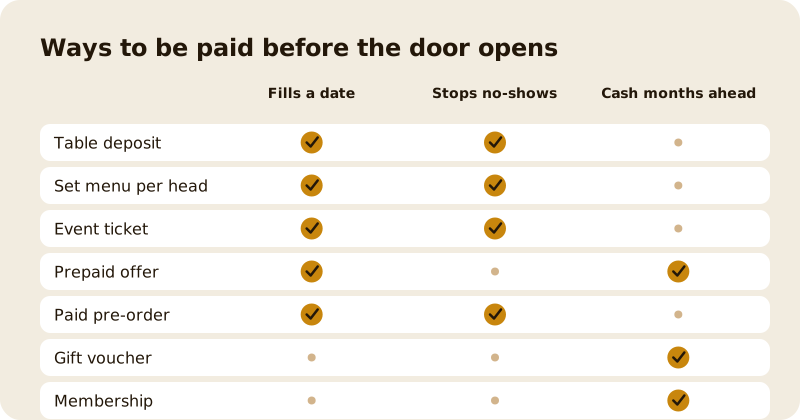
Why does money up front change a quiet week?
Rent, wages and the fish order fall due whether the room fills or not. In a quiet week the takings arrive late and in small amounts, and every bill seems to land at once. Money taken in advance turns that around: the cash is in before you order the food, and you know how many people are coming before you write the rota.
It changes behaviour too. A guest who has paid something turns up, or tells you they cannot. A group that has chosen and paid for its food arrives with fewer questions. Someone given a voucher in December comes in during January, when you need them most.
It is not a loan, and it is not free money. Money paid ahead is a promise of food, drink or a seat that you still have to deliver, and some of it will come back as refunds. Treat it as cash you are minding until the day, not cash you have earned. The cash flow guide shows how to plan around it.
Which way of being paid in advance suits your business?
Start from what you sell and when people decide to buy it.
- A restaurant that takes bookings: a deposit or a card hold on the nights that fill, and a per-head deposit when a big group books a set menu.
- A bar or restaurant that runs dated nights: tickets for a tasting, a supper club, a launch or a chef's table.
- A café, bakery or deli: paid pre-orders for collection, so the order is on your list and the money is in before you bake.
- Anyone with a dead slot: a prepaid offer for that slot, sold with a cap and an end date.
- Anyone with regulars: gift vouchers for the people who send their friends to you, and a membership for the people who come every week.
- Anyone who caters: a deposit to hold the date and a balance before the day.
Most businesses need two or three of these, not all of them. Pick the ones that fix the problem you have now: empty tables, no-shows, a cash gap after Christmas or food bought for people who never came.
How do you take a deposit on a table booking?
A deposit is a small commitment at the moment of booking. It does not have to be large to work, because most no-shows are forgetting, not deciding. Ask for it on the nights you turn people away and for larger parties, rather than on every booking in the diary.
A card hold is the softer version. The guest's card is saved and charged only if they do not turn up, so the guest who comes pays nothing extra up front. It suits a busy room where you want protection without putting off the regular who books every Friday.
For a big group, go further. When twelve people book, ask them to choose a set menu and pay a deposit per head, up to the full price of the menu, so the food is paid for before it is cooked. The group pre-order guide covers getting a big table to choose in time.
Whatever you charge, write the rule down and show it before the guest pays. The cancellation and deposit policy guide has wording guests accept.
How do you sell a seat, a meal or a deal before the day?
Tickets suit anything with a date and a fixed number of seats. You know the headcount before you order, and a sold-out night can keep a waitlist. The ticketed event guide shows how to check a night pays before you announce it.
Paid pre-orders suit food that is made ahead: a celebration cake, a roast to take home, a Christmas box. The customer picks a collection time and pays when they order, so the order is real before you start. For bespoke work booked weeks out, the cake deposit guide explains how to take part of the money first.
A prepaid offer sells a quiet slot in advance: a set lunch on a Tuesday, coffee and cake at four o'clock. It works when it has edges: a date range, a cap on numbers and a limit per person. The prepaid offers guide covers pricing one so it still pays.
How do gift vouchers and memberships pay you months ahead?
A gift voucher is a meal bought today by one person for another. The buyer pays at once, the person who receives it comes in later, and they often bring someone with them. The gift voucher guide covers when people buy and which values to sell. Companies buy them too, for staff and clients, as the company voucher guide explains.
A membership is paid monthly or yearly by your best regulars: a coffee pass, a supper club, a founding membership for a new opening. The money arrives on the same day every month, which makes a slow month easier to plan. The coffee subscription guide shows one built for a café, and the membership pricing guide checks the perks against the fee.
For catering, a deposit holds the date and the balance falls due before the job. The catering payment guide covers the terms to set.
What do guests accept, and what puts them off?
Guests accept paying ahead when the reason is obvious. A ticket for a dated night, a deposit for a party of ten and a cake made to order all make sense to the person paying. A deposit on a Tuesday lunch for two does not, and it sends people to the café next door.
They are put off by surprises. A deposit that appears at the last step, a cancellation rule they cannot find, a voucher that cannot be used on Saturdays: each reads as a trap. Say the rule in one sentence before they pay, and keep it the same every time.
They like control. A guest who can cancel inside a fair window, hand the booking to a friend or move the date without ringing you is happy to pay first. Make the way out easy and fewer people need it.
Refunds, cancellations and voucher expiry are covered by Irish consumer law, so check the current rule with the Competition and Consumer Protection Commission before you write your own.
How does Mosey take the money for you?
Mosey is Irish-built and Irish-run, and every method on this page sits in one login, with the money going to your own Stripe account. Stripe's card fee is passed through at cost.
- Reservation deposits and card holds: no Mosey fee on the deposit at any plan. Deposits start on the Starter plan at €79.99 a month, and card holds are on Host at €169.99 a month.
- Event tickets: 4% of the ticket price, with a waitlist and check-in at the door.
- Prepaid offers: 4.5% of what the guest pays, with the caps, limits and hours you set.
- Pre-orders for collection: 1.5% of the food, scheduled from thirty minutes to seven days ahead and paid at checkout.
- Gift vouchers: 4.5% of the value when one is sold, in the app, on the website or at your counter.
- Memberships: 8% of the subscription when a member pays.
- Catering: 3% of the job, with the deposit and the balance paid in the app.
Guests pay a small booking fee on an online order, scaled to the order, and a flat booking fee on purchases such as vouchers and tickets. See pricing for every figure, and reservations on Mosey for what a guest sees when they book.
Where should you start this week?
Look at last month and find the one thing that cost you most: the Friday no-shows, the group that changed its order at the table, the cakes nobody collected or the empty room in January. Pick the method that fixes it and set it up before the next busy weekend. Host on Mosey free, connect your Stripe account and switch on the one you need first.
More in the guides for food businesses.
This guide is general information, not legal, tax or financial advice. Rules change and depend on your business and where it is, so check the current rule with the official body named in the guide and take advice from a solicitor or accountant in your area before you act.
Questions
Common questions
Is taking money in advance the same as a loan?
No. A loan is money you pay back with interest. Money taken in advance is paid for food, a seat or a voucher you still have to provide, so treat it as owed until the day and keep enough aside for refunds.
Will a deposit put people off booking?
Not when the reason is clear and the rule is shown before they pay. Ask for one on busy nights and big groups rather than every booking, and use a card hold where you want protection without an up-front charge.
What is the difference between a deposit and a card hold?
A deposit is paid when the guest books. A card hold saves the guest's card and charges it only if they do not turn up, so a guest who arrives pays nothing extra in advance. On Mosey card holds are part of the Host plan.
Does Mosey take a cut of reservation deposits?
No. Reservation deposits carry no Mosey fee on any plan. They go to your own Stripe account, and Stripe's card fee is passed through at cost. The plan itself is a flat monthly price shown on the pricing page.
Can guests pay in advance without the Mosey app?
Yes, for some things. The booking widget on your own website takes a deposit without an account, and gift vouchers can be bought on the Mosey website after a sign-in link is sent to the buyer's email.
What happens to the money if I have to cancel?
The guest gets it back. If you cancel an event every confirmed ticket is refunded, and an order you cancel is refunded in full. Keep money taken in advance separate in your planning so a cancellation never leaves you short.
More like this
Read next
A hotel restaurant that locals use too
A hotel dining room earns local trade when it acts like a restaurant of its own. Here is why locals stay away, how to set the dining room up on Mosey beside your hotel, and which offers fill it.
An alcohol-free drinks menu that still makes margin
More guests are drinking less, in January and the rest of the year. Here is how to cost, price, name and sell an alcohol-free menu so it earns as well as the wine list, with the Irish VAT and offer rules checked.
A pub that does food: making the kitchen pay
A pub kitchen pays when its gross profit covers its own wages and running costs. Here is how to count it, which services to fill, what the alcohol rules say and how Mosey fits.
Auto-enrolment pension for Irish restaurants and cafés: what you pay and do
Since 1 January 2026 an Irish employer matches the pension contribution of each eligible employee. Here is who counts, what it costs on a wage bill, the payroll steps and what staff can opt out of.
Get started
Host your business on Mosey. It is free to claim.
Free to list, no set-up fee, and Order Ahead is 1.5% commission when you start taking orders.