For businesses
Restaurant insurance in Ireland: what cover you need
Mosey · 22 November 2026 · 10 min read

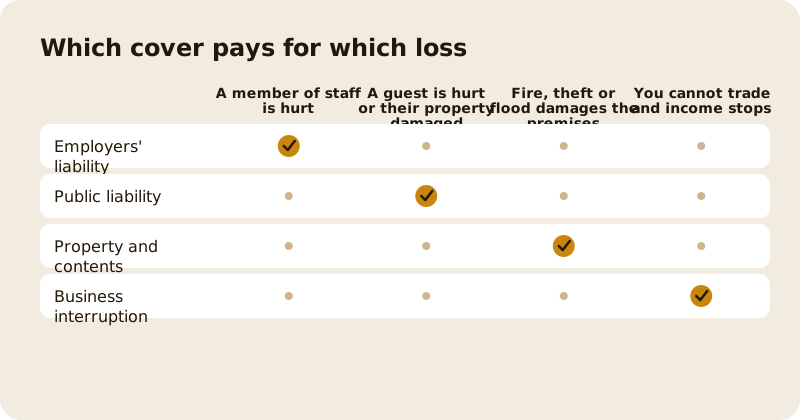
A restaurant or café in Ireland usually carries four kinds of cover: employers' liability (a member of staff is hurt), public liability (a guest is hurt or their property damaged), property and contents (fire, theft, flood) and business interruption (income lost while you cannot trade). The Central Bank and the CCPC say the first two are not compulsory by law, though most businesses hold them.
Is insurance a legal requirement for a restaurant in Ireland?
Not in the way many owners assume. The Central Bank says employers' liability "is not a compulsory class of insurance in Ireland but most employers will take out this cover". The CCPC, in its market study of public liability insurance, says it is not a legal requirement either, but is "usually seen as a necessary part of doing business". In that study, 97% of the organisations the CCPC surveyed held a policy.
So the law is not what makes you buy it. These do:
- Your lease. A landlord can require public liability and property cover, and name what the limits must be.
- Your lender or an event organiser. Some ask to see the certificate.
- Your own exposure. The Central Bank's reasoning for employers' liability is that without it you are liable for compensation if an employee has an accident or becomes ill because of work and you are held responsible.
One caution. Rules change. Ask your broker and your solicitor what applies to your premises and your licence, and check the current rule with the Central Bank or the CCPC before you open. Motor insurance is different: the Central Bank says it is required by law, so a vehicle you use for delivery needs its own cover.
What does employers' liability insurance cover?
Injury or illness to your staff. The Central Bank defines it as cover against legal liability to compensate an employee, or their estate, for bodily injury, disease or death suffered through the employer's negligence in the course of employment, and says damage to an employee's property is usually covered too.
In a kitchen, think of a burn from a fryer, a cut, a slip on a wet floor, a strain from lifting or an injury on the cellar stairs. The cover answers a claim made against you, which is why it matters even in a small team.
Three points to settle with your broker:
- Who counts as an employee. Part-timers, students, trainees and casual or seasonal staff. Ask how agency workers and people on work experience are treated.
- The limit of cover. The most the insurer will pay on one claim.
- The wage roll. The CCPC notes that payroll or turnover is one of the factors in a premium, so a figure that is out of date leaves you either overpaying or under-covered.
What does public liability insurance cover?
Injury to guests, and damage to their property, caused by your business. The CCPC defines it as cover against potential liability for damage or injury to members of the public arising from business activities, and calls it an integral part of the cover for organisations that deal with the public.
For a restaurant, that is the guest who slips on a wet floor, the diner whose coat is damaged by a spilled drink, a falling sign above the door or a customer who is injured by a hot plate. It also reaches outside the building: tables on the pavement, a market stall or a catering job at someone else's premises.
Ask your broker whether the policy includes product liability, the claim that something you served made a guest ill. Some policies include it with public liability and some treat it separately, so a food business should not guess. Also ask whether the policy covers catering and events away from your premises, delivery and a pop-up. If you serve a guest who has told you about an allergy, your allergen records are part of how you show you took care.
What does property and contents insurance cover?
The building, if you own or must insure it, and everything inside. The Central Bank defines commercial property insurance as cover for loss of or damage to buildings and their contents from perils such as fire, theft and natural disaster.
In a restaurant the contents are the expensive part:
- Fit-out: the bar, the banquettes, the lighting and the extraction.
- Kitchen equipment: ovens, fryers, dishwashers and refrigeration.
- Stock: food, drink and packaging.
- Tills, screens, laptops and phones.
Read your lease to see who insures what. In some leases the landlord insures the structure and the tenant insures the fit-out and contents, but your lease decides. Ask whether stock lost when the fridge fails is covered and under what conditions, because some policies treat it separately.
The Central Bank makes one point in its buying guidance for home insurance that applies here too: use correct values, because being under-insured can leave gaps in cover when you claim. Value your fit-out at what it would cost to replace, not what you paid for it.
Do you need business interruption cover?
It pays when a covered event shuts you down and your income stops. The Central Bank's claims report notes that commercial property insurance can include business interruption cover, and that business interruption claims rose sharply in 2020 because of COVID-19 restrictions. That is a reminder to read how far a policy goes. Ask your broker three things:
- What triggers it. A fire at your own premises is the usual case. Ask about a flood next door, a utility outage, a road closed by the council and an infectious disease.
- The indemnity period. How long the insurer pays after the event. A rebuild after a serious fire can take longer than the period you chose.
- What is covered. Lost gross profit, staff wages and fixed costs, such as rent and loan repayments, while you are closed.
Weigh it against your cash. A restaurant with three months of costs in the bank faces a different risk from one with three weeks, so put the answer in your cash flow plan.
Which other covers should you ask about?
Some are optional and some belong inside the main policies. Ask which are included, which cost extra and which you do not need.
- Stock deterioration from a refrigeration failure or power cut.
- Cyber and data cover if you hold customer details or take orders online.
- Legal expenses.
- Glass and signage.
- Money on the premises and in transit.
- Goods in transit and delivery if you deliver food yourself.
- Alcohol. If you hold a licence, ask that the policy accounts for it. The licensing guide sets out the licences.
You do not need all of these. A written list of what is in and out, with the limits and excesses, is worth more than a long schedule you have not read. The CCPC defines the excess as the amount you pay from your own funds when a claim is paid. A higher excess lowers the premium and raises what you absorb on a claim, so pick the figure your cash can meet.
What should you have ready before you ask for a quote?
Five things, gathered once, answer many of a broker's questions. A worked example, with round numbers that are illustrative only: a café with eight staff, a rented unit and a small fit-out.
- The people. How many staff, full-time and part-time, and a figure for the year's payroll, from your payroll provider.
- The takings. Last year's turnover and this year's forecast, from your own books.
- The premises. Whether you own or rent, a copy of the lease and the insurance clause in it, and what is in the unit. Say whether the kitchen has an extraction system.
- The replacement cost. A list of fit-out and equipment priced as new. In the example, a café that paid for second-hand equipment still values it at what replacing it would cost today.
- The history. Any claims or incidents in the past few years, and what you changed afterwards. An honest answer is the one you can stand behind when you claim.
Give the same facts to every broker or insurer you ask, so the quotes can be compared.
How do you buy cover and compare quotes?
Start with the facts an insurer asks for, then check who you are buying from. The CCPC lists the nature of the risk, payroll or turnover and the level of excess among the factors in a premium, and a broker will ask for the first two.
- List what you must insure. Premises, fit-out, stock, staff and turnover. Add an honest description of what you do, including delivery, events and late hours.
- Check the seller. The Central Bank says to check that the firm is regulated, using its registers, and warns about "ghost brokers" who sell forged or invalid policies. If a firm is not authorised, do not use it. This guide names no broker.
- Compare like with like. Same limits, same excess, same period of indemnity, same exclusions. A cheaper quote with a narrower definition costs more when you claim.
- Read the schedule and the exclusions before you pay, not after.
- Keep every document and a note of what you were told. For what shapes a premium and how to present your risk, see insurance costs for Irish restaurants and cafés.
- Diary the renewal. The Central Bank's code requires a renewal notice at least 20 working days before a motor or home policy ends. Do not assume a business policy works the same way: ask what your own policy promises.
What should you do after an accident or incident?
Act the same day, and write it down. The HSA's guide for hotels, restaurants, catering and bars sets out the steps:
- Look after the person, then preserve the scene as far as you safely can. Take photographs and video.
- Report the incident. Accidents that keep someone off work for more than three days, and dangerous occurrences such as serious fires, must be reported to the Health and Safety Authority. The HSA also says to report to your insurance company as required, so read your policy for how soon.
- Investigate. Draw up a report, interview the people involved and any witnesses, and record what they say.
- Keep records, labelled and accurate.
- Fix the cause. Revise the risk assessment and safety statement, then train staff on the change.
The HSA says the law requires employers to identify hazards, carry out a risk assessment and prepare a written safety statement. An insurer that asks how you manage risk is asking for those documents, so keep them where you can find them.
If you are unhappy with how a claim or a sale was handled, complain to the insurer or broker first. The Central Bank says you can then go to the Financial Services and Pensions Ombudsman, which the FSPO says deals with complaints from consumers, including small businesses. The Central Bank's Consumer Protection Code covers incorporated businesses with a turnover under €5m in the previous year, so ask which protection applies if you trade as a sole trader or partnership.
How does Mosey help you stay ready for a claim?
Mosey does not sell, arrange, compare or check insurance, and nothing on Mosey replaces a broker. It does not run your payroll, keep your register of under-18s or deal with the WRC or the HSA for you either. What it does is keep the staff and training records you reach for when an insurer, a broker or the HSA asks how you run your restaurant or café.
- People and contracts. Each person has a record with role, start date and contract. See staff, rotas and training.
- Training certificates. Courses assigned to staff are recorded, and a completed course produces a certificate stored on that person's record. The training guide shows how to keep the file current, and the allergen training guide covers the one most worth dating.
- Hours. Staff clock in and out, you approve the hours and export them. Your payroll figure still comes from your payroll provider or accountant, who runs pay.
Records do not lower a premium on their own, and an incident is still an incident. They make your answers quick and your file complete. The pricing page lists what each part of Mosey costs.
If you are opening, the guide to opening a restaurant in Ireland puts insurance in order with the licence, the registration and the lease. Host on Mosey free, add your menu and open for bookings, so the room fills while the paperwork finishes. Every other guide for Irish food businesses is on the business guides page.
This guide is general information, not legal, tax or financial advice. Rules change and depend on your business and where it is, so check the current rule with the official body named in the guide and take advice from a solicitor or accountant in your area before you act.
Questions
Common questions
Is public liability insurance compulsory for a restaurant in Ireland?
The CCPC says public liability is not a legal requirement but is usually seen as a necessary part of doing business. A landlord, lender or event organiser may still require it. Ask your broker and your solicitor what applies to your premises.
Is employers' liability insurance compulsory in Ireland?
The Central Bank says it is not a compulsory class of insurance in Ireland, but most employers take it out, because otherwise they would be liable for compensation if an employee is injured or made ill through work. Check the current rule with a broker or solicitor.
What is the difference between employers' liability and public liability?
Employers' liability answers a claim by a member of your staff injured or made ill by work. Public liability answers a claim by a guest or other member of the public injured, or whose property is damaged, by your business.
What does business interruption insurance cover for a restaurant?
It pays when a covered event, such as a fire, stops you trading and your income falls. The Central Bank says commercial property policies can include it. Ask what triggers it, how long it pays and which costs it covers.
Does public liability cover food poisoning?
Not automatically. Ask your broker whether the policy includes product liability, the claim that something you served made a guest ill, and whether it covers catering, events and delivery away from your premises. Get the answer in writing.
How do I check that an insurance broker is genuine?
The Central Bank says to check that the firm is regulated, using its registers, and to avoid ghost brokers who sell forged or invalid policies. If a firm is not authorised for the service, do not use it.
What should I do after a customer or staff accident?
Look after the person, preserve the scene with photographs, report to the Health and Safety Authority if the HSA's rules apply, tell your insurer as your policy requires, investigate and keep records. Then update your risk assessment and safety statement.
Does Mosey sell or arrange restaurant insurance?
No. Mosey does not sell, arrange, compare or check insurance, and it does not run payroll. It keeps staff records, signed contracts, training certificates and approved hours in one place, which helps when a broker, insurer or the HSA asks how you run the business.
More like this
Read next
A hotel restaurant that locals use too
A hotel dining room earns local trade when it acts like a restaurant of its own. Here is why locals stay away, how to set the dining room up on Mosey beside your hotel, and which offers fill it.
An alcohol-free drinks menu that still makes margin
More guests are drinking less, in January and the rest of the year. Here is how to cost, price, name and sell an alcohol-free menu so it earns as well as the wine list, with the Irish VAT and offer rules checked.
A pub that does food: making the kitchen pay
A pub kitchen pays when its gross profit covers its own wages and running costs. Here is how to count it, which services to fill, what the alcohol rules say and how Mosey fits.
Auto-enrolment pension for Irish restaurants and cafés: what you pay and do
Since 1 January 2026 an Irish employer matches the pension contribution of each eligible employee. Here is who counts, what it costs on a wage bill, the payroll steps and what staff can opt out of.
Get started
Host your business on Mosey. It is free to claim.
Free to list, no set-up fee, and Order Ahead is 1.5% commission when you start taking orders.