
For businesses
How much to charge for a cooking class
Mosey · 15 November 2026 · 7 min read
Charge for a cooking class by costing one seat first, then adding the margin the room has to earn for giving up a service. Add the ingredients, the paid hours, anything people take home and the fees, divide by the seats you will really fill, and price above that. A price set by looking at what others charge, without your own cost under it, can fill every class and still lose money.
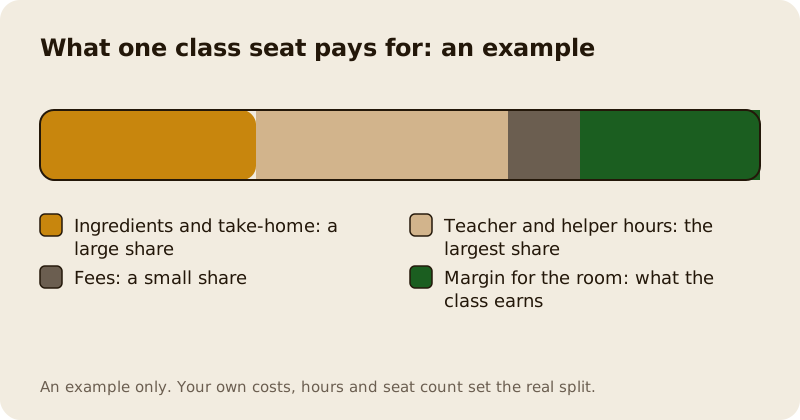
What goes into the cost of one class seat?
List every cost the class creates, then share it across the seats. Most owners remember the food and forget the hours.
- Ingredients per person, including what gets spoiled in practice. Learners burn, drop and over-pour, so allow more than the recipe says.
- The teacher's paid hours, counted from set-up to the last clean pan, not only the class itself.
- A helper's hours. Even a small class needs someone to fetch, wash and watch.
- Take-home extras: boxes, jars, printed recipe cards, an apron if you give one.
- Kit you buy for classes, spread over the classes it will serve: portable hobs, extra knives and boards.
- Fees: the card fee and the booking platform's share.
- The room. If the class runs when you would otherwise be open, the profit you would have made from that service is a cost too.
Do not forget the smaller costs that pile up: the laundry for aprons and cloths, the extra cleaning, the electricity for hobs and ovens running outside service, and the printing. Each is small, but together they can take a real slice of the margin.
The last line is the one that decides whether a class is worth running. A class on a day you are closed only has to beat zero. A class in place of a busy lunch has to beat that lunch.
How do you work out a price from the cost?
Add up the costs that do not change with numbers (the teacher, the helper, the kit share, the room) and divide them by the seats you expect to fill, not the seats you have. Then add the costs per person (ingredients and take-home) and the fees.
Here is a worked example with round numbers, to show the method rather than a market rate. Fixed costs of €240 shared across 8 seats come to €30 a seat. Ingredients and a take-home jar add €15, so the seat costs €45 before fees and margin. Adding a margin of a third takes the seat to €60, and the fees are added on top before you settle on a round price.
| Line | Per seat |
|---|---|
| Teacher, helper and kit share (fixed costs over 8 seats) | €30 |
| Ingredients and take-home | €15 |
| Cost of the seat before fees | €45 |
| With a margin of a third | €60 |
Now test it the other way. If only 6 people book, the fixed costs per seat rise to €40 and your margin shrinks. Decide the smallest class you will run, and set a date by which you cancel if it is not reached, refunding everyone.
Use your own figures. The ticketed event guide runs the same break-even sum for any ticketed night, including a wine tasting, and food cost and gross profit explains the margin side.
How do you price a private class against a public one?
A public class is priced per seat. A private class for a group (a birthday, a hen party, a work team) is priced for the room, because the group has bought every seat and the date that goes with it.
Set a minimum for a private class: a minimum number of guests, or a minimum spend, whichever suits you. Charge for the seats on top of that, and price drinks separately so the group can choose. Take a deposit to hold the date, because a private class that cancels late costs you the whole day.
A private class can carry a higher price per head than a public one. The group gets the room to itself, a date of its choosing and often a menu built for the occasion. The team-building class guide covers selling them to local companies.
Should an in-person class cost more than an online course?
Usually, yes, because an in-person class has a cost for every person who comes and an online course does not. Once you have filmed an online course, the next learner costs you almost nothing beyond the fees, so it can be priced lower and still earn more over a year.
The two work well together. A short online course can be the cheaper first step, and the in-person class the treat for people who want to cook beside you. A hybrid course puts the theory online and keeps the class for hands-on time, which lets you teach more in the same hours.
When should you sell a bundle or a series?
Sell a series when one skill takes several sessions to learn: bread over four weeks, a knife-skills course over three evenings. On Mosey, an in-person class can have several dates, and a learner books the whole series in one go and attends each date. Price the series slightly below the sum of single classes, so committing early feels like the better deal.
A bundle suits online courses. On Mosey you can group several online courses into a bundle at one lower price, which lifts the order value from people who would have bought one course and stopped.
Do not discount a class that already sells out. A waitlist is the market telling you the price is right, or low.
How do Mosey's fees fit into the price?
There is no monthly fee for Courses on Mosey. A paid course carries two published rates, a buyer fee and a business commission, with VAT on Mosey's fee, and it comes out of your payout; the learner also pays a flat booking fee shown at checkout. A free course has no fee. The pricing page shows every figure, so put them into your seat cost before you set the price.
If you sell a class as an event ticket instead, for example because one parent or organiser buys for several people, Mosey takes 4% of the ticket price, and Stripe's card fee is passed through at cost. In both cases the money goes to your own Stripe account.
How do you price a children's class or a short taster?
A short class, such as an hour of decorating for children or a quick taster session, has the same fixed costs to set up and clean down as a longer one, spread over less time. Price it on the seat cost, not on the clock, and keep the per-person extras simple.
Children's classes are usually bought by a parent for one or two children, so sell them as event tickets with ticket types (a child alone, or a child with a parent at the bench). A taster class can be the cheaper first step that leads people to your full class, so price it to cover its costs and treat the profit as coming from the next booking. The children's baking class guide covers running them.
When should you raise the price of a class?
Raise the price when a class sells out quickly and keeps a waitlist, when your ingredient costs rise, or when you add something people value, such as a take-home kit. Change it for new dates only; never change the price of a class people have already booked.
Watch the reviews too. If learners keep saying the class was great value, they are telling you there is room. The menu price calculator helps with the food side of the sum when your ingredient prices move.
How do you set your first class price this week?
Write down every cost for one class, divide by the seats you expect to fill, add your margin and the fees, and round to a price you would be glad to pay yourself. Publish one class at that price and see how fast it fills.
Your next job is putting the class on sale. Host your business on Mosey, free to list, and publish your first priced class: Host on Mosey. For the running of the class itself, read how to run cooking classes at your restaurant.
More in the guides for food businesses.
This guide is general information, not legal, tax or financial advice. Rules change and depend on your business and where it is, so check the current rule with the official body named in the guide and take advice from a solicitor or accountant in your area before you act.
Questions
Common questions
How do I work out the cost of one cooking class seat?
Add the fixed costs (teacher, helper, kit share and the room) and divide by the seats you expect to fill. Add ingredients, take-home extras and fees per person. Price above that total with the margin you want.
Should a private cooking class cost more per person?
Often, yes. The group gets the room to itself and a date of its choosing. Set a minimum number of guests or a minimum spend, price drinks separately and take a deposit to hold the date.
What if not enough people book a class?
Decide the smallest class you will run and a date by which you cancel if it is not reached. Refund everyone if you cancel, and try a different day or a lower price for the next date.
Can I sell several classes together at a lower price?
Yes. An in-person class can have several dates booked as one series, and online courses can be grouped into a bundle at one lower price. Price the series slightly below the sum of single classes.
Does Mosey charge a monthly fee for courses?
No. A paid course carries Mosey's published buyer fee and business commission, and the learner pays a flat booking fee at checkout. A free course has no fee. The pricing page lists every figure.
More like this
Read next
A hotel restaurant that locals use too
A hotel dining room earns local trade when it acts like a restaurant of its own. Here is why locals stay away, how to set the dining room up on Mosey beside your hotel, and which offers fill it.
An alcohol-free drinks menu that still makes margin
More guests are drinking less, in January and the rest of the year. Here is how to cost, price, name and sell an alcohol-free menu so it earns as well as the wine list, with the Irish VAT and offer rules checked.
A pub that does food: making the kitchen pay
A pub kitchen pays when its gross profit covers its own wages and running costs. Here is how to count it, which services to fill, what the alcohol rules say and how Mosey fits.
Auto-enrolment pension for Irish restaurants and cafés: what you pay and do
Since 1 January 2026 an Irish employer matches the pension contribution of each eligible employee. Here is who counts, what it costs on a wage bill, the payroll steps and what staff can opt out of.
Get started
Host your business on Mosey. It is free to claim.
Free to list, no set-up fee, and Order Ahead is 1.5% commission when you start taking orders.