
For businesses
A neighbourhood pass: one membership across local businesses
Mosey · 15 November 2026 · 11 min read
A neighbourhood pass is one monthly membership that works at several local businesses, such as a café, a bakery and a restaurant on the same street. One business, the lead, sells it and is paid the whole price. It then pays each of the others the share you agreed in advance. On Mosey, the lead settles with the others itself. Mosey holds none of the money.
Why would neighbouring businesses sell one membership?
A single café can offer a coffee club. Three businesses on the same street can offer something a chain cannot: one price, and a reason to spend a whole morning and evening in one neighbourhood.
You know the problem from your own door. Your regulars come in, but they spend the rest of the day somewhere else. The bakery down the road has the same story. Each of you pays to be found separately, and each of you watches the same people walk past.
A pass turns that around. A member pays once a month and uses the perks at every business in the pass. For a member, the pass is one decision. For you, it is a reason to be the first stop and a reason for the others to send their regulars your way.
It also suits the way independents already work. You do not merge, share a till or hand over your menu. You agree a price, a set of perks and a split, and each of you carries on running your own business.
What is a neighbourhood pass on Mosey, and who gets paid?
On Mosey a pass is the lead business's own ordinary membership, shared with other businesses. The lead sets the price. Members join through the lead's membership, like any other, and the payment goes straight to the lead's own Stripe account.
That detail matters. Mosey's rule is that it holds no customer money, so there is no pot at Mosey that pays the other businesses. The lead is paid the whole price and settles with each business itself, outside Mosey, by the shares you agreed. Mosey records each paid month with the shares as they stood that day. Each month the lead adds up the pass payments it was paid, takes off any refunds, and pays each business its share of that total.
Here is who does what:
- The lead sells the pass, is paid, pays Mosey's fee and pays the other businesses.
- Each other business accepts the invitation, chooses its own perk and is owed its share each month.
- Members pay the lead once a month and use the perks at every business in the pass.
The other businesses need no Stripe account of their own for this, because the lead pays them. They do need to be on Mosey, in Ireland like the lead, and to say yes to the invitation.
How do you split the price fairly?
Split it by shares agreed before the first sale, not by guesswork afterwards. On Mosey each business other than the lead is given a share of the monthly price. The lead's share is whatever the others do not hold, so the shares always add up to 100%.
Two rules in the code shape how you think about it:
- Shares are taken of the price before tax. Mosey's fee is not taken off first, so the lead carries it, not the other businesses.
- Shares are fixed. They do not move with how much each business is used in a month, so a busy month at the bakery does not change what anyone is owed.
Here is a worked example. The numbers are round and are an example only.
| Share | Amount from 40 members at 30 euro a month | |
|---|---|---|
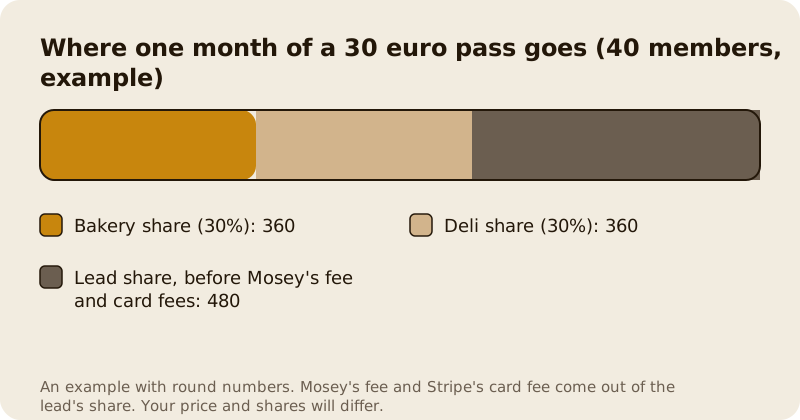
| Restaurant (lead) | 40% | 480 |
| Bakery | 30% | 360 |
| Deli | 30% | 360 |
| Total price taken | 100% | 1,200 |
Mosey's fee on that month is 8% of the price, plus VAT at 23% on the fee, and Stripe's card fee is passed on at cost. Both come out of the lead's side. So the restaurant's 480 is before those fees, while the bakery and the deli are owed their full 360 each. Work out your own fee from the rate on the pricing page before you agree the split.
That is why the lead's share should be bigger than an equal split. The lead sells, carries the fee, answers member questions and takes the risk. A fair split pays for that work.
Test your own numbers before you invite anyone. For each business, work out what a member who uses every perk costs it, and check the share still leaves a margin. The guide to pricing a membership and checking the margin shows how.
Who should you ask to join?
Ask businesses whose customers are your customers, and whose products do not compete with yours. A café, a bakery and a restaurant on one street work. Two cafés side by side selling the same coffee will find the split harder.
Look for these in a partner:
- Open hours that overlap with yours. A member should be able to use a perk on the same day at more than one business.
- Similar standards. A member who loves your food will judge the pass by the weakest business in it.
- A perk that costs them little and means a lot to a member. A free pastry or a percentage off a coffee does more than a vague "discount".
- An owner who answers. You are going to settle money each month, and you want someone who replies.
You need at least two businesses to publish the pass page, and the lead must have given every business a share first. Start with two or three. A small pass you can run well beats a long list you cannot.
On Mosey, you search for a business and invite it from the memberships page, set its share when you invite it, and the business accepts. When it accepts it chooses the perk it will give. The pass then gets its own page on the Mosey website, with its own address, a headline you write, the businesses in it, the perks at each and the price.
What does the lead take on?
The lead takes on more than the others, so be honest about it before you volunteer.
- The sale. Members join through your membership and pay your Stripe account. You are the business on the card statement.
- The tax on the sale. The pass is sold by you. Ask your accountant how the shares you pay out are treated in your accounts and for VAT. Mosey does not file VAT or give tax advice.
- Mosey's fee. 8% of the price, as the example shows, on every member and every month.
- Paying the others. On time, by the agreed shares, outside Mosey. If you are late, the other businesses are the ones waiting.
- Refunds and cancellations. A member who cancels or is refunded is your member. Agree that a refunded payment is left out of the month's total, so the other businesses are not paid a share of money you gave back.
None of this is a reason not to lead. It is a reason to be paid for it, in your share, and to pick the lead because they are organised, not because they are the biggest.
What can a pass not do?
Knowing the limits stops a disagreement before it starts.
- It is monthly. The pass plan is billed monthly. There are no quarterly or annual terms on a pass.
- It is for one person each. No family seats on the pass plan.
- No gifts or referral rewards on it. A pass plan cannot be sold as a gift membership or carry a referral reward.
- No shared credit. A pass gives members perks at each business. It does not give them a balance that moves between businesses, because that would be stored money crossing from one business to another.
- Shares lock at the first payment. You can change the shares until the pass has taken its first payment. After that, a change means starting a new pass. Settle the split early.
- You need two or more businesses to publish. A pass of one is not a pass.
What do you write down before you sell?
Put the agreement in writing, even a single page, and have each owner sign it. Mosey records the shares and the monthly figures. It does not write your agreement, and it does not give legal advice. Agreeing prices and perks between businesses can raise legal questions, so show the page to a solicitor before you launch.
Cover these points:
- The price and the perks. What the pass costs a month, and the one perk each business gives.
- Caps. How often a member can use a perk, such as once a week at each business. Mosey lets each business set a limit per day, week or month, and a cap on the value of one use.
- The shares. The percentage each business holds, and that the lead's share is the remainder.
- The fee. That the lead pays Mosey's fee and card fees from its own share.
- The settling date. For example, the lead pays each business by the tenth of the next month, with a line showing the month's total and each share.
- Refunds. That a refunded payment is left out, and who answers a member who asks.
- Leaving. A business can leave only at the end of a calendar month on Mosey, and members are told before it does. Agree the notice you will give one another.
- Who answers members. One business, named, so a member is never passed around.
- A review date. Three months after launch, look at the numbers together and decide whether to carry on.
What happens when a member cancels, or a business leaves?
A pass member is an ordinary member of the lead's membership, so cancelling, pausing and refunds follow the normal membership rules. A member who cancels keeps their perks to the end of the period they paid for.
Members who join online also have a legal right to cancel. The Competition and Consumer Protection Commission says an online service contract can be cancelled within 14 days of agreeing it, by telling the business within that time, and the business must refund within 14 days of being told. On Mosey, a first cycle with no perk used is refunded automatically. Because the lead was paid, the lead refunds, and that payment drops out of the month's total.
When a business leaves, it goes at the end of a calendar month. Until then it keeps its share and its members keep its perks. Members are told once, in plain words, when the exit is set. A business that changes its mind can cancel the exit before the month ends.
What does a pass cost on Mosey?
There is no monthly fee for a pass. Mosey takes 8% of the price before tax, plus VAT on that fee, the same as any membership. The lead pays it. The other businesses pay Mosey nothing for being in the pass. Stripe's card fee is passed on at cost. See the full list on the pricing page.
How do you launch one in a month?
A realistic plan, one step a week.
- Week one: choose the businesses. Walk the street. Pick two or three owners whose regulars look like yours, and ask each for twenty minutes.
- Week two: agree the numbers. Price, perks, caps, shares and the settling date. Write them down. Check each business's margin using the worst case, a member who uses every perk.
- Week three: set it up. The lead creates the membership on the memberships page, starts the pass, invites each business with its share, and gives the pass an address and a headline. Each business accepts and sets its perk.
- Week four: tell people. Put a card at each till. Tell your own regulars first, because they are the likeliest members. Share the pass page link on your social accounts. A founding member drop with a limited number of spaces gives the launch a date.
After launch, look at who joined and who uses what with the member profitability guide, and let members join and cancel through your own link.
A pass is a cousin of two other ideas. If you want a paid route that members walk between stops, read how to sell a paid food trail with neighbouring businesses. If you are deciding whether a membership suits your own business first, start with should your restaurant launch a membership, and work out the perks with membership perks that do not eat your margin. The guide to teaming up with local businesses covers the first conversation, and food trails cover the stamp-at-each-stop version.
Ready to start? Host on Mosey free, claim your page and start with the lead membership. More on memberships on Mosey and in the guides for food businesses.
This guide is general information, not legal, tax or financial advice. Rules change and depend on your business and where it is, so check the current rule with the official body named in the guide and take advice from a solicitor or accountant in your area before you act.
Questions
Common questions
What is a neighbourhood pass for local businesses?
One monthly membership that works at several nearby businesses, such as a café, a bakery and a restaurant. One business sells it and is paid the whole price, then pays the others the shares you agreed in advance. On Mosey, Mosey holds none of the money.
How do the businesses in a pass get paid?
The lead business is paid the whole price into its own Stripe account and pays each other business its agreed share of the month's total, outside Mosey. Mosey records each paid month with the shares as they stood that day.
How do you split the price of a shared membership?
Agree a percentage for each business before the first sale. On Mosey the shares are taken of the price before tax and always total 100%, with the lead holding what the others do not. They are fixed, so they do not change with how much each business is used.
Who pays Mosey's fee on a pass?
The lead business. Mosey takes 8% of the price before tax, plus VAT on that fee, and the lead pays it from its own side. Shares are worked out on the full price, so the other businesses are not charged. Stripe's card fee is passed on at cost.
Do the other businesses need a Stripe account?
No. The lead is paid and settles with them itself, so they need no Stripe account for the pass. They do need to be on Mosey, in Ireland like the lead, and to accept the invitation and choose the perk they will give.
Can I change the shares after the pass has started selling?
Not once the pass has taken its first payment. Until then the lead can change each business's share. After that, the shares are what members have paid on, so a change means starting a new pass. Agree the split carefully before you sell.
What happens if a business wants to leave a pass?
It leaves at the end of a calendar month. Until then it keeps its share and its members keep its perks, and members are told once, in plain words, before the exit. The lead cannot leave its own pass. It would archive the pass instead.
Can I set up a neighbourhood pass on Mosey?
Yes. Host on Mosey, create a monthly membership as the lead, start a pass, and invite at least one other business with its share. The pass page can go live once two businesses are in it and every share is agreed.
More like this
Read next
A hotel restaurant that locals use too
A hotel dining room earns local trade when it acts like a restaurant of its own. Here is why locals stay away, how to set the dining room up on Mosey beside your hotel, and which offers fill it.
An alcohol-free drinks menu that still makes margin
More guests are drinking less, in January and the rest of the year. Here is how to cost, price, name and sell an alcohol-free menu so it earns as well as the wine list, with the Irish VAT and offer rules checked.
A pub that does food: making the kitchen pay
A pub kitchen pays when its gross profit covers its own wages and running costs. Here is how to count it, which services to fill, what the alcohol rules say and how Mosey fits.
Auto-enrolment pension for Irish restaurants and cafés: what you pay and do
Since 1 January 2026 an Irish employer matches the pension contribution of each eligible employee. Here is who counts, what it costs on a wage bill, the payroll steps and what staff can opt out of.
Get started
Host your business on Mosey. It is free to claim.
Free to list, no set-up fee, and Order Ahead is 1.5% commission when you start taking orders.