
For businesses
How to sell a paid food trail with neighbouring businesses
Mosey · 15 November 2026 · 11 min read

To sell a paid food trail with neighbouring businesses, one of you leads. The lead builds the route, invites the other stops, agrees each stop's share of the ticket price up front and sells the ticket. The lead is paid the whole price, and pays each stop its share once a month. Mosey holds none of the money.
Why would a paid trail beat a discount on your own street?
A discount asks a customer to choose you. A trail asks them to spend an afternoon on your street and visit four or five of you, and it puts the money in your tills before they arrive.
Each business on a quiet street has a slow Tuesday and a full Saturday, and none can afford to advertise alone. A trail makes the street itself the reason to come, and the guest who would never have walked into the bakery at the far end now has a stamp to collect there.
A free voucher costs each of you margin on every redemption. A paid ticket is bought by the guest and shared by percentages you agreed in advance. The rest of this guide is the organisation. If you want the short version of the set-up screens first, read food trails for a street of businesses and the guide to teaming up with local businesses, then come back.
Who can lead a trail, and who can be a stop?
Leading and joining are different jobs with different plans, so settle this before you invite anyone.
- Lead a trail on the Host plan. The lead owns the trail, invites the stops and carries the money and the coordination. A food hall or market operator that hosts its own vendors may also lead a trail for them.
- Join as a stop on Starter or above. A stop accepts an invitation, writes its own offer and stamps guests. It does not sell the ticket and does not need to take money through Mosey for the trail.
- Up to 15 stops. A trail goes live once at least two stops have accepted, the lead included, and no invitation is still waiting for an answer.
Be honest about the lead job before you volunteer. The lead sells, answers guests, refunds when something goes wrong and pays the other stops every month. Choose the most organised business on the street, not the biggest.
The full plan details are on the pricing page, and the food trails feature page shows what each plan includes.
How many stops, and which ones?
Pick stops that a person can walk between in a pleasant afternoon, and that do not compete head to head. Four or five works for most streets. More stops mean more shares to agree and more to stamp, so grow it later rather than start big.
A useful mix for an example street:
- A café for the start of the walk.
- A bakery or deli with something to carry.
- A restaurant or gastropub for the main course.
- A bar, an ice cream counter or a dessert stop to finish.
Check each stop: is it open when guests will walk, can it serve a trail guest without slowing its own customers, and is it a business you would send your own regulars to? A trail is a recommendation from all of you to all of you.
Mosey lets you set the order: guests can visit the stops in any order, in sequence, or as a mystery route. Any order is the easiest to run. A fixed sequence suits a route with a start and a finish. Choose it only if the order matters to the experience.
What does each stop give the guest?
Each stop writes its own offer, and the guest sees the offers before they buy. The offer is the reason to walk in, so make it specific and cheap to give.
Mosey offers six kinds: a free item, a specific item, a percentage off, an amount off, a free choice from a section of your menu, or your own wording. The most reliable is a free item the guest can see on your menu, such as a small plate, a half pint, a coffee or a scoop.
Cost it before you commit. If a stop's share is 20% of a ticket and its offer costs more than that to produce, it loses money on every guest who finishes. Raise the share or shrink the offer.
The lead can also set a reward for finishing: a badge, or a voucher the guest can spend later. A voucher brings the guest back to the lead, so decide whether that is a reward you can afford before you offer it.
How do you agree who gets paid what?
Agree the shares in a conversation, not in a message thread at midnight. Do it before you invite anyone on Mosey, because the invitation carries the share.
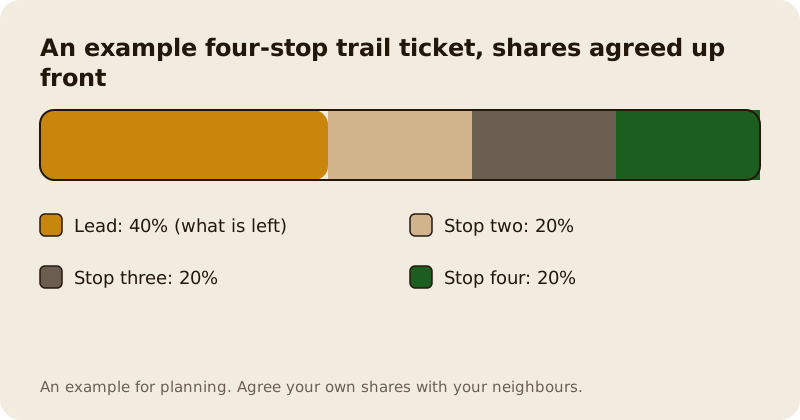
On Mosey each stop's share is a percentage of the ticket price, before the booking fee the guest pays and before any sales tax added on top. The partners' shares are set when they are invited. The lead's own share is whatever the partners leave, so the shares always add up to 100%. A paid trail cannot go on sale until every accepted stop has a share and they total 100%.
Here is a worked example, labelled as one. A trail ticket costs 40 euro. Four stops: the lead and three others. The three other stops are each owed 20%, which is 8 euro each, so 24 euro in total. The lead keeps the remaining 40%, 16 euro.
From that 16 euro the lead also covers Mosey's commission on the ticket, the VAT on that commission and the payment processing cost. So the stops get exactly their agreed share, and the cost of selling the ticket is the lead's. That is the fair reading of the job: the lead sells, so the lead carries the cost of selling.
Use equal shares if every offer costs about the same, and weighted shares if one stop gives a meal and another a coffee. Write them down and let every stop read them. The shares can change while the trail is a draft or waiting for partners. Once it is live, they are locked, and every ticket keeps the shares it was sold with. A later change never rewrites an earlier sale. Fix the shares you agree now, or be ready to end the trail and start a new one.
Does Mosey hold the money, and how do the stops get paid?
Mosey holds none of the money. A guest pays for the ticket, and the money goes to the lead's own Stripe account. The lead is the seller of the whole ticket and is paid the whole price. Nothing is held and nothing is transferred to the stops later by Mosey.
The stops are paid by the lead, outside Mosey, from a monthly statement. For each month, per stop, the statement shows:
- the stop's agreed share,
- how many stamps were collected at that stop on tickets that were not refunded,
- the amount the lead owes it,
- and the number of sales counted.
The lines add up to the month's ticket value to the cent. The lead sees every line and can download it as a spreadsheet file. A stop sees only its own line. When the lead has paid, the stop marks the month as received, and a received line is frozen, so a later refund appears beside it instead of changing it.
So the routine is: the lead opens the statement, pays each stop however you agreed, and the stop checks the figure against its own stamps and marks it received.
Because the lead is the seller, ask your accountant how the lead and each stop should treat the ticket and the payments between you, including VAT. Mosey does not give financial or legal advice, and the answer depends on your own set-up.
What does the guest pay on top, and what do you pay?
The guest pays the ticket price you set plus one flat booking fee of €1.29 for the purchase. It is one fee per purchase, however many stops are on the trail. The lead is charged Mosey's commission on the ticket price, at 8%, plus the VAT on that commission. The pricing page lists both, and the lead should price the ticket with that cost in mind.
Work it through before you set the price. Take the example 40 euro ticket. The stops are owed their shares of the full ticket price, so the lead's own share is what bears the commission, the VAT on it and the processing cost. Take those off the lead's 16 euro and see what is left. If that gets thin, raise the price or lower the partners' shares. Do not ask the stops to absorb it later.
Set a cap on tickets if your stops have limited seats, and choose how long a guest has to finish once they start.
How do guests collect stamps?
A guest buys the ticket, walks the route and collects a stamp at each stop. A stamp never hands over the offer by itself. The stop still gives the offer in person, so staff keep control of what goes out.
There are three ways to stamp, and the lead chooses how self-guided the trail is:
- A staff scan. The guest shows the trail QR code on their phone and a member of staff scans it. The phone's location must be near the stop, so a screenshot sent to a friend cannot collect a stamp.
- A counter stamp. A member of staff stamps the ticket from the Mosey dashboard while the guest is standing there.
- A self-serve stamp. The guest taps in with their phone, and Mosey checks their location. This is off by default on each trail, and the lead switches it on, even while the trail is live.
Staff scanning is the safest to start with, because a person at each stop meets the guest and hands over the offer. Switch on self-serve once the route is running well.
When a guest has a stamp at every stop, the trail is complete and they get the reward the lead set, a badge or a voucher. They can then rate the trail, and the rating appears on the trail's page.
Brief your staff before launch with one line: "When someone shows a trail code, scan it, give them the offer, say thank you."
What if a guest wants a refund?
A guest can refund their own ticket within 24 hours of buying it, as long as they have not collected a stamp. The refund comes out of the lead's balance, Mosey's commission on it is returned, and that ticket drops out of the next monthly statement. Nobody else is chased for money back.
If the lead pauses the trail while guests are part way round, those guests can also leave and be refunded, because the walk was ended for them. An archived trail has its own refund window, so a guest is not left holding a ticket for a route that no longer runs.
Mosey also locks each stop's offer once the first ticket is out of the door. Guests buy a trail knowing what they will get, so a stop cannot swap a free item for a small discount after the money has been taken. If you need to change an offer, end the trail and start a new one. Get the offers right before you sell.
How do you launch it in a fortnight?
Work backwards from the day you want to sell the first ticket. This is a plan for a four-stop trail on one street.
- Week one, Monday: the lead rings each stop and asks one question: would you be a stop at a share you can live with?
- Week one, midweek: agree the shares, the offers and the price on a single piece of paper, and have every owner say yes to it.
- Week one, end: the lead creates the trail, writes its own offer and invites each stop with its share.
- Week two, early: each stop accepts, writes its offer and checks that it is on the Starter plan or above. Fix anything that blocks the trail from going live.
- Week two, midweek: brief staff, print the trail card for the counter and decide the stamping method.
- Week two, end: go live. Post it on your own pages and let your regulars know first.
- Each month: the lead opens the statement, pays the stops and the stops mark it received.
Run the first trail for one weekend, then look at tickets sold and which stop was busiest. Change the next run, not the one in progress.
If you want to go further, an event night on the same street gives guests a fixed date to plan around, and the guide to turning events into a calendar that pays ahead shows how. A market or festival works the same way at a larger scale, as the guide to running a food market or festival with online tickets explains. If your businesses already want one membership across the street, read a neighbourhood pass. And if you own two or three sites yourself, run them from one dashboard.
Before you sell the first ticket, tick this list:
- Every stop has accepted and is on the Starter plan or above.
- The shares are written down, agreed and add up to 100%.
- Each stop's offer is costed and fits inside its share.
- The ticket price covers the lead's cost of selling after the commission.
- A cap on tickets suits the smallest stop.
- Every stop's opening hours match the days you sell, and staff know how to stamp.
- Your accountant has seen how the money moves between you.
When the list is ticked, you are ready. Host on Mosey free, claim your page and lead your street's first trail. More in the guides for food businesses, and the pricing page shows every rate.
This guide is general information, not legal, tax or financial advice. Rules change and depend on your business and where it is, so check the current rule with the official body named in the guide and take advice from a solicitor or accountant in your area before you act.
Questions
Common questions
How does a food trail with other businesses make money?
One business, the lead, sells the ticket and is paid the whole price. Each stop has a share agreed up front as a percentage of the ticket price, and the lead pays it monthly from a statement. The guest buys once, and every stop gets footfall.
Who gets paid what on a paid trail?
The lead is paid the whole ticket price by Stripe and owes each stop its agreed percentage. The lead keeps what is left, and covers the commission and the VAT on it. Mosey holds none of the money and the shares are frozen on each ticket when it is sold.
What plan do I need to lead or join a food trail on Mosey?
Lead a trail on the Host plan. Join a trail as a stop on Starter or above. A trail can have up to 15 stops, and it goes live once at least two stops, the lead included, have accepted and no invitation is pending. The pricing page lists each plan and what it includes.
Can a guest get a refund on a trail ticket?
Yes, within 24 hours of buying it, if they have not collected a stamp. The refund comes from the lead, Mosey returns its commission on it and the ticket drops out of the monthly statement. A paused trail also lets guests leave and be refunded.
Can a stop change its offer after tickets have sold?
No. Once a ticket has been taken, offers are locked, so guests get what they were shown. To change an offer, end the trail and start a new one. Agree and cost the offers carefully before you sell the first ticket.
How do guests collect stamps at each stop?
A staff member scans the guest's trail QR code, with the phone's location checked, or stamps the ticket from the dashboard. The lead can also switch on self-serve stamps, which are off by default. A stamp never hands over the offer, so staff still give it in person.
What does a food trail cost the lead and the guest on Mosey?
The lead pays Mosey 8% commission on the ticket price plus VAT on it. The guest pays the ticket price plus a flat booking fee of €1.29 per purchase. The pricing page shows each rate in full.
Does Mosey hold the money from a food trail ticket?
No. The guest's payment goes to the lead's own Stripe account, and the lead pays each stop its share outside Mosey. Mosey gives the lead a monthly statement for each stop and lets the stop mark its payment received.
More like this
Read next
A hotel restaurant that locals use too
A hotel dining room earns local trade when it acts like a restaurant of its own. Here is why locals stay away, how to set the dining room up on Mosey beside your hotel, and which offers fill it.
An alcohol-free drinks menu that still makes margin
More guests are drinking less, in January and the rest of the year. Here is how to cost, price, name and sell an alcohol-free menu so it earns as well as the wine list, with the Irish VAT and offer rules checked.
A pub that does food: making the kitchen pay
A pub kitchen pays when its gross profit covers its own wages and running costs. Here is how to count it, which services to fill, what the alcohol rules say and how Mosey fits.
Auto-enrolment pension for Irish restaurants and cafés: what you pay and do
Since 1 January 2026 an Irish employer matches the pension contribution of each eligible employee. Here is who counts, what it costs on a wage bill, the payroll steps and what staff can opt out of.
Get started
Host your business on Mosey. It is free to claim.
Free to list, no set-up fee, and Order Ahead is 1.5% commission when you start taking orders.