
For businesses
Single-use cups, packaging and the rules for takeaways in Ireland
Mosey · 22 November 2026 · 11 min read
No coffee cup levy is in force in Ireland. The law lets the Minister make one, and none has been made, but other rules already apply to a café or takeaway: single-use plastic cutlery, plates, straws, stirrers and polystyrene food and drink containers are banned from the market, and single-use plastic drinks cups must be marked. Check the current position with the Department and the EPA before you reorder packaging.
Is there a coffee cup levy in Ireland?
Not today. The Circular Economy and Miscellaneous Provisions Act 2022 gives the Minister power, with the consent of the Government, to make regulations for an environmental levy on the supply of single-use cups, containers and packaging at classes of retail premises. That is a power, not a charge. A levy only exists once the regulations are made.
The Irish Statute Book lists the regulations made under that section of the Act, and, in its table updated to 11 November 2026, the only ones are the two plastic bag levy regulations. No cup levy regulations are listed. So the 20 cent charge you may have read about is a plan, not a rule you must collect.
RTE reported in October 2025 that the department was working towards a different model, in which the levy would be collected when cups are first placed on the market by producers or importers, and that this would need the Act to be amended and talks with Revenue. If that goes ahead, the cost may reach you through your supplier's price instead of a line on the till. Do not print a cup charge on your menu on the strength of a news story.
Check the current position with the Department of Climate, Energy and the Environment and with Revenue before you change a price or a sign.
Which single-use plastic items can a café or takeaway no longer buy?
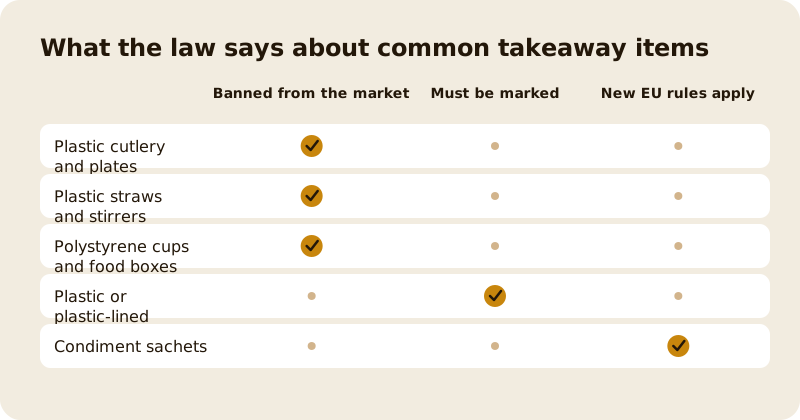
The single-use plastics rules (S.I. 516 of 2021) list items that may not be placed on the market in Ireland. For a café or takeaway the list is close to your drawer of consumables:
- Plastic cutlery: forks, knives, spoons and chopsticks.
- Plastic plates.
- Plastic straws.
- Plastic beverage stirrers.
- Food containers made of expanded polystyrene, the kind used for fast food or a meal ready to eat, with or without a lid.
- Beverage containers and cups made of expanded polystyrene, including their lids.
- Cotton bud sticks and balloon sticks, which matter less to a kitchen.
The Regulations also ban any product made in whole or in part of oxo-degradable plastic.
The ban is written as a restriction on placing the product on the market, and it sits with the producers and the supply chain. Do not read that as "not my problem". Your supplier should not be selling you a banned item, and if one turns up in your delivery you should not use it. Ask for a written confirmation that what you buy is compliant, and keep it with your invoices. The Regulations define who counts as a producer by reference to the EU Directive, so if you import packaging yourself, ask the EPA how the definition applies to you.
What must a disposable cup carry, and what about lids?
A single-use plastic cup for a drink is on the marking list. The Regulations say a product on that list may not be placed on the market unless it carries the harmonised marking set out in a Commission Implementing Regulation. Drinks cups are on the list, along with items such as wet wipes and tobacco filters. Many paper cups are lined with plastic, so ask your supplier whether yours are covered. The specification of the marking is in the Commission Implementing Regulation the Regulations name, and your supplier should be able to show you what it looks like on the cup.
This is another thing to check with your supplier rather than something you apply. A box of cups with no marking on it is a question to put to whoever sold it to you.
Two further points:
- Polystyrene cups and lids are banned outright, as in the list above.
- Bottle caps. A beverage container of up to three litres with a plastic cap or lid has to have the cap stay attached to the container in use, and that has applied since 3 July 2024. It matters if you sell bottled drinks, because the water or juice you resell should already comply.
A paper cup is not on the banned list. If it is a single-use plastic cup under the rules, the marking applies, and so would the levy that has not been made.
What does the EU packaging regulation change for takeaways?
A new EU law arrives in stages. Regulation (EU) 2025/40 on packaging and packaging waste has been in force since 11 February 2025, and the European Commission lists its application date as 12 August 2026. Some provisions of the earlier Directive continue to apply after that date.
The Commission's summary names three things that touch a takeaway:
- Restrictions on certain single-use plastics, such as individual portions or sachets of condiments and sauces.
- A requirement for take-away businesses to offer customers the option to bring their own containers at no extra cost.
- Restrictions on PFAS in food contact packaging above certain thresholds. A fibre box that resists grease may be treated with it, so ask your supplier.
Each duty has its own date inside the Regulation. Article 32 says that by 12 February 2027 a business in the hotel, restaurant and catering sector that sells drinks or ready-prepared food in take-away packaging shall provide a system for customers to bring their own container to be filled, at no higher cost and on no less favourable terms, and shall say so on a clearly visible sign. Article 33 adds, by 12 February 2028, an option to buy in reusable packaging within a re-use system, and exempts micro-enterprises from that article. The Commission has also proposed changes to cut the burden on small businesses, so check the current rule with the EPA before you plan around a date.
You do not have to wait to prepare. A café that already says "bring your own cup or box" is ahead of a rule that will make it a standing offer.
Who enforces the rules, and what are the penalties?
Summary proceedings for an offence under the single-use plastics Regulations can be brought by the local authority or the EPA. The offences cover the ban on listed products, marking and the attached-cap rule. On summary conviction the penalty is a class A fine or imprisonment for up to 12 months, or both. On conviction on indictment it is a fine of up to 500,000 euro or imprisonment for up to three years, or both.
The Regulations also allow an authorised person to offer a fixed payment notice of 2,000 euro for an offence that would be prosecuted summarily. Paying it within 21 days means no prosecution for that offence.
Those figures are the ceiling for a producer who ignores the rules. A café's likelier problem is a stock of banned cutlery bought before the rules and still in the cupboard, or a new supplier who does not know them. Check the cupboard, the storeroom and the van. Stock bought years ago for a festival stall, or a case of stirrers left over from a catering job, is still stock. Take any banned item out of use, ask the supplier or the local authority what to do with it, and replace it with wood, paper or a reusable alternative.
How do you check what your supplier sends you?
Go through your consumables in one sitting and ask for the same four answers from each supplier.
- Is it on the banned list? Plastic cutlery, plates, straws, stirrers, polystyrene cups and food boxes are out.
- Is the cup marked? Look at the sleeve and the cup for the marking.
- Does the packing carry a claim? "Compostable" or "biodegradable" is a claim you cannot check by eye, so ask for the certificate. Oxo-degradable plastic is banned.
- Is it fit for the food? A leaking box costs you a refund, whatever the law says.
Ask the same questions of a new product as of an old one. A range of takeaway boxes can change its material between one order and the next, and the person who orders for you may not know the rule. Put the four questions on the order sheet, so that whoever places the order asks them.
A simple record helps. For each item, write the supplier, the date you asked and what they said. When an inspector or a new supplier asks, you can answer in a minute.
What does a reusable cup offer cost you?
Less than you may fear. No law currently obliges you to run a reusable cup scheme, so everything here is your choice.
A government survey of 1,314 people in November 2023, reported by RTE, found that 83 per cent owned a reusable cup and 33 per cent used it every time they bought a takeaway coffee. Of those who answered, 40 per cent said remembering to bring one would be a challenge. That points to a reminder at the till as the cheapest nudge, and it costs you nothing to try for a month.
Worked example (illustrative). Say a cup, lid and sleeve cost you 20 cent a set, and you sell three hundred takeaway coffees a week. That is 60 euro a week of packaging. If one coffee in ten comes in the guest's own cup, you save 6 euro a week. You could give 10 cent off each one and still be ahead by 3 euro. These are round numbers to show the sum. Use your own supplier's price.
A discount is your decision. Whatever you offer, keep it simple enough that the person at the till can say it in one breath.
How do you tell customers without a lecture?
Keep it to a line and a fact.
- At the till: "Bringing your own cup? I will fill it."
- On the menu: one line under the coffee prices, in your usual tone.
- When you stop a product: "We have moved to wooden cutlery." Say what you did, not what the customer should feel.
If you plan to charge for a cup in future, wait for the regulations. A charge you invent today may not match the rule when it arrives.
How does Mosey help a takeaway cut packaging waste?
Mosey does not buy, check or label your packaging, and it has no cutlery or cup setting. It does not register you with Re-turn or handle the deposit on cans and bottles either. It helps you plan the takeaway side of the day.
- Orders you can see ahead. With Order Ahead, guests order and pay on your Mosey page for a collection time you set, so your team sees a run of orders coming and packs for them. Order Ahead is free to switch on, and Mosey takes 1.5% of the food on a paid order, with VAT on that fee (see pricing). The click and collect guide sets out slots and caps, and the online ordering feature page shows how it works.
- A note on every order. A guest can add a note and your kitchen sees it with the order. "No cutlery, thanks" or "I will bring a cup" arrives before the bag is packed.
- Less made and not collected. Paid orders for a set time mean fewer bags made on a guess. The food waste guide covers the rest of the bin.
Packaging that is thrown away still costs you what you paid for it. Fewer unneeded forks and sachets is a saving as well as a rule followed.
What can you do this month?
Work down this list.
- Count every item in your takeaway stock and mark any plastic cutlery, plate, straw, stirrer or polystyrene item for replacement.
- Ask each supplier to confirm in writing that the items are compliant and the cups are marked.
- Check any sachet, tub or box you buy for single-use plastic condiment portions and grease-proofing, and ask about the PFAS rule.
- Decide how you will take a customer's own cup or box before 12 February 2027, and check the current rule with the EPA.
- Decide on a reusable cup offer, or a line at the till, and tell your team.
- Do not print a cup charge until the regulations exist.
- Keep a dated note of what each supplier told you.
When that is done, Host on Mosey free, put your menu up and switch on collection orders, so the bags you pack are the bags that were ordered. If you also sell cans and bottles, read the deposit return scheme guide, and find every other guide for Irish food businesses on the business guides page.
This guide is general information, not legal, tax or financial advice. Rules change and depend on your business and where it is, so check the current rule with the official body named in the guide and take advice from a solicitor or accountant in your area before you act.
Questions
Common questions
Is there a coffee cup levy in Ireland?
No. The 2022 Circular Economy Act lets the Minister make regulations for a levy on single-use cups, but the Irish Statute Book lists only plastic bag levy regulations made under that section, as at 11 November 2026. Check the current position with the Department of Climate, Energy and the Environment before you change prices.
What plastic items can a café not buy in Ireland?
Single-use plastic cutlery, plates, straws and beverage stirrers, plus polystyrene food containers, drink containers and cups with their lids, are banned from the market under S.I. 516 of 2021. Products made of oxo-degradable plastic are banned too. Ask your supplier to confirm what you buy.
Do paper coffee cups have to be marked?
Cups for beverages are on the list of single-use plastic products that must carry the harmonised marking set out in the Commission Implementing Regulation. Many paper cups are lined with plastic, so ask your supplier whether yours are covered. It is the supplier's duty to place only compliant cups on the market.
Who enforces the single-use plastics rules?
Summary proceedings can be brought by the local authority or the EPA. On summary conviction an offence carries a class A fine or up to 12 months in prison, or both. An authorised person may also offer a fixed payment notice of 2,000 euro, payable within 21 days.
Do I have to let customers bring their own container?
The EU packaging regulation includes a requirement for take-away businesses to offer customers the option to bring their own containers at no extra cost. Article 32 of the Regulation sets this duty for 12 February 2027, at no higher cost than single-use packaging. Check the current rule with the EPA.
Can I charge for a disposable cup now?
No law requires you to, and no cup levy has been made. You may set your own price for a drink in a cup, but do not describe it as a levy. Wait for the regulations before printing a cup charge, because a rate or a rule may differ from what you guess.
Are compostable cups and lids allowed?
Compostable is a claim about how a product breaks down, not an exemption from the rules. Polystyrene cups are banned and oxo-degradable plastic is banned. Ask your supplier for the certificate behind a compostable claim and for the cup marking, and keep both with your invoices.
How can Mosey help a takeaway with packaging?
Mosey does not buy, check or label packaging, and does not handle Re-turn registration or deposits. It gives you paid orders for set collection times so you can see what to pack, and a note on each order so a guest can say no cutlery or that they will bring a cup. Order Ahead is free to switch on.
More like this
Read next
A hotel restaurant that locals use too
A hotel dining room earns local trade when it acts like a restaurant of its own. Here is why locals stay away, how to set the dining room up on Mosey beside your hotel, and which offers fill it.
An alcohol-free drinks menu that still makes margin
More guests are drinking less, in January and the rest of the year. Here is how to cost, price, name and sell an alcohol-free menu so it earns as well as the wine list, with the Irish VAT and offer rules checked.
A pub that does food: making the kitchen pay
A pub kitchen pays when its gross profit covers its own wages and running costs. Here is how to count it, which services to fill, what the alcohol rules say and how Mosey fits.
Auto-enrolment pension for Irish restaurants and cafés: what you pay and do
Since 1 January 2026 an Irish employer matches the pension contribution of each eligible employee. Here is who counts, what it costs on a wage bill, the payroll steps and what staff can opt out of.
Get started
Host your business on Mosey. It is free to claim.
Free to list, no set-up fee, and Order Ahead is 1.5% commission when you start taking orders.