
For businesses
Own your customer list: how to get your customers back from the apps
Mosey · 15 November 2026 · 12 min read

You own a customer list when the people on it chose to hear from you and you can say how they did. To build one in Ireland, ask for clear consent, record each yes, make leaving as easy as joining, and answer a request for someone's data within one month. On Mosey, the consents are recorded for you and you message the people who said yes.
Who owns your customers when they order through someone else?
A customer who orders through another company's app is that company's customer first. They signed up there, they get that company's messages, and the next time they are hungry they open that app, not your menu. You supplied the food. Someone else holds the relationship.
Delivery apps commonly charge around 30% of an order. That is the visible cost. The hidden one is that after two years of paying it you may know very little about who your regulars are, what they like and when they stopped coming. What you are able to see is set by your own agreement with each company, so read what yours says about customer details before you plan around them.
A customer list of your own changes the sum. A quiet Tuesday becomes a message to people who live nearby and already like your food. A new menu reaches your regulars before anyone else. Nobody can raise the price of reaching them.
This guide is the wider plan behind the shorter guide to building a customer list. It covers what a list is, what you can lawfully hold, what you can export, and how to move customers over without losing them.
What does a customer list actually contain?
It is not one list. It is four different relationships, and each carries different rights.
- Customers. People you have served: an order, a booking, a ticket, a membership. You hold their details because you delivered a service.
- Followers. People who chose to follow your page. A follow says "show me your news". It is not a request for offers.
- Members. People who pay you every month. They are customers with a standing relationship.
- People who said yes to hear from you. The smaller group you may send offers to. This is the list that is worth most.
The mistake most owners make is treating the first three as the fourth. A booking gives you a name and a way to confirm the table. It does not give you permission to send a discount next month. The Data Protection Commission (DPC) says the general rule for electronic direct marketing is the clear, affirmative consent of the recipient.
Mosey keeps these apart on purpose. When someone orders, books or joins a programme, your business holds them as a customer, and that record is separate from a yes to offers.
What can you see and export on Mosey today?
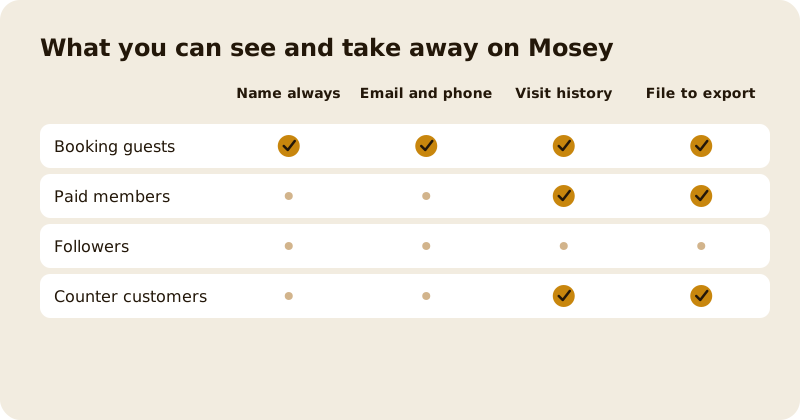
Here is what each part of your customer base shows you, checked against the code that serves it.
| What | What you see | What you can take away |
|---|---|---|
| Booking guests | Name, email and phone as the guest gave them when booking, plus party size, occasion, allergens, source and deposit | A file of every reservation, filterable by date, with the guest's name, email and phone |
| Paid members | The roster with plan, status, joined and renewal dates, spend and visits | A member file of up to 5,000 rows |
| Followers | A running count; a list in which a person appears by name only if they shared it with you | No file of followers |
| Counter customers | Visit counts, first and last visit, member and rewards waiting, for people who shared their name | A file of up to 1,000 customers |
| Voucher sales | Amounts, dates, channel and the last four characters of the code | A file of sales or of redemptions, up to 20,000 rows, for your accountant, with no customer names or emails |
Two rules sit under that table. A name is shown in a marketing view only when the customer chose to share it with your business, in their settings or when they follow. A service record, such as a booking you took, shows the name the guest gave you, because you need it to serve them.
The member file lists a member by name only if they shared theirs, and otherwise by a reference your business alone uses. It carries your own private tags and notes. A birthday appears only for a member who chose to tell you.
What can you not take away, and why does that protect you?
You cannot export an email address or a phone number for a follower, a member or a counter customer. The member file has no email or phone. The counter customers file has none either, and no photo. The follower list does not return an email at all.
That can feel like a restriction. It is a protection with a practical benefit. A spreadsheet of addresses leaves your business the moment you save it. It can be forwarded, lost, kept long after the person stopped being a customer, or used for a message nobody agreed to. The most common way a small business ends up with a data problem is a list nobody can account for.
What you get instead is a way to reach the people who said yes without holding their address. You build a group, preview how many people it reaches, and send through Mosey. The message goes by notification and inbox. An offer email goes only to a person who said yes to your offers and, separately, yes to email. Mosey sends it, from Mosey's address, and your business never sees the address. Every one carries a one-click unsubscribe, and the later answer wins.
The honest trade is this. You do not own a spreadsheet of everyone, but you do own the relationship with everyone who said yes, and you can reach them whenever you have something to say.
How do you get people to say yes?
People say yes to something specific. "Join our list" gets a shrug. "Hear first when the Sunday roast is back" gets a yes. Ask at the moment someone is pleased: after a good meal, at the counter, or when they join your rewards card.
On Mosey, a customer chooses whether to hear your offers when they follow you or join your loyalty programme. Joining a rewards programme does not switch that business's offers on: the join screen shows an unticked box, and a customer hears from you only if they tick it. If you rely on the soft opt-in rule for existing customers instead, it is narrow. The DPC lists four conditions for existing customers: the product or service is your own, it is of a kind similar to what they bought, they were clearly given the chance to object, and the first message goes out within 12 months of the sale. Keep your offers within those lines.
A follow alone is not a yes to offers, and Mosey does not treat it as one. Following a business and agreeing to be named to it are also separate choices, each with its own switch.
Three habits make the yes worth having:
- Say what they will get and how often. "About twice a month" is reassuring.
- Ask once, in one line, the same way every time. A customer who feels pushed says yes and then ignores you.
- Never tick the box for them. The DPC is plain that clear, affirmative consent is the general rule.
What does Irish data protection require?
Four points matter most to a small restaurant or café. Each is from the DPC's own guidance, which is where to check the current position.
- Consent for marketing is the general rule. The DPC says electronic direct marketing generally needs the clear, affirmative consent of the recipient. The exception is existing customers, with the four conditions above. It also says you must not send electronic direct marketing to a prospective customer.
- Every message needs a way out. Each marketing message must carry a valid opt-out, such as an unsubscribe link. People can object at any time, and the DPC says withdrawing consent must be as easy as giving it.
- People can ask what you hold. A valid access request must be answered without undue delay and at the latest within one month. It can be extended by a further two months for a complex request or repeated requests, with the person told within the first month. The DPC says access is free of charge.
- Your records have to match what you do. If you keep a spreadsheet, you are responsible for it. If you do not, you cannot lose it.
This is a summary of regulator guidance, not legal advice. Mosey does not give legal advice, and your own adviser can confirm how it applies to your business.
On Mosey, withdrawal takes effect on the next send. A customer can switch your offers off in their settings for your business, and an email unsubscribe is honoured on the following send. You do not need to run a suppression list of your own.
How do you turn a list into visits?
Counts are only useful when you act on them. Work from the group, not the individual.
On Mosey, Analytics shows followers, returning customers and page views. Customer groups split the people who said yes by what they do, for example regulars who have gone quiet, customers who came once and never returned, and members who have gone quiet. You can also combine conditions, such as members who have not ordered in 30 days, and see how many people the message would reach before you send it. The preview gives counts only, never names.
Three rules keep the list healthy:
- Nobody is written to twice by one campaign.
- The tool holds back anyone you messaged in the past seven days. A list that gets a message every two days gets unsubscribed.
- Results are counted for you. Orders, payments and bookings within 48 hours of a message are counted against it, so you learn what worked.
Start with one group and one message. A regular who has gone quiet and a reason to return, such as a dish they ordered before, is the cheapest campaign you will ever send. The guide to winning back customers who stopped coming goes through the offers, and the plan for keeping more loyal customers covers what to do once they are back.
How do you move customers from the apps to your own door?
You cannot take a customer list from an app. You can give each customer a better reason to come to you.
- Put a direct link where they already look. Your menu page, your bio, your window and the bag. A direct order for collection costs you 1.5% of the food, before VAT. The pricing page shows each rate, and guests pay a booking fee on an online order.
- Give a first-order reason. A free coffee or a stamp already on the card costs far less than an app's commission on an order you were going to get anyway.
- Ask for the follow at the same moment. One line on the receipt or the bag, "Follow us for the Sunday menu".
- Reward the second order, not the first. The aim is a regular, not a one-off.
The guide to moving regulars off delivery apps covers the order-by-order plan.
An example, with round numbers: a café meets 300 customers a week across the counter and orders. If one in five agrees to hear from you, that is 60 people a week. After ten weeks, 600 people have said yes. Those are example figures, not a forecast, but they show why a small habit on the counter beats a large one-off campaign.
What if you already hold guests from another system?
Many businesses arrive with a booking history somewhere else. Mosey can import your own guest list from another system, as the business's own contacts. They are contacts, not Mosey accounts, and the import never tells you whether an email already has a Mosey account.
They carry no marketing consent unless you confirm that your file has an explicit opt-in column and a row says an explicit yes. A blank, a no or an unsubscribed row is never a yes. Because those contacts are not accounts, nothing on Mosey sends them an offer, and Mosey keeps them for six months after the later of the import and their last visit, unless you remove them sooner. You can delete a contact, or undo an import within seven days.
So treat the import as a record, not a mailing list. Use it to recognise a guest when they return, and invite them to follow you, join your rewards or book through your page, where their own yes can be recorded.
A 30-day plan to build a list you can stand behind
- Week 1: look. Count the customers you meet in a normal week and how many you could reach again. List the places they arrive: bookings, orders, rewards, tickets and the counter.
- Week 2: ask. Choose the one line you will use. Print it by the till and teach it to the team. Add it to your booking and order confirmations.
- Week 3: split. Open Customer groups. Look at regulars who have gone quiet and customers who came once. Note the counts.
- Week 4: send one message. One group, one reason to come back, and one thing to measure.
Keep a short note of the wording you used to ask, and the date you started. If a customer or the DPC asks how someone came to be on your list, you can answer in a sentence.
Ready to own the relationship? Host on Mosey free, claim your page and start with the follow. More in the guides for food businesses, the customer analytics guide and the outreach and win-back tools. See what each number shows on the analytics feature page.
This guide is general information, not legal, tax or financial advice. Rules change and depend on your business and where it is, so check the current rule with the official body named in the guide and take advice from a solicitor or accountant in your area before you act.
Questions
Common questions
Who owns my customers when they order through a delivery app?
Check your agreement with each company, because it decides what customer details you can see. In practice the customer signed up with the app, so the relationship sits there. A direct link, a follow and a rewards card give you a relationship of your own.
Do I need consent to email my customers in Ireland?
Generally yes. The Data Protection Commission says electronic direct marketing needs the clear, affirmative consent of the recipient. The exception is existing customers, where the product is your own and similar, they could object, and your first message goes out within 12 months of the sale.
Can I export my customers' emails from Mosey?
No email or phone is in the member file, the counter customers file or the follower list. Your reservations file does carry the name, email and phone a guest gave when booking, because you need them to serve the table. Offers go through Mosey instead.
Does a follow on Mosey mean I can send offers?
No. A follow shows your news. Offers need a separate yes to your offers, and email needs a further yes to email. A customer also chooses separately whether to share their name with you. Mosey checks these on every send.
How quickly must I answer a request for someone's data?
The Data Protection Commission says without undue delay and at the latest within one month of receiving a valid request. Complex or repeated requests can take a further two months, and you must tell the person within the first month. Access is free of charge.
What happens when a customer unsubscribes or objects?
Stop sending them offers. The DPC says people can object at any time and that withdrawing must be as easy as giving consent. On Mosey, a customer can switch your offers off in their settings and an email unsubscribe is honoured on the next send.
Can I upload my old guest list and message it through Mosey?
You can import it as your own contacts, but they carry no consent unless your file has an explicit opt-in column you confirm, and nothing on Mosey sends offers to them. Invite them to follow you or join your rewards so their own yes is recorded.
How do I start building a customer list on Mosey?
Claim your page free, then ask for the follow and the rewards sign-up in one line at the counter and on every booking and order. Open Customer groups after a few weeks, pick one group and send one message. Fees apply only when you take money through Mosey.
More like this
Read next
A hotel restaurant that locals use too
A hotel dining room earns local trade when it acts like a restaurant of its own. Here is why locals stay away, how to set the dining room up on Mosey beside your hotel, and which offers fill it.
An alcohol-free drinks menu that still makes margin
More guests are drinking less, in January and the rest of the year. Here is how to cost, price, name and sell an alcohol-free menu so it earns as well as the wine list, with the Irish VAT and offer rules checked.
A pub that does food: making the kitchen pay
A pub kitchen pays when its gross profit covers its own wages and running costs. Here is how to count it, which services to fill, what the alcohol rules say and how Mosey fits.
Auto-enrolment pension for Irish restaurants and cafés: what you pay and do
Since 1 January 2026 an Irish employer matches the pension contribution of each eligible employee. Here is who counts, what it costs on a wage bill, the payroll steps and what staff can opt out of.
Get started
Host your business on Mosey. It is free to claim.
Free to list, no set-up fee, and Order Ahead is 1.5% commission when you start taking orders.