
For businesses
How to make a fair restaurant rota your staff trust
Mosey · 15 November 2026 · 7 min read

A fair restaurant rota is one your staff can predict: it goes up on the same day each week, it changes only for a reason you explain, the Friday nights and the closes rotate rather than landing on the same people, and every request is handled by the same rule. Get those four things right and the rota stops being the thing people complain about on their break.
Why does a rota make people leave?
Because it decides their life outside work. A cook who finds out on Thursday that they are on Saturday cannot say yes to a wedding, a match or a shift in a second job. A server who always gets the close never makes the last bus home. When the rota looks like favouritism, the people on the wrong end of it stop trusting everything else you say.
The rota is also where small resentments add up. One unfair week is forgiven. The same person closing every Sunday for three months is a conversation with a recruiter.
How far ahead should you publish the rota?
Pick a day and keep to it. If the rota goes up every Wednesday for the week starting Monday, people learn to plan around Wednesday. If it goes up "when the manager gets to it", they plan around nothing.
Publish as far ahead as you can keep it stable. Two weeks is better than one, and a month of fixed core shifts with a weekly top-up is better again for a small team. Irish law sets a minimum notice for working hours, so check the current rule with the Workplace Relations Commission, and read the rota and working time guide for the rules on breaks and rest between shifts.
When a change is unavoidable, tell the person directly, say why, and ask rather than announce. A change made with a phone call feels very different from one that appears silently on the board.
How do you share out the Friday nights and the closes fairly?
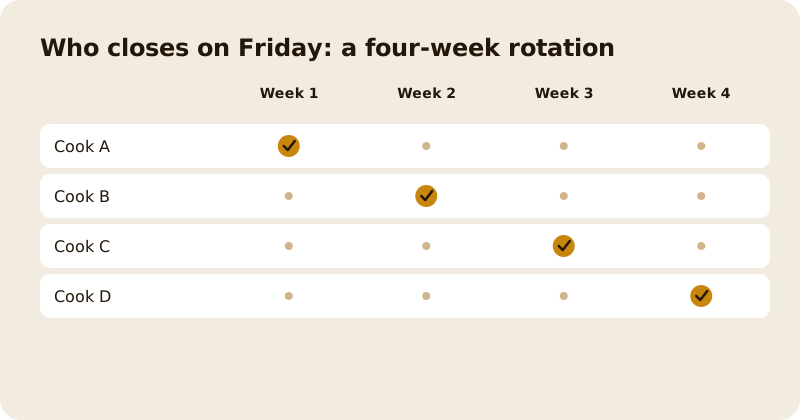
List the shifts nobody wants. In most kitchens it is the Friday and Saturday close, the Sunday open after a late Saturday, and the bank holiday. Then rotate them on a fixed pattern, as in the picture above, so that each person can see when their turn is coming.
Do the same with the shifts everyone wants. The quiet Tuesday lunch with an early finish is a prize. If it always goes to the same two people, the rest notice.
Managers and owners belong on the rotation too. A head chef who never closes, or an owner who is never in on a Sunday, sends a message about whose time counts. Taking your turn on the worst shift is one of the quickest ways to earn the team's trust in the rest of the rota.
Write down who worked what, and look back over the last month before you build the next rota. Fairness you can show is worth more than fairness you feel. Share the pattern with the team too, so nobody has to wonder whether it is being kept. When someone says "I always close", you can open the record and either agree and fix it, or show them it is not so.
How do you handle requests for time off?
Use one rule for everyone and say what it is. For example: requests in by a set day get an answer within three days; first in, first served for the same date; nobody gets every weekend off in a month unless it is agreed leave.
Answer quickly. A request left unanswered for a fortnight is read as a no, and it is often the moment people start looking. If the answer is no, offer another date in the same breath.
Keep a list of the dates people care about most: exams, weddings, a child's first day at school. You will not always grant them, but asking early and remembering them is noticed.
Students and part-timers need the same rule with a little more planning. Ask for exam dates and term dates at the start of each term, and build them in before you write the rota, rather than finding out the week before.
What should every shift on the rota show?
Each shift should say the start, the finish, the role or section, and the break. A shift that says only "PM" leaves the finish open to argument at midnight. Put the role on it too, so a cook covering the pass knows before they arrive.
Show the total hours for each person for the week, and the total for the whole team. It lets you spot someone sliding towards too many hours, and it lets them check their own pay. The wage bill guide explains why the total matters for your own figures as well as theirs.
How do you stop the rota being rewritten every day?
Most daily changes come from three things: a sick call, a booking that grew, or a manager who builds the rota without looking at what is booked. Fix the third first. Look at the bookings, the events and last year's sales for the same week before you staff it.
For sick calls, keep a short cover list of who has said they are happy to pick up extra hours, and offer the shift to them in turn. For a booking that grows, decide in advance the size of party that needs an extra pair of hands, so the answer is a rule and not a scramble.
When you do change a shift, record why. A month of reasons tells you whether the problem is sickness, bookings or planning.
Build the rota from a template. Most weeks look much like the last: the same core shifts, the same opening and closing pattern, the same quiet Monday. Start from that pattern each week and change only what the bookings call for, rather than writing the whole week from a blank page. Fewer changes means fewer mistakes, and your team start to recognise their week before they read it.
How do you handle swaps between staff?
Swaps keep a team flexible, and they are fine as long as the rota still works afterwards. Set three rules and write them down. A swap is between two people who can both do the role, so a server does not swap into the kitchen. Both people agree before anyone tells a manager. And a manager says yes before it is final, because a swap can push someone over their hours for the week or break the rest they need between shifts.
Record every swap on the rota itself, not only in a group chat. When pay day comes, the hours paid should match the shifts people actually worked, and the rota is where you check that.
Watch for the person who always gives shifts away or always picks them up. Someone giving away every Saturday is telling you something about their life outside work, or about how they feel at work, and it is worth a quiet conversation.
How does Mosey keep your rota fair and visible?
The Mosey rota sits in the same login as your bookings, so you can check the covers before you staff the night. You build the week, and your team see their own shifts, hours and leave on the Mosey Jobs site. They ask for time off there, and you approve or decline it in one place, so the record of who asked for what, and when, is kept for you.
Clock-ins become timesheets that you approve before pay day, which means the hours on the rota and the hours that were worked sit side by side. Who can edit the rota, leave and timesheets is a permission you give, so a supervisor can run the week without seeing anything else.
Read the hiring and training guide for the rest of the staff tools and pricing for what each part costs.
What should you do first?
Choose the day the rota goes up and announce it. Then write down who closed in the last four weeks and build the next rotation from that list. When you want the rota, the leave and the hours in one place your team can open on their phones, Host on Mosey free and switch on the staff tools. The guide to keeping staff covers what else keeps a team together.
More in the guides for food businesses.
This guide is general information, not legal, tax or financial advice. Rules change and depend on your business and where it is, so check the current rule with the official body named in the guide and take advice from a solicitor or accountant in your area before you act.
Questions
Common questions
How much notice should staff get of the rota in Ireland?
As much as you can keep stable, and at least the minimum the law sets. Rules on notice of working hours apply, so check the current rule with the Workplace Relations Commission before you set your policy.
What is the fairest way to share weekend shifts?
List the shifts nobody wants, such as the Friday and Saturday close, and rotate them on a fixed pattern so each person can see when their turn comes. Keep a record so you can show it is fair.
How should a small restaurant handle time-off requests?
Use one rule for everyone, such as first in first served, and answer within a few days. A slow answer reads as a no. If you have to refuse, offer another date at once.
Should staff be able to see each other's shifts?
Seeing who else is on helps people plan swaps and cover, and makes the rota feel open rather than secret. Keep pay and personal notes private, and share only the shifts and roles.
Can my staff see the rota on their phones with Mosey?
Yes. Once you add someone to your team, they see their shifts, hours and leave on the Mosey Jobs site and can ask for time off there. You approve leave and timesheets from your dashboard.
Can a supervisor manage the rota without seeing everything else?
Yes. On Mosey, rota, leave, timesheets and staff records are one permission you can give to a supervisor, so they can run the week without you handing over the keys to everything else.
More like this
Read next
A hotel restaurant that locals use too
A hotel dining room earns local trade when it acts like a restaurant of its own. Here is why locals stay away, how to set the dining room up on Mosey beside your hotel, and which offers fill it.
An alcohol-free drinks menu that still makes margin
More guests are drinking less, in January and the rest of the year. Here is how to cost, price, name and sell an alcohol-free menu so it earns as well as the wine list, with the Irish VAT and offer rules checked.
A pub that does food: making the kitchen pay
A pub kitchen pays when its gross profit covers its own wages and running costs. Here is how to count it, which services to fill, what the alcohol rules say and how Mosey fits.
Auto-enrolment pension for Irish restaurants and cafés: what you pay and do
Since 1 January 2026 an Irish employer matches the pension contribution of each eligible employee. Here is who counts, what it costs on a wage bill, the payroll steps and what staff can opt out of.
Get started
Host your business on Mosey. It is free to claim.
Free to list, no set-up fee, and Order Ahead is 1.5% commission when you start taking orders.