
For businesses
Employer PRSI rises for Irish restaurants and what else adds to the payroll
Mosey · 15 November 2026 · 5 min read

Employer PRSI, the social insurance an Irish employer pays on each employee's pay, rises again on 1 October 2026. The Department of Social Protection's advance notice says all PRSI rates increase by a further 0.15% on that date, as part of the PRSI Roadmap agreed by Government. On the rates in force from 1 October 2025, 11.25% for pay above the weekly threshold and 9.00% below it, that means 11.40% and 9.15%. For a restaurant with a large team on modest hourly pay, it is a steady upward pressure on the payroll.
What changed on 1 October 2026?
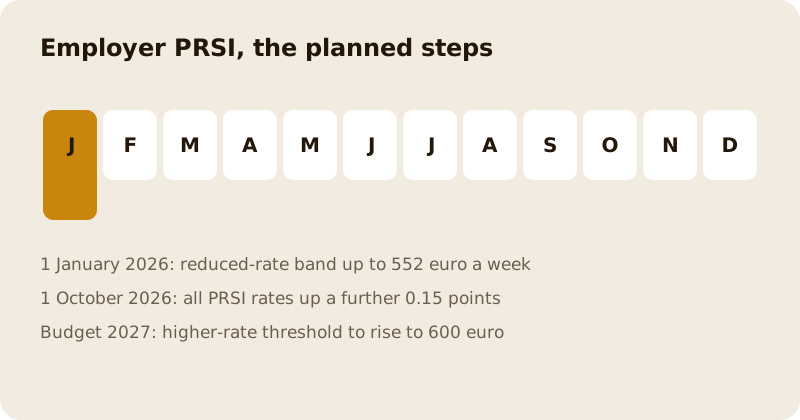
The advance notice says that all PRSI rates, for employers and employees, increase by a further 0.15% on 1 October 2026, and that a revised notice would be circulated in mid-2026 with the changes. It also says the increases were agreed by Government as part of the PRSI Roadmap and are not Budget 2026 measures. The employee rate on weekly earnings above the lower bands was 4.20% from 1 October 2025. The employer charge under Class A includes the 1% National Training Fund Levy. Check the Department of Social Protection's current notice for the exact bands and rates that apply to your employees.
How does the reduced rate work?
The reduced employer rate of 9.00% applies to Class A employees whose weekly earnings are at or below a threshold. The advance notice says that, in line with the national minimum wage rising to €14.15 an hour, the upper threshold for paying the 9.0% rate increased from €527 to €552 a week from 1 January 2026. Many part-time and student staff in food businesses sit near this line. If an employee's weekly pay is above the threshold in any week, the standard rate applies to that week's pay, so the rate can change from week to week for the same person.
What further rises are planned?
The Department of Social Protection issues an advance notice each year with the rates, so watch it and each October's Budget. For 2027, the Department of Enterprise, Tourism and Employment says Budget 2027 will raise the higher-rate employer PRSI threshold from €552 to €600 a week. Build announced changes into your forecasts, and expect to revise them.
How big is the effect on a restaurant?
Small per employee, and large across a team. A rise of 0.15 percentage points on a single hour of pay is tiny. Multiplied across every hour worked by a team of fifteen for a year, it is a cost you can calculate from your payroll report. Use the figures from your own payroll provider. Do not estimate from another business.
Treat the figure as a monthly line in your forecast, not a once-a-year surprise. If your payroll provider can split employer PRSI from wages in its report, review that line each quarter. A small change in the rate is easy to miss in a large total, and the quarter when a rise begins is the quarter to check that your software has applied it correctly.
What else lands on payroll?
Several costs rise together, and it helps to see them in one list.
- The minimum wage, rising again in January 2027, as the minimum wage guide explains.
- Pension auto-enrolment, which began in January 2026 and steps up every three years, covered in the auto-enrolment guide.
- Statutory sick pay and leave, where entitlements are set by law. Check gov.ie for the current number of days and the rate.
- Holiday pay and public holidays, set by working time law.
- Training, such as food safety and allergen courses.
How do you plan around the steps?
- Ask your payroll provider for a full cost report that shows employer PRSI, pension contributions and holiday pay by employee.
- Add a line to your budget for each announced change, with the date it begins.
- Re-run your menu costing with the new labour figure, using the food cost guide.
- Review your rota, so that you do not pay for hours that do not earn.
- Keep a reserve in your cash flow plan for the quarter when a rise lands.
Does it change who you hire?
The tax system should not decide who you hire, but it will affect how you structure hours. Fewer, longer shifts for trained staff can be more efficient than many short shifts for new starters, since training takes time. Balance cost with service quality and with fairness to your team.
What should you check with Revenue?
Rates, thresholds and class bands are published by the Department of Social Protection, and Revenue collects PRSI through payroll. Your payroll software should update automatically, but check the first payslip after each change. If you run payroll by hand, ask your accountant to review it.
What about students and seasonal staff?
Students and seasonal workers often earn below the reduced-rate threshold in a given week, but not always: a long shift in a busy week can lift pay above it. Ask your payroll provider how the rate is applied week by week, and check that your software handles it correctly. If you use many short contracts, make sure each employee's class of PRSI is set up properly. A wrong class is an easy error to make and a tedious one to fix.
Do you want more sales from the same wage bill?
You cannot negotiate with the tax system, but you can fill your quiet hours. Mosey is a food discovery app where diners rate the dishes they ate, and Host on Mosey helps a good business be found at the times it needs customers most. Nobody can pay to outrank you there, because Mosey Gold is earned from ratings alone, and the no-show cost calculator shows what empty tables cost.
More guides for your business:
More in the guides for food businesses.
This guide is general information, not legal, tax or financial advice. Rules change and depend on your business and where it is, so check the current rule with the official body named in the guide and take advice from a solicitor or accountant in your area before you act.
Questions
Common questions
What is the employer PRSI rate from 1 October 2026?
The advance notice says all PRSI rates rise a further 0.15% on 1 October 2026. On the 11.25% standard and 9.00% reduced employer rates in force from 1 October 2025, that gives 11.40% and 9.15%. Check the Department of Social Protection's current notice for the bands that apply to you.
Are more PRSI changes planned?
The rises follow the Government's PRSI Roadmap, and Budget 2027 will raise the higher-rate employer threshold from 552 to 600 euro a week. The Department of Social Protection publishes the rates each year, so check its advance notice after each Budget.
What is the reduced rate of employer PRSI?
It applies to employees whose weekly pay is at or below a threshold. The advance notice gives the upper threshold for the 9.0% rate as €552 a week from 1 January 2026.
How can I work out the cost to my restaurant?
Ask your payroll provider for a full cost report by employee, then apply each announced change from its start date to your own hours.
Where do I find official PRSI rates?
The Department of Social Protection publishes the PRSI rates and thresholds in its advance notice each year, and Revenue collects PRSI through payroll. Your payroll software should update, but check the first payslip after a change.
More like this
Read next
A hotel restaurant that locals use too
A hotel dining room earns local trade when it acts like a restaurant of its own. Here is why locals stay away, how to set the dining room up on Mosey beside your hotel, and which offers fill it.
An alcohol-free drinks menu that still makes margin
More guests are drinking less, in January and the rest of the year. Here is how to cost, price, name and sell an alcohol-free menu so it earns as well as the wine list, with the Irish VAT and offer rules checked.
A pub that does food: making the kitchen pay
A pub kitchen pays when its gross profit covers its own wages and running costs. Here is how to count it, which services to fill, what the alcohol rules say and how Mosey fits.
Auto-enrolment pension for Irish restaurants and cafés: what you pay and do
Since 1 January 2026 an Irish employer matches the pension contribution of each eligible employee. Here is who counts, what it costs on a wage bill, the payroll steps and what staff can opt out of.
Get started
Host your business on Mosey. It is free to claim.
Free to list, no set-up fee, and Order Ahead is 1.5% commission when you start taking orders.